Recommended reading / viewing / listening

This week: A new history of Robert McNamara / 40 TV shows to watch / The wisdom of a human stain remover / Protest music survives Iran’s theocracy / More women choose to go makeup free / The Booker Prize shortlist unveiled

Most of these items come from my social media networks. Follow me on BlueSky, Instagram, Tumblr, LinkedIn, and Facebook for more fascinating videos, photos, articles, essays, and criticism. Learn more about my academic background here and about me here.

1. The War Hawk Who Wasn’t
By Philip Taubman and William Taubman | The Atlantic | September 2025
“Newly discovered documents reveal Robert McNamara’s private doubts about Vietnam.”

2. So You Want a Civil War? Let’s Pause to Remember What One Looks Like.
By David Blight | The New Republic | September 2025
“[Sept. 17] marks the 163rd anniversary of Antietam. Those who say they’re ready for civil war should stop and think about what happened there.”

3. 40 Shows to Watch This Fall
By Mike Hale | The New York Times | September 2025
“A Ken Burns documentary on the birth of the American Republic, the end of ‘Stranger Things,’ a new series from Sterlin Harjo and much more.”

4. After Martha
By Paul Laity | The London Review of Books | September 2025
“It​ was immediately clear when Martha, my 13-year-old daughter, died of septic shock that serious errors had been made.”

5. The human stain remover: what Britain’s greatest extreme cleaner learned from 25 years on the job
By Tom Lamont | The Guardian | September 2025
“From murder scenes to whale blubber, Ben Giles has seen it – and cleaned it – all. In their stickiest hours, people rely on him to restore order”

6. The Trump Administration Is Quietly Curbing the Flow of Disaster Dollars
By Jennifer DeCesaro and Sarah Labowitz | Emissary :: The Carnegie Endowment for International Peace | September 2025
“The current administration is deploying three different strategies to slow-walk the flow of disaster dollars to state and local governments: stalling disbursements, delaying FEMA’s emergency response function, and suspending mitigation funding.”

7. Birding by ear: How to learn the songs of nature’s symphony with some simple techniques
By Chris Lituma | The Conversation | September 2025
“A simple way to start bird-watching is to buy a feeder, a pair of binoculars and a field guide, and begin watching birds from your window. However, one of the most rewarding ways to identify birds is to listen to them and learn to recognize their songs.”

8. The world needs peasants
By Maryam Aslany | Aeon | September 2025
“Far from being a relic of the past, peasants are vital to feeding the world. They need to be supported, not marginalized.”

9. Dr. Strangelove: The Darkest Room
By David Bromwich | The Criterion Collection | June 2016
“Human beings for Kubrick possess something of the quality of mobile dolls or mannequins. … Human actions, in his view, are governed by determinations beyond our grasp.”

10. Protest music thrives in Iran, three years after young woman’s death sparked grassroots uprising
By Joy Hackel | The World :: PRI | September 2025
“The death of Mahsa Amini — a young Kurdish Iranian woman who was arrested and beaten in police custody — sparked widespread protests across Iran in September 2022. Protest songs became a powerful unifying force for the movement.”

11. New evidence proves North Sea asteroid impact
BBC News | September 2025
“Scientists have found proof that an asteroid hit the North Sea more than 43 million years ago causing a huge tsunami and leaving a 1.9 mile (3km) wide crater under the seabed.”

12. RFK Jr’s war on vaccines is about shaming women, not helping kids
By Amanda Marcotte | Salon | September 2025
“The MAHA movement regards all childhood ailments as a sign that moms are failing.”

13. Pamela Anderson leads the way for women who choose to go makeup free
By Leanne Italie | Associated Press | September 2025
“It’s a look, especially for older women, that serves to plague and perplex. Do we chase youth (and relevancy) with a full face, or do we foster radiant skin and march on makeup free?”

14. From looms to laptops, Afghan women lose lifeline in Taliban internet ban
By Mohammad Yunus Yawar | Reuters | September 2025
“Local government officials confirmed a ban on fibre-optic services in five northern provinces — Balkh, Kunduz, Badakhshan, Takhar and Baghlan. Officials said the ban is to prevent ‘immoral activities.’ Residents in other provinces, including Kandahar, Herat and Parwan have reported disruptions, though these have not been formally acknowledged by authorities.”

15. Introducing the Booker Prize 2025 shortlist!
The Booker Prizes | September 2025
“Find out which six books are in the running for the world’s most significant award for a single work of fiction.”

16. A look inside the AI strategies at ‘The New York Times’ and ‘The Washington Post’
By Joshua Benton | Nieman Lab | September 2025
“Digiday held the most recent edition of its Digiday Publishing Summit in Miami last week, and it’s been rolling out highlights from many of the sessions.”

17. New Black Hole Measurements Show More Ways Stephen Hawking and Albert Einstein Were Right
By Clara Moskowitz | Scientific American | September 2025
“Spacetime ripples from a black hole collision across the cosmos have confirmed weird aspects of black hole physics”

18. Scott Glenn on Gene Hackman, Saving Coppola’s Life and Still Having ‘Gas Left in the Tank’
By Scott Roxborough | The Hollywood Reporter | September 2025
“The character actor’s character actor plays a rare leading role in ‘Eugene the Machine,’ which is opening the 2025 Oldenburg Film Festival.”

19. Lincoln As Commander in Chief
By James M. McPherson | American Heritage | Summer 2025
“Even though he had no military training, Lincoln quickly rose to become one of America’s most talented commanders.”

20. Roman Slavery
By Melvyn Bragg | In Our Time :: BBC 4 | 2015-2018
Also see: Saturn | Josephus | Frederick the Great | Frida Kahlo

Recommended reading / viewing / listening

This week: The resilience of U.S. democracy / Preparing for death out of a love for life / The magic of kokedama / Amanda Shires builds her post-divorce life / ‘Platoon’ was Charlie Sheen’s Vietnam

Most of these items come from my social media networks. Follow me on BlueSky, Instagram, Tumblr, LinkedIn, and Facebook for more fascinating videos, photos, articles, essays, and criticism. Learn more about my academic background here and about me here.

1. Six Ways to Start Early and Lift Your Mood
By Arthur C. Brooks | The Atlantic | September 2025
“Try my protocol for a happy start to the day and see what works for your own well-being.”

2. Transform your houseplants into art with this Japanese gardening technique
By Jessica Damiano | Associated Press | September 2025
“The Japanese method of growing plants in a living planter made of a moss-covered ball of soil, is a simple, DIY project that elevates common houseplants into works of art. They make great gifts, too.”

3. Amanda Shires Tells Her Side of the Story After Divorce From Jason Isbell: ‘I’m Not Scared’
By Natalie Weiner | Texas Monthly | September 2025
“The Lubbock-raised singer-songwriter-fiddler’s new album, Nobody’s Girl, is a raw and revealing look at falling out of love and finding resilience.”

4. I Tested How Well AI Tools Work for Journalism
By Hilke Schellmann | Columbia Journalism Review | August 2025
“Some tools were sufficient for summarizing meetings. For research, the results were a disaster.”

5. American Democracy Might Be Stronger Than Donald Trump
By Jonathan Schlefer | Politico Magazine | September 2025
“Yes, Donald Trump is a threat to democracy. But the country has a few attributes that make it more resilient than you might think.”

6. We Are Watching a Scientific Superpower Destroy Itself
By Stephen Greenblatt | The New York Times | September 2025
“We are currently governed by a leader indifferent to scientific consensus if it contradicts his political or economic interests, hostile to immigrants and intent on crippling the research universities that embody our collective hope for the future. The menace now is within. And with very few exceptions, the leaders of American universities have done little more than duck and cover.”

7. ‘I love life:’ The man who has scheduled his death so he can enjoy living
By Amandas Ong | Al Jazeera | September 2025
“Despite Alzheimer’s, Alex Pandolfo leads a full life. But when his health declines, he plans to have an assisted death.”

8. Historian Jill Lepore explores the Constitution and its interpretations in ‘We the People’
By Geoff Bennett | PBS News Hour | September 2025
“Originalism is often countered by the idea that the Constitution is a living, breathing document meant to be interpreted and changed along with the times.”

9. What If the Next Democratic President Governs Like Trump?
By Matt Ford | The New Republic | September 2025
“Between a permissive Supreme Court and his own governing innovations, the president has greatly expanded executive power. Liberals, take note.”

10. Cats and Dogs in History
By Christopher Rose, Joan Neuberger and Henry Wiencek | 15 Minute History :: UT Department of History | 2014-2020
Also see: Indian Ocean Trade and European Dominance | Indian Ocean Trade from its Origins to the Eve of Imperialism | Ukraine and Russia | Urban Slavery in the Antebellum United States

11. Charlie Sheen’s Lifestyle Couldn’t Kill Him. ‘Platoon’ Nearly Did.
By Charlie Sheen | The Hollywood Reporter | September 2025
“In 1986, well before the sex scandals, the crack and the tiger blood, the 20-year-old actor embarked on the most intense shoot of his career. In an excerpt from his explosive new memoir, Sheen reveals how Oliver Stone’s epic Vietnam War film changed him forever.”

12. Theaters bet big on massive screens, booming sound and recliners to lure movie fans
By Harshita Mary Varghese and Dawn Chmielewski | Reuters | September 2025
“Auditoriums with enhanced visual and video formats, such as IMAX, Dolby Cinema, and ScreenX, account for a record 14.9% of all tickets sold in the U.S. and Canada this year, up from 9.8% in 2019, according to data from research firm Comscore exclusively compiled for Reuters.”

13. Orchid Fever
By Susan Orlean | The New Yorker | January 1995
“How seductive are orchids? Connoisseurs spare nothing for a rare bloom — the issue in a battle between Florida, the Seminoles, and a man with a passion.”

14. The South’s Inner Civil War
By Eric Foner | American Heritage | Summer 2025
“The more fiercely the Confederacy fought for its independence, the more bitterly divided it became. To fully understand the vast changes which the war unleashed on the country, you must first understand the plight of the Southerners who didn’t want secession.”

15. 6 More Things E.R. Doctors Wish You’d Avoid
By Jancee Dunn | Well :: The New York Times | September 2025
“Stay out of the emergency room with these tips.”

16. Strawberries in Winter
By Adrienne LaFrance | The Atlantic | September 2025
“Most Americans do not want civil war. Anyone who is declaring it should stop.”

17. Why your nose could be the perfect window into your mental state
By Gillian Forrester | New Scientist | September 2025
“Diagnosing mental health conditions like anxiety and depression can be difficult, but it turns out that your nose could help doctors understand when you are feeling the strain.”

18. ‘We wanted to make it real:’ How ‘Goodfellas’ reinvented the gangster film
By Myles Burke | BBC Culture | September 2025
“Martin Scorsese’s crime epic was released 35 years ago. In 1990, the director and his stars, Robert De Niro and Ray Liotta, revealed its secrets to the BBC.”

19. Laughing in Hell: How We Tell the Stories of Other Peoples’ Suicides
By Sarah Adler | LitHub | September 2025
“I was drawn to memoirs about suicide even before Rebecca’s death, probably because when someone you love travels often against the thin curtain between life and death, these stories can feel like windows.”

20. Echolocation
By Melvyn Bragg | In Our Time :: BBC 4 | 2016-2018
Also see: Animal Farm | Agrippina the Younger | The Sikh Empire | The Gettysburg Address

Have a rum cake

This is a recipe for the Dan Mudd Rum Cake, one of my all-time favorite desserts, named after a former colleague from the Corpus Christi Caller-Times.

This is a recipe for the Dan Mudd Rum Cake, one of my all-time favorite desserts, named after a former colleague from the Corpus Christi Caller-Times.

I made one this morning. It gets better and better every year.

Enjoy.

The cake:
— 1 cup pecans, halved or coarsely chopped
— 1 package of yellow cake mix, any brand but not a pudding mix
— 1 package of instant vanilla pudding mix
— 4 medium or large eggs (not extra-large or jumbo)
— 1/4 cup cold water
— 1/2 cup vegetable oil
— 1/2 cup of rum (any kind of rum, but do not use a Jamaican-type of rum)

Directions
— Preheat oven to 325F degrees
— Grease and flour 10-inch tube (angel-food type) pan
— Sprinkle nuts over bottom of pan
— Mix all cake ingredients
— Pour batter over nuts
— Bake for about 40 minutes
— Cool for about 30 minutes
— Make glaze while cake is cooling
— Prick deeply all over the top of the cake with a toothpick or thin knife
— Drizzle and smooth glaze evenly over top and sides, allowing glaze to soak into cake
— Keep spooning the glaze over cake until all glaze has been absorbed
— After all has cooled at room temperature, run knife along edge of cake and along center tube, and remove cake from pan

The glaze (make while cake is cooling)
— 1/2 cup of butter or 1/2 cup stick oleo (do not use tub or watered-down soft spread)
— 1/4 cup of water
— 1 cup of sugar
— 1/4 cup of rum

Directions
— Melt butter or oleo in a medium-sized saucepan
— Stir in water and sugar
— Boil for five minutes, stirring constantly
— Remove from heat and cool slightly
— Stir in rum slowly
— While warm, spoon over cake

It’s only the beginning of the intellectual journey

I don’t consider myself particularly wise or much of a role model, but I thought I had a few guiding principles that might be useful, if only because history, journalism and fiction are my passions too.

I was reviewing old emails the other day, and I came across a letter I wrote to a young college student who asked for my advice. He was considering joining his college newspaper. He also hoped to pursue an academic career as a historian and maybe dabble in writing historical fiction. He was worried he couldn’t do it all.

Now, I don’t consider myself particularly wise or much of a role model, but I thought I had a few guiding principles that might be useful, if only because history, journalism and fiction are my passions too.

Here’s shortened and edited version of what I said.

******

Thank you for reaching out. It sounds like you’re taking the right perspective and asking the right questions. My overall advice is this: Stick with journalism and see where it takes you. Does this mean you can’t be a historian? No. It will make you a better historian and academic writer. Does this mean you can’t be a fiction writer? Absolutely not. It will make you a clear thinker and writer.

I was always shy, but I realized early in life that I enjoyed expressing myself through the written word. When I was in my teens or early twenties, I read about Theodore Roosevelt and the many different passions he pursued throughout his life, and I decided I would be someone like that. I decided that my life would focus on three overall passions. I decided that I wanted to be remembered as a journalist, as a historian and as a historical novelist.

I started writing in college newspapers at Del Mar College in Corpus Christi (The Foghorn) and at the University of Texas at Austin (The Daily Texan). I wrote book reviews, reviewed theater performances and movies, and contributed op-ed pieces. I was already deeply interested in history, and I convinced the editors at the Texan to let me write an occasional column on history. Ironically, I wasn’t interested in straight reporting and was too shy to speak to strangers, so I never became a reporter. I worked as a proofreader — what they call a copy editor — and as a page designer.

After college, I eventually got a job at the Corpus Christi Caller-Times. No matter how accomplished you may be, always swallow your pride and start at the bottom — I started as a news assistant and junior copy editor — and work your way up. I did this even in college. Step by step. Prove yourself to your colleagues and to yourself. Learn everything you can from everyone — they all know something you don’t.

Figure out how each job and experience can help you move on to the next job and take on the challenge. The college newspaper jobs helped me get the Caller-Times job. The Caller-Times job led to a similar job at the San Antonio Express-News. That editing and writing experience was invaluable in graduate school at Texas A&M-Corpus Christi and at the University of Texas at San Antonio. After several years in academics, as you know, I’m now an editor at Texas Public Radio. …

I had always been interested in current events and foreign affairs. I always saw journalism and history as two halves of the same heart, the two ends of the same spectrum of civilization. I had an old-fashioned idea that all smart people — writers, scientists, athletes, anyone — should all spend at least a year working in some capacity at a newspaper. It’s a great place to learn how to write clearly and succinctly. Experience the constant flow of information all around you and through you. Understand the value of journalism in a democracy. I equated journalism to public service or military service — an enriching challenge that benefits everyone. That’s what motivated me to enter journalism and become an editor. I feel it is noble work, just as noble as being a teacher. You are really making a difference as a journalist. I wish more people would participate in the industry. I wish it was better funded.

Working in a newspaper taught me to pay close attention to details and maintain a consistent sense of what’s important and what isn’t. It strengthened my capacity to deal with all kinds of different people and personalities and deepened my sympathy for the less fortunate, those without a voice, those who need help. You can’t be afraid of a newsroom’s chaos, and you have to have faith that you can bring a semblance of order to it all. Always view problems and setbacks as opportunities. Always.

You’ve got your foot in the door at the student newspaper. Stay with it. Work for free. Work for the experience. Work at one job, then at another, then another. Build up a body of experience and a body of work. Work in different departments. Figure what you don’t like doing and what you really like to do. Write book reviews. Learn about the newspaper’s website. If you want to work at a professional newspaper or radio station, bring them a wide variety of examples of the work you’ve done in college. That will take time but it’s doable and worth every second of effort. Talk to journalism professors and to the leaders of the college newspaper or radio station. When you have time, see if professional newspapers/news web sites need help from a smart college journalist. That’s great experience too.

The great advantage of staying with journalism is this: The field has space for and needs all kinds of different, smart people to illustrate and explain the world for everyone else. Also, don’t assume that once you enter journalism you will be a journalist forever. Learn about science, literature, law, history, engineering, politics and other subjects. Let journalism be the foundation upon which you build a life filled with different experiences, different expertise and different ambitions. Becoming an effective journalist — editor, reporter, whatever — is only the beginning of your intellectual journey.

Recommended reading / viewing / listening

This week: Charting the road to today’s divided America / Billie Eilish and James Bond / Remembering Flight 93 on 9/11 / Men and beach body tyranny / Women’s experiences in the military

This week: Charting the road to today’s divided America / Billie Eilish and James Bond / Remembering Flight 93 on 9/11 / Men and beach body tyranny / Women’s experiences in the military

Most of these great items come from my social media networks. Follow me on Twitter, Instagram, Tumblr, LinkedIn, and Facebook for more fascinating videos, photos, articles, essays, and criticism. Learn more about my academic background here.

1. Women don’t need new year resolutions: we’re pressured to improve ourselves every day
By Yomi Adegoke | The Guardian | January 2020
“Don’t worry if you haven’t kept your promises this month: there’s always the rest of the year to feel the expectation to make yourself better”

2.America’s Great Divide: From Obama to Trump
Frontline :: PBS | January 2020
Part One traces how Barack Obama’s promise of unity collapsed as increasing racial, cultural and political divisions laid the groundwork for the rise of Donald Trump.
Part Two examines how Trump’s campaign exploited the country’s divisions, how his presidency has unleashed anger on both sides of the divide, and what America’s polarization could mean for the country’s future.”

3. How AP will call Iowa winner
By Lauren Easton | The Definitive Source :: Associated Press | January 2020
“The Associated Press will declare the winner of the Feb. 3 Iowa caucuses based on the number of state delegate equivalents awarded to the candidates.”

4. Globally, roads are deadlier than HIV or murder
The Economist | January 2020
“The tragedy is that this is so easy to change”

5. Is Billie Eilish too cool for the James Bond franchise?
By Stuart Heritage | The Guardian | January 2020
“The 18-year-old will be the youngest singer to do a 007 theme but she might prove too contemporary for one of the dustiest film franchises around”
Also see: Midas touch: how to create the perfect James Bond song

6. ‘We May Have to Shoot Down This Aircraft’
By Garrett M. Graff | Politico Magazine | September 2019
“What the chaos aboard Flight 93 on 9/11 looked like to the White House, to the fighter pilots prepared to ram the cockpit and to the passengers.”

7. Beach Body Tyranny Hurts Men Too
By Katharine A. Phillips | The New York Times | August 2019
“Women feel tremendous pressure to look good, especially during vacation season. But what about the men and boys who are suffering quietly?”

8. Albert Einstein – Separating Man from Myth
By Augusta Dell’Omo | Not Even Past :: UT Austin Department of History | February 2019
“We go deep into the personal life of Einstein, discussing his damaged relationships, intellectually incoherent views on pacifism and religion, and his own eccentric worldview.”

9. 40 Stories From Women About Life in the Military
By Lauren Katzenberg | At War :: The New York Times | March 2019
“For International Women’s Day, The Times asked servicewomen and veterans to send us the stories that defined their experiences in the military. We left it to them whether to share their accomplishments, the challenges they faced or something unforgettable from their time in the military. Below is a selection of the more than 650 submissions we received.”

10. Ending in 2020, NASA’s Infrared Spitzer Mission Leaves a Gap in Astronomy
By Jonathan O’Callaghan | Scientific American | June 2019
“Delays to the James Webb Space Telescope will result in at least a yearlong hiatus in space-based infrared observations”

Recommended reading / viewing / listening

This week: Havana’s neon past / 48 hours that almost destroyed Trump / The myth of nice-guy Gen. Lee / The voice of a Ken Burns documentary film / Women on the edge of the ‘glass cliff’

This week: Havana’s neon past / 48 hours that almost destroyed Trump / The myth of nice-guy Gen. Lee / The voice of a Ken Burns documentary film / Women on the edge of the ‘glass cliff’

Most of these great items come from my social media networks. Follow me on Twitter, Instagram, Tumblr, LinkedIn, and Facebook for more fascinating videos, photos, articles, essays, and criticism. Learn more about my academic background here.

1. In Search of the Brain’s Social Road Maps
By Matthew Schafer and Daniela Schiller | Scientific American | January 2020
“Neural circuits that track our whereabouts in space and time may also play vital roles in determining how we relate to other people”

2. Inside the restoration of Havana’s 20th-century neon signs
The Economist | January 2020
“After the Cuban revolution, much of the signage was destroyed or fell into disrepair. One artist has made it luminous again.”

3. Do women feel guilt after having an abortion? No, mainly relief
By Suzanne Moore | The Guardian | January 2020
“Most women don’t regret their decision to have a termination — and that outlook could help us protect reproductive rights”

4. Is this the most powerful word in the English language?
Helene Schumacher | BBC Culture | January 2020
“The most commonly-used word in English might only have three letters — but it packs a punch.”

5. ‘Mother Is Not Going to Like This’: The 48 Hours That Almost Brought Down Trump
By Tim Alberta | Politico Magazine | July 2019
“The exclusive story of how Trump survived the Access Hollywood tape.”

6. The Myth of the Kindly General Lee
By Adam Serwer | The Atlantic | June 2017
“The legend of the Confederate leader’s heroism and decency is based in the fiction of a person who never existed.”

7. The Golden Voice Behind All Those Ken Burns Documentaries
By Tim Greiving | Vulture | September 2019
” His calm, cowboy-around-a-campfire timbre is basically the voice of America, at least within the orbit of PBS.”

8. The ‘glass cliff’ puts women in power during crisis — often without support
By Traci Tong | PRI :: The World | March 2019
“It’s the phenomenon of women in leadership roles — CEOs or political figures — who are far more likely to ascend to leadership roles during a crisis, when the risk of failure is highest.”

9. What Survival Looks Like After the Oceans Rise
By Andrea Frazzetta | The New York Times Magazine | April 2019
“At the site of a Bangladeshi town lost to devastating storms, locals make do by scavenging what remains.”

10. Slavery and Abolition
By Brooks Winfree | Not Even Past :: UT Austin Department of History | April 2018
“Who were abolitionists How did they organize What were their methods And, considering that it took a Civil War to put an end to slavery, did they have any real effect”

Recommended reading / viewing / listening

This week: The fate of Trump’s followers / How we speak to our dogs / The women taking down Harvey Weinstein / Slavery in Native America / Are you doing enough?

This week: The fate of Trump’s followers / How we speak to our dogs / The women taking down Harvey Weinstein / Slavery in Native America / Are you doing enough?

Most of these great items come from my social media networks. Follow me on Twitter, Instagram, Tumblr, LinkedIn, and Facebook for more fascinating videos, photos, articles, essays, and criticism. Learn more about my academic background here.

1. What Will Happen to The Trump Toadies?
By Frank Rich | Intelligencer :: New York Magazine | January 2020
“Look to Nixon’s defenders, and the Vichy collaborators, for clues.”

2. Which Star Trek Captain Has the Best Managerial Technique?
By Keith Phipps | Vulture | March 2019
“We considered the captains featured in various film and TV branches of the Star Trek universe and tried to rank them based on who would provide the best work experience — and who would be most likely to bring you back home in one piece.”

3. Why Jacqueline Kennedy Onassis spent her final days in an office instead of a yacht
By Eric Spitznagel | The New York Post | April 2019
“What makes her editing career so remarkable — besides that it lasted longer than her two famous marriages combined — was how it shed new light on a woman whose name is synonymous with 20th-century glamour.”

4. Things People Say to Their Dogs
By Alexanda Horowitz | The New York Times | August 2019
“Our running commentary tells us a lot about who we are — and who we think animals are.”

5. Can CBD Really Do All That?
By Moises Velasquez-Manoff | The New York Times Magazine | May 2019
“How one molecule from the cannabis plant came to be seen as a therapeutic cure-all.”

6. We Have Always Loved Ranking Things, Particularly American Presidents
By Douglas Brinkley | LitHub | May 2019
“In the 18th century, when the Republic began, ranking the American presidents was not much of a discussion. Washington was a demigod, and Adams acted like one, making him a bitterly controversial second choice. From 1800 onward, however, as more presidencies piled up, the debate expanded, but only in a cracker-barrel way.”

7. 100 Women vs. Harvey Weinstein
By Irin Carmon and Amanda Demme | The Cut :: New York Magazine | January 2020
“The disgraced movie mogul finally faces his day in court. But as his accusers know best, there might not be a Hollywood ending. ”
Also see: The Complete List of Allegations Against Harvey Weinstein

8. The Voice of Orson Welles
By Farran Smith Nehme | Current :: The Criterion Collection | November 2018
“In Welles’s The Magnificent Ambersons (1942), the summit of his work as a vocal actor, he is chronicling the decline of an entire wealthy midwestern civilization—both how the Ambersons pulled their own world down and what was lost with it. He does so with breathtaking grace.”

9. Slavery in Indian Territory
By Brooks Winfree | Not Even Past :: UT Austin Department of History | December 2018
“Many American Indian cultures, like the Choctaw and Chickasaw Indians, practiced a form of non-hereditary slavery for centuries before contact with Europeans. But after Europeans arrived on Native shores, and they forcibly brought African people into labor in the beginning of the 17th century, the dynamics of native slavery practices changed.”

10. Do you ever feel like you’re not enough?
By Mary Halton | Ideas :: TED.com | March 2019
“If your self-worth seems to rise and fall according to what other people think, you’re not alone. But you can challenge this mindset and find a new way of valuing yourself, says psychologist Meag-gan O’Reilly.”

Recommended reading / viewing / listening

This week: How to avoid loneliness / Joe Biden in the Trump Era / 60,000 Mexicans ‘disappeared’ / The nuns who sold slaves / Racist tipping

This week: How to avoid loneliness / Joe Biden in the Trump Era / 60,000 Mexicans ‘disappeared’ / The nuns who sold slaves / Racist tipping

Most of these great items come from my social media networks. Follow me on Twitter, Instagram, Tumblr, LinkedIn, and Facebook for more fascinating videos, photos, articles, essays, and criticism. Learn more about my academic background here.

1. García Márquez’s Five Favorite Cocktail Stories
By Santiago Mutis Duran, and translated by David Unger | The Paris Review | August 2019
“Santiago Mutis Durán, the son of Márquez’s close friend Álvaro Mutis, gathered together small author-less stories that Márquez had written down or told over the course of his lifetime.”

2. How to avoid the traps that produce loneliness and isolation
By Arthur C. Brooks | The Washington Post | January 2020
“But the real question is why so many people feel isolated, when contact with others should be easier than ever. If we can answer that, we can craft a solution — if not societally, at least personally, to make our lives happier and better.”

3. A Man In Full
By Walter Shapiro | The New Republic | January 2020
“Joe Biden wants to be a normal president in a highly abnormal age.”

4. More than 60,000 Mexicans have been ‘disappeared’ amid drug war, officials say
By Mary Beth Sheridan | The Washington Post | January 2020
“Karla Quintana, head of Mexico’s National Search Commission, which coordinates the effort to find the missing, said at least 61,637 people had been reported disappeared and not been found — what she called ‘data of horror.’ The actual number is thought to be even higher, since many cases are never reported. The numbers confirm that Mexico is suffering one of the worst crises of ‘the disappeared’ in Latin American history.”

5. The Racist History of Tipping
By William J. Barber II | Politico Magazine | July 2019
“Tipping originated in feudal Europe and was imported back to the United States by American travelers eager to seem sophisticated. The practice spread throughout the country after the Civil War as U.S. employers, largely in the hospitality sector, looked for ways to avoid paying formerly enslaved workers.”

6. The Nuns Who Bought and Sold Human Beings
By Rachel L. Swarns | The New York Times | August 2019
“America’s nuns are beginning to confront their ties to slavery, but it’s still a long road to repentance.”

7. The Great Boundary-Breaking Women of Fiction
By Louisa Treger | CrimeReads :: LitHub | August 2019
“Celebrating 10 strong women who refused to conform and who struggled to find their place in the world.”

8. One Year in Washington
By David Freelander | The Cut :: New York Magazine | January 2020
“Alexandria Ocasio-Cortez reshaped her party’s agenda, resuscitated Bernie Sanders’s campaign, and hardly has a friend in town.”

9. Violent Policing of the Texas Border
By Augusta Dell’Omo | Not Even Past :: UT Austin Department of History | January 2019
“Between 1910 and 1920, an era of state-sanctioned racial violence descended upon the U.S.-Mexico border. Texas Rangers, local ranchers, and U.S. soldiers terrorized ethnic Mexican communities, under the guise of community policing.”

10. Is your to-do list making you nuts? Start a to-don’t list instead
By Anna Phelan | Ideas :: TED.com | March 2019
“The TED speaker and podcast host shares 4 items from his to-don’t list — stuff he’s shed from his life to make him a happier and more effective human. Read it and learn.”

Recommended reading / viewing / listening

This week: The secrets of Afghanistan / The female gaze on film / 2019’s best books / Loving and hating the New York subway / Boris Johnson and the future

This week: The secrets of Afghanistan / The female gaze on film / 2019’s best books / Loving and hating the New York subway / Boris Johnson and the future

Most of these great items come from my social media networks. Follow me on Twitter, Instagram, Tumblr, LinkedIn, and Facebook for more fascinating videos, photos, articles, essays, and criticism. Learn more about my academic background here.

1. The Afghanistan Papers: A secret history of the war
By Craig Whitlock, Leslie Shapiro and Armand Emamdjomeh | The Washington Post | December 2019
“In a cache of previously unpublished interviews and memos, key insiders reveal what went wrong during the longest armed conflict in U.S. history.”

2. ‘Hustler’s’ Greatest Trick Is Its Take on the Female Gaze
By Alison Willmore | Vulture :: New York Magazine | October 2019
“The intention is not to evoke the lust of the money-hurling mass of customers but to show us Ramona the way Destiny sees her, as this powerful, enviable whole.”

3. How photos taken from the sky are helping farmers
By Andie Corban and Kai Ryssdal | Marketplace | October 2019
“Technology is changing the way most of us work these days, and farming is no exception. There are several new ag-tech companies dedicated solely to making agriculture more efficient.”

4. Our 50 Favorite Books of the Year
LitHub | December 2019
“Highlights From a Year in Reading by the Literary Hub Staff”

5. I Still Kind of Love the New York Subway
By Maeve Higgins | The New York Times | December 2019
“Sometimes I wonder if I can stand many more years of unreliable service. Then something happens that gets me all mushy again.”

6. Could Boris Johnson Be the Last Prime Minister of the U.K. As We Know It?
By Jonah Shepp | Intelligencer :: New York Magazine | December 2019
“British — or rather, English — politicians a generation from now could find themselves in a downsized House of Commons, debating whether breaking up with the European Union was worth breaking up their own union as well.”

7. The worst takes of the 2010s
The Outline | December 2019
“The past decade had a lot of pieces that should have been left unpublished.”

8. How Fiction Can Defeat Fake News
By Amitava Kumar | Columbia Journalism Review | Fall 2019
“There is fiction and then there is fiction — falsities that lead to lynchings and riots. Both rely on storytelling, but that’s like saying soil is used both in gardens and in graves. The way language is used in each case is entirely different, if not opposed.”

9. A Tiny Leak Led to a Massive, Unexpected Collapse at Kilauea Volcano
By Stephanie Pappas | Scientific American | December 2019
“Its caldera’s dramatic, surprisingly slow collapse could point to other risks worldwide.”

10. The War That Continues to Shape Russia, 25 Years Later
By Andrew Higgins | The New York Times | December 2019
“Haunting images show how the first Chechen war humiliated post-Soviet Russia, exposed its weakness, strengthened hard-liners and enabled the rise of Vladimir V. Putin.”

My Old-Fashioned Summer

Several friends this summer fell in love with my Old-Fashioned cocktails.

Several friends this summer fell in love with my Old-Fashioned cocktails. One friend said he always loved the simplicity of my preparation. I said I never did anything fancy. It was always simply about the drink and about the ceremony of sharing that first sip with someone special.

Salud …


1. I begin with a beautiful glass …


2. I drop in a Demerara sugar cube …


3. I douse it with aromatic bitters. Three or four dashes. I give the cube a moment to soak it up. ​…


4. I use a muddler to crush the soaked cube and mix it with the bitters. Essentially, I’m trying to make a paste or syrup base.​ …


5. I drop in a single large ice cube or sphere.​ …


6. I slowly pour in three fluid ounces of bourbon, usually Bullitt.​ …


7. I gently stir it 20 times, keeping the back of the spoon lightly pressed against the inside of the glass as I stir.​ …


8. I cut off an orange rind, and with the white part facing up, I hold it over the drink and quickly fold it lengthwise. The oils spray into the bourbon. I then rub the rind along the edge of the glass and the inside of the glass. I then drop it into the drink.​ …


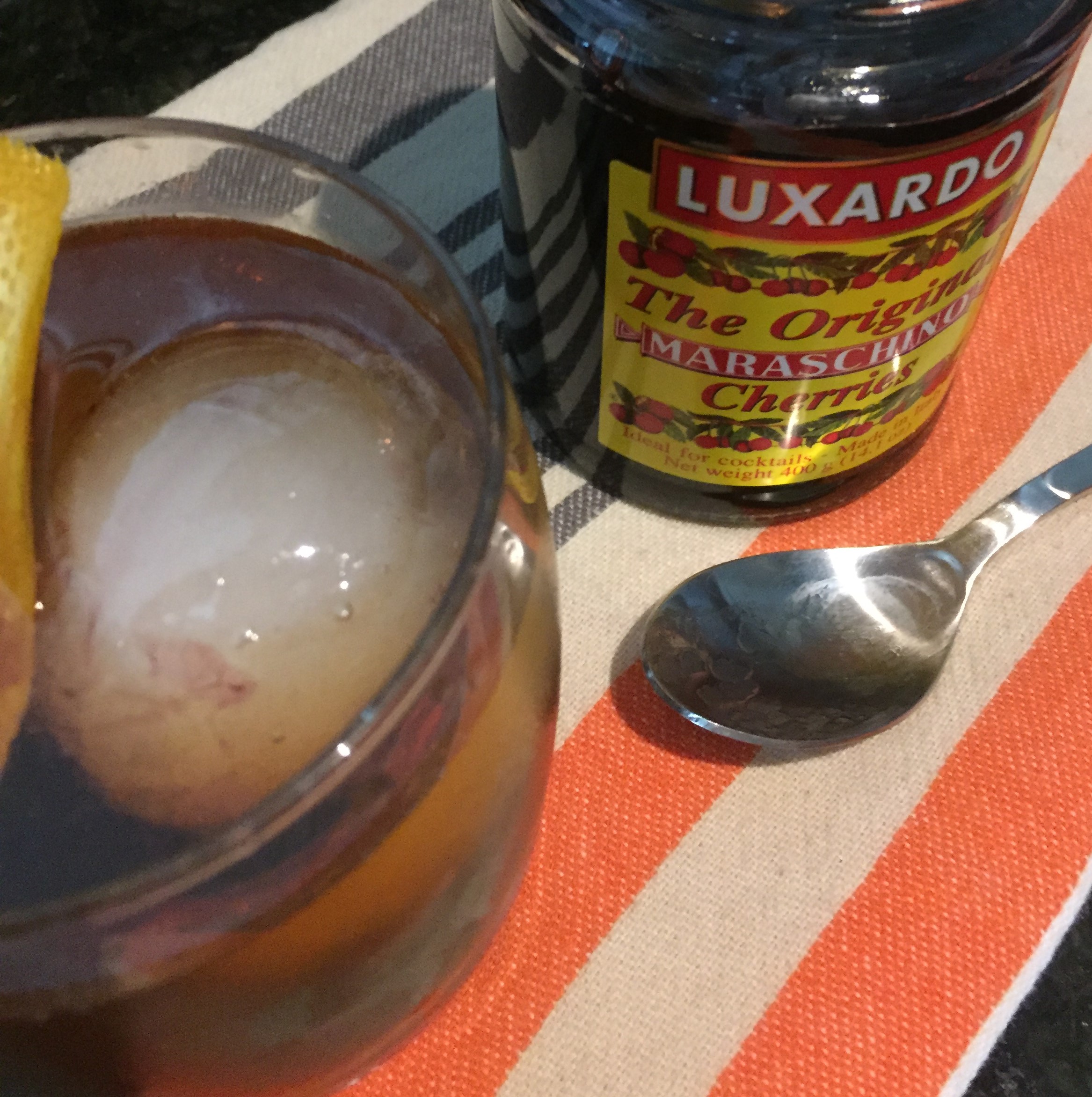
9. I drop in two Luxardo cherries and two spoonfuls of the dark syrup.​ …


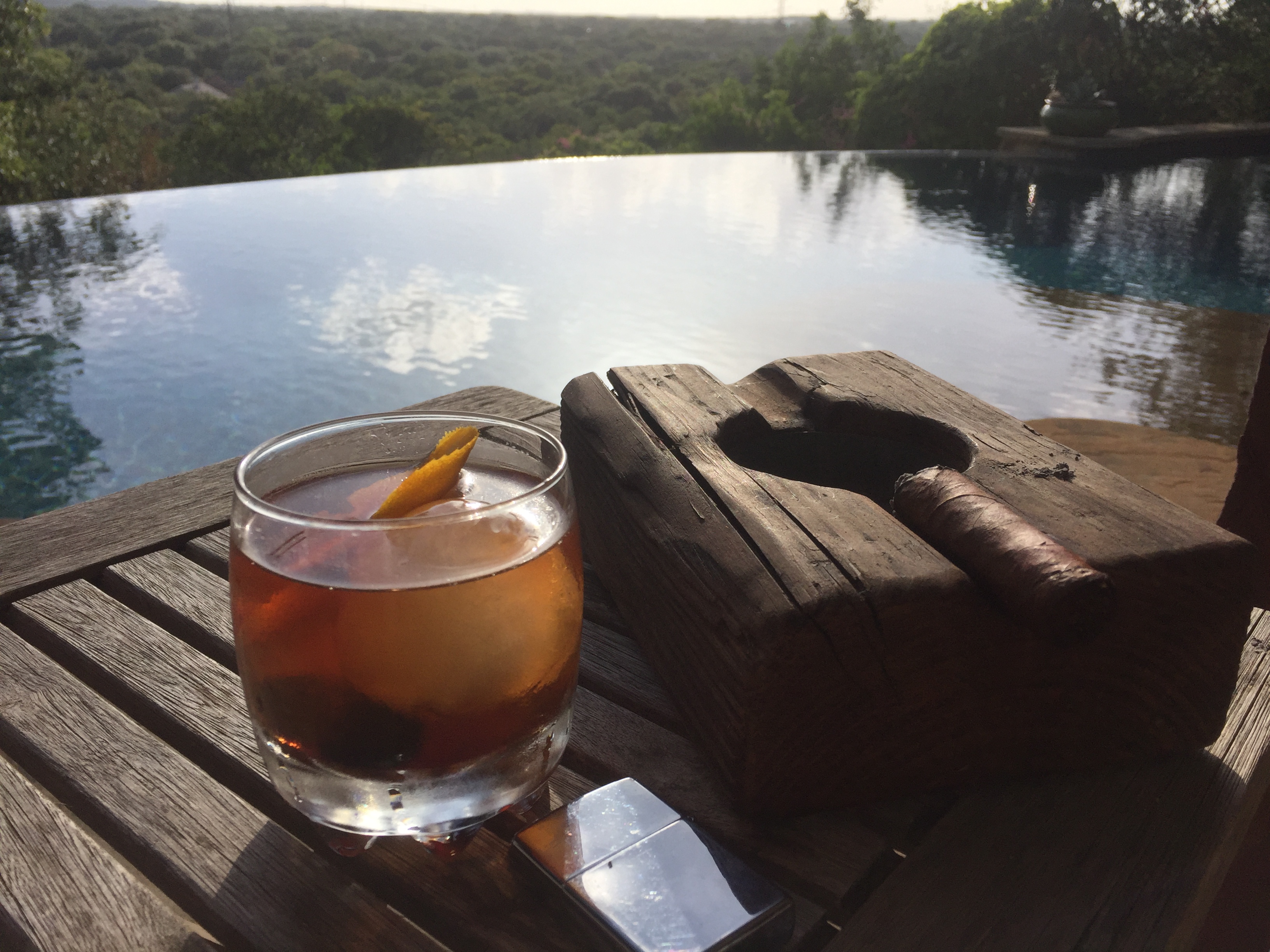
10. I light a cigar, watch the sunset and take a moment to appreciate the small luxuries and pleasures of life.​

Rebecca Aguilar

#CallingAllJournalists Initiative | Reporter | Media Watchdog | Mentor | Latinas in Journalism

Anna Fonte's Paper Planes

Words, images & collages tossed from a window.

Postcards from Barton Springs

Gayle Brennan Spencer - sending random thoughts to and from South Austin

The Flask Half Full

Irreverent travelogues, good drinks, and the cultural stories they tell.

Government Book Talk

Talking about some of the best publications from the Federal Government, past and present.

Cadillac Society

Cadillac News, Forums, Rumors, Reviews

Ob360media

Real News That Matters

Mealtime Joy

bringing joy to family meals

Øl, Mad og Folk

Bloggen Øl, Mad og Folk

a joyous kitchen

fun, delicious food for everyone

A Perfect Feast

Modern Comfort Food

donnablackwrites

Art is a gift we give ourselves

Fridgelore

low waste living drawn from food lore through the ages

BeckiesKitchen.com

MUSINGS : CRITICISM : HISTORY : NEWS

North River Notes

Observations on the Hudson River as it passes through New York City. The section of the Hudson which passes through New York is historically known as the North River, called this by the Dutch to distinguish it from the Delaware River, which they knew as the South River. This stretch of the Hudson is still often referred to as the North River by local mariners today. All photos copyright Daniel Katzive unless otherwise attributed. For more frequent updates, please follow northriverblog on Facebook or Instagram.

Flavorite

Where your favorite flavors come together