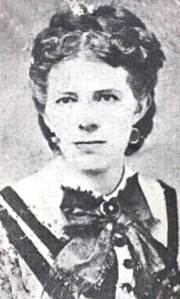
Loreta’s Civil War: Not the handsomest man I ever saw

Velazquez is arrested, brought before the infamous commander of Federal forces in New Orleans, and accused of being a spy.

KS54

Throughout 2016 and 2017, Stillness of Heart will share edited excerpts from the extraordinary memoir of Loreta Janeta Velazquez, who chronicled her adventures throughout the Civil War — either as herself, as a Confederate spy, or in disguise as Confederate Lt. Harry T. Buford. She fought and led men in terrible battles, fell in love, bore and lost children, and traveled throughout the U.S. and Europe, ultimately fulfilling her childhood dream of a rich and adventurous life.

You can read the entire 1876 memoir online here. Learn more about Velazquez (and the incredible documentary film Maria Agui Carter made about her) here.

Part 24: Velazquez is arrested, brought before the infamous commander of Federal forces in New Orleans, and accused of being a spy.

******

I found some Confederate soldiers preparing to cross the lake, and, going to one of them, who seemed to be in command of the party, I told him a number of things which I had thought it more prudent not to commit to writing, and desired him to pass the word along. Then, waiting until the boat was ready to set sail, I gave him an enclosure containing my dispatches, asking him, if possible, to deliver it at headquarters, or if he was unable to do this, to drop it at the earliest moment in the post office. … He promised a faithful compliance with my instructions, and jumping into the boat, he and his companions shoved off from the shore and were soon lost in the heavy mist that rested upon the surface of the lake. …

Unluckily for me, [the] officer to whom I had entrusted my dispatch was captured, and the document was found upon his person. Through some means, which I could not surmise, the provost marshal was informed that I was the writer of the dispatch, although the name signed to it was not the one he knew me by. A negro was found, too, who swore that he had seen me walking along the river, outside of the lines, and the result was that I was placed under arrest, and taken before [Union Maj. Gen. Benjamin] Butler himself.

Butler was not the handsomest man I ever saw in my life, and he certainly looked the tyrant that he was. It was a favorite amusement with him to browbeat people who were brought before him, and he was remarkably skillful in terrifying those who were weak enough to submit to being bullied by him into making just the admission he wanted them to make. I had heard a good deal about his peculiar methods of dealing with those who had incurred his displeasure in any way … and I was therefore prepared, in a measure, for the ordeal which I was now compelled to undergo. …

[W]hen I was brought into his presence, he proceeded on the theory that I was the person he wanted and that I was guilty of the charge made against me. He evidently thought the case was a perfectly plain one and that I would not attempt a denial. I, however, kept cool and refused to look at the matter from his point of view, and, as none of the witnesses who appeared were able to swear positively to my identity as the woman who had acted as the bearer of the dispatch found on the Confederate officer, I began to think that I was going to get clear without a great deal of trouble.

Butler, however, was not one from whom it was easy to get away when his suspicions were once aroused, and I saw plainly that he was convinced of the fact that he had captured the right person this time, and that his prisoner was a spy who had been giving him serious annoyance. He was, therefore, resolved not to let me slip through his fingers if he could help it, and finding that he could not absolutely prove anything against me, he concluded to try whether it would not be possible to force me into committing myself.

When, therefore, instead of ordering my release, Butler settled his pudgy figure back in his chair, and, apparently, making a vigorous attempt to look straight at me with both eyes at once — an impossibility, by the way — said, with a harsh, grating voice, and with what was intended to be an intensely satirical manner, “Well, madam, you have shown your hand nicely. I have been wanting you for some time past, and I propose to send you to Ship Island” — I felt that the real ordeal was but just commencing.

Without permitting myself to be disconcerted, either by his manner or by his threat, I replied, “I guess not; the law does not permit you to sentence anyone on mere hearsay or belief, and no evidence has been produced against me. …”

“Come, come, madam, I don’t want any of this nonsense,” struck in Butler, sharply. “I know you, and your tricks; and as your little game is played out, you might as well confess, and be done with it.”

“There is no difficulty about your finding out who I am,” I retorted. “My name, and residence, and circumstances are well known to your officers, and have been ever since the capture of the city. You have no proof against me, and I have nothing to confess.”

“Do you mean to say,” continued the general, “that you are not the writer of that letter, or that you did not smuggle it through the lines?”

“I don’t mean to say anything about it,” I answered, “and I don’t mean to confess what I didn’t do.”

By this time Butler, seeing that he was not making much headway with me, began to get angry, and he roared out, “Well, madam, if you won’t confess without compulsion, I’ll see whether I can’t compel you. I’m tired of this sort of thing, and I’m going to make an example of you for the benefit of the other female spies who are hanging about this city.” I replied, as cool as possible, “You may get yourself into trouble, sir, if you attempt to punish an innocent woman on a false and scandalous charge like this, when there is not a particle of evidence to sustain it.”

This appeared to infuriate Butler more than ever; and, turning to one of his officers, he gave an order that I should be locked up in a cell in the Custom House until my case was investigated further. When I heard this order I turned to him with all the dignity I could command, and said, “One word, sir, you will please to understand that I am a British subject and that I claim the protection of the British flag.”

Butler, who displayed a particular antipathy to foreigners, and especially to the English, on all occasions, blurted out, “We will see about that. I don’t care for Johnny Bull,” and then turning to the officer he said, “Take that woman to the Custom House.”

This ended the investigation, and I left the presence of the general, feeling tolerably well-satisfied with having got the best of him thus far, but dubious about the ultimate issue of the affair, for I was confident that he would make an endeavor to fasten the charge on me in such a manner that there would be no escape. …

I, however, was not disposed to vex myself with troubles before they came, and preserved my equanimity, trusting to my usual good luck to bring my present difficulties to a satisfactory conclusion. The officer in whose charge I was placed was a gentleman in every respect, and he treated me in the most courteous manner while escorting me to the Custom House, apologizing for being compelled to perform so unpleasant a duty, and, on our arrival at the building which was to serve as my prison, he procured a nice camp bed for my cell, and in other ways tried to make me as comfortable as circumstances would permit. He ordered that my meals should be sent me regularly and promised that an effort would be made to prevent my incarceration from being any more unpleasant than was absolutely necessary. …

A friend of mine, Sergeant B., hearing that I was imprisoned, came to see me, and on my expressing a great desire to have some pens, ink, and paper, he promised to procure them and slip them in to me. He also said that he would carry any message I might desire to send to my friends outside. I thanked him and requested him to try and let me have some writing materials as soon as possible. He therefore procured them, and I immediately wrote a note to Mr. Coppell, the British consul, in which I explained my situation briefly, and asked his assistance.

Mr. Coppell called upon me at once, and I, claiming that I was a British subject … asked his protection and his influence for a release without more delay. He promised to do what he could for me and asked for my proofs of British citizenship. I therefore gave him my trunk key and the number of my room, with a description of the papers I had purchased in view of just such an emergency as this, and he, having obtained them, went to Butler’s headquarters to demand my liberation.

I do not know what passed between the consul and the general, but the result of the interview was an order for my release, and I accordingly walked out of the Custom House under Mr. Coppell’s escort, and with all the rebel in me exultant at having got the better of Butler.

I understood plainly that my operations as a spy in New Orleans were now at an end, and that the safest and best thing I could do, if I did not want to get into further trouble, would be to leave the city at the earliest possible moment. There was, however, no longer any necessity for keeping my rebel sympathies concealed, and I was really glad of an opportunity to let them be seen. As we were going out of the Custom House I heard some one bragging how they were going to thrash Johnny Bull, and I could not resist the temptation of turning to Mr. Coppell, who must also have heard the remark, and saying, “That fellow must be crazy. He and his friends had better wipe out secession first, before they talk about whipping Johnny Bull.” I said this loud enough for everbody to hear me, and it made the speaker and others around us furious, and elicited several retorts, at which we only laughed. This was a foolish proceeding on my part, but I could not help taking a bit of womanly revenge on my enemies for what they had done to me.

Having obtained my freedom again, I prepared to forsake New Orleans and applied for a pass. This, however, was refused me, and I saw that if I intended to get out of Butler’s power so as to be able to resume operations either as a spy or as a Confederate officer, it would be necessary for me to run the blockade. Situated as I was, and under suspicion of being a spy, this, I was well aware, would be a particularly risky thing to attempt; but there was no alternative left me except to either attempt it, or else remain in the city in idleness, and in constant danger of having some of my many previous transactions, in the way of carrying information to the Confederates, found out. I felt very certain that if Butler did succeed in discovering who I was … I would not get off so easily as I had done in my first controversy with him, and I therefore concluded that I ran a greater risk in remaining in New Orleans than I did in attempting to leave it surreptitiously. …

I knew well that some of the stanchest adherents of the Confederacy were to be found among the poor white population of New Orleans and vicinity. I knew that if I could once make the other side of Lake Pontchartrain I would be safe, and that there would be fewer risks to run in attempting an escape in that direction than in any other. I accordingly laid my plans for a trip across the lake, with a view of striking a point near the railroad so that I could reach Jackson with the least inconvenience.

Going down to the lake, I found a fisherman who was pursuing his avocation under a permit from Butler, and taking advantage of an opportunity to speak to him when our conversation could not be overheard, I asked, “Do any rebels ever cross the lake without papers?”

“Yes,” said he, “sometimes.”

“Do you think that you could take me over if I were to make it worth your while?” said I.

“Are you a Reb?” he questioned, looking at me sharply.

“They say I am,” I answered.

“Well, I might take you over if you will pay enough.”

“I’ll give you a good deal more than you can get for any job you do for the Federals.”

“All right, then,” said he, and without more argument we struck a bargain and arranged time and place of meeting, my boatman giving me some directions how to proceed so as to avoid attracting attention, from which I inferred that this was not the first time he had been engaged in running the blockade. … At the appointed time I was at the rendezvous, and saw my boatman waiting. Fearful, however, of being apprehended just as I was about to start, I did not show myself at first, but crept cautiously through the bushes until I could see whether any one was observing my movements. Finding the coast apparently clear, I made a signal to the man, and he approached and took me into the boat.

In a moment more the sail was hoisted, and we were speeding over the lake before a good breeze, which promised, ere a great while, to waft me beyond Butler’s jurisdiction, and enable me once more to give the Confederacy the benefit of my services.

I had a reasonable amount of confidence in the fidelity of the boatman, but at the same time was determined to be prepared against any attempt at treachery on his part. I had, accordingly, provided myself with a six-shooter and had taken pains to see that it was loaded and all in condition for instant use before leaving my room. On taking my seat in the boat I placed my hand on this weapon, and was resolved to put it to the head of the man if he showed the slightest indication of a desire to betray me. I had no fancy for a sojourn on Ship Island, and would, without the slightest hesitation, have used my revolver freely before submitting to a capture. The man, however, was faithful enough, and with the prospect of a liberal reward before him, he was only eager to reach the other side of the lake as soon as he could, and to avoid the Federal patrols in doing so.

Fortune favored us, and it was not long before we were out of the reach of immediate danger, and in a fair way to make the Mississippi shore without being interfered with. On landing I paid the boatman his money, according to the bargain I had made with him and started off for the nearest railroad station for the purpose of going to Jackson. Thus ended my career in New Orleans as a Confederate spy. It was a successful one, taking all things into consideration, but I was not sorry to get away, and considered myself fortunate in being able to make my escape with as much ease as I did.

Loreta’s Civil War: A brute as this man Butler

As Velazquez recovers from her wound, New Orleans falls to Federal forces, and she decides to try to spy on the occupation forces.

KS57

Throughout 2016 and 2017, Stillness of Heart will share edited excerpts from the extraordinary memoir of Loreta Janeta Velazquez, who chronicled her adventures throughout the Civil War — either as herself, as a Confederate spy, or in disguise as Confederate Lt. Harry T. Buford. She fought and led men in terrible battles, fell in love, bore and lost children, and traveled throughout the U.S. and Europe, ultimately fulfilling her childhood dream of a rich and adventurous life.

You can read the entire 1876 memoir online here. Learn more about Velazquez (and the incredible documentary film Maria Agui Carter made about her) here.

Part 22: As Velazquez recovers from her wound, New Orleans falls to Federal forces, and she decides to try to spy on the occupation forces.

******

My shoulder was found to be out of place, my arm cut, and my little finger lacerated — a disagreeable and exceedingly painful but not necessarily a very dangerous wound. The surgeon applied a dressing and put my arm in a sling, after which I felt a great deal more comfortable, although the pain was still intense, and he then endeavored to induce me to stop at Corinth until I was in better condition for traveling. Now, however, that my sex was discovered, I was more than ever anxious to get away from my old associates in the hope of finding some place where I could remain until I got well and able to commence operations again in a different locality, without being annoyed by the attentions of impertinently curious people. I therefore insisted upon pushing on to Grenada, and … [he], appreciating my reasons for getting away as soon as possible, very kindly went and procured transportation papers for me, and before the information that a woman, disguised as an officer, was among the wounded on the train, we were, to my infinite satisfaction, speeding out of sight, leaving behind us the camp occupied by a defeated army. The thought that our brave army should be resting under the cloud of a most humiliating defeat was a mental torture, which even my intense physical suffering could not pacify, and I was heartily glad to be able to take myself off from a locality which had so many unpleasant associations.

While on the train I suffered a great deal, although I was as well cared for as circumstances would permit, and it was an immense relief when we reached Grand Junction, for the hotel proprietor there was an old and true friend of mine, and I felt sure of receiving from him all the attention it was in his power to bestow. I found, however, that it was almost an impossibility to get any accommodation whatever, on account of the crowds of people who filled the place. The wives and other relatives of officers and soldiers had come to await the result of the battle, and as the news that the Confederate army had been defeated had preceded me, everything was in confusion, and everybody plunged in the deepest grief. Some of the waiting ones had already received their wounded friends, or the corpses of the slain, while others were nearly wild with anxiety on account of husbands, or brothers, or lovers who had not yet been heard from. …

I was asked a thousand questions about the battle, and was pressed with a thousand anxious interrogatories about particular persons and endeavored to answer as well as I could, notwithstanding the pain which my wounded arm and shoulder caused. Many of the women could not prevail upon themselves to believe that the Confederate army had been again defeated and indulged in the fiercest invective against the invaders. The intense grief of these stricken people affected me even more than the terrible scenes incident to the battle and the retreat, and, as I was not in a fit condition to endure anything more of anguish, and as it seemed to be impossible to obtain a room where I could be quiet and free from intrusion, I determined to push on to Grenada, without more delay, although I was anything but able to endure the excitement and discomfort of several hours’ ride by rail.

Having reached Grenada, I took a good rest by remaining there for two days. … I was visited by a great many of the ladies of the place, who presented me with bouquets, delicacies of various kinds, and bandages for my wound, and who otherwise overwhelmed me with attentions, for which I hope I was duly grateful. Not only the natural restlessness of my disposition, which my wound aggravated to such an extent that it was an impossibility for me to keep quiet, but a desire to get as far away from the Army of Tennessee as possible, before the fact that Lt. Harry T. Buford was a woman became generally known, induced me to move on with all the speed I could make, and I consequently started for New Orleans before I was really fit to travel. The result was, that when I reached Jackson, I found myself too ill to proceed farther, and was compelled, much against my will, to make another stop.

The hospitality I received at Jackson I will always remember with the warmest feelings of gratitude. I was really very sick, and my wounded shoulder and arm were terribly inflamed, and I scarcely know what I should have done had not a widow lady and her daughter taken a fancy to me and waited on me until I was able to be on the road again. These ladies treated me like a young lord, and I shall ever think of them as having placed me under a debt that I can never repay. So soon as I thought myself able to endure the fatigues of travel, I insisted upon being on the move in spite of the remonstrances of my friends, and made another start for New Orleans. …

By this time my wound was healing quite nicely, and although it pained me considerably still, the feverishness which had attended it was gone, and I began to feel myself once more, and with restored health began to busy myself in making plans for the future. …

On the train there were a great many wounded men, some of them old friends of mine whom I was glad to meet with again. The trip, therefore, was a pleasant one in some respects, notwithstanding its melancholy aspects, and we had a tolerably lively time discussing the late battle, and the chances of the Confederates being able to make headway in the future against the force which the Federals were bringing against them in every direction. We were obliged to acknowledge that the outlook was not a particularly promising one, and more than once expressed the belief that New Orleans would be the next object of attack. There was a good deal of confidence felt, however, that a Federal advance against the Gulf city, if it should be attempted, would be repulsed. …

When the news came that the Federal fleet had passed Forts Jackson and St. Philip, I at first thought of leaving as quickly as I could but a little reflection induced me to change my mind, for I saw clearly that if the Federals took possession of the city, I would, as a woman, have a grand field of operation. I therefore resolved to remain and see the thing out, and the uniform of Lt. Harry T. Buford was carefully put away for future use if need be, and the wearer thereof assumed the garments of a non-combatant feminine for the purpose of witnessing the entry of the victors into the captured city. …

Exactly when or where the blow would be struck, however, it was impossible to tell. The general impression was that the attack would be made by the army under [Union Maj. Gen. Benjamin] Butler, and how really formidable the Federal fleet was, few, if any, had any real notion. I suppose that scarcely anyone imagined the ships would make an unsupported effort to pass the fortifications below the city, or that they would succeed in doing so in case the attempt was made. I knew little or nothing about the river defenses or the preparations that were being made to receive a naval attack from my own observations, but from what I understood with regard to them, I felt tolerably assured of their efficiency, and my chief concern was about the insufficiency of the measures adopted to resist a land attack.

The Federal fleet, however, to the surprise of every one, succeeded in overcoming the obstructions in the river, and in passing the two principal forts, after a desperate battle, and then New Orleans was at the mercy of the naval gunners, specimens of whose methods of fighting had been exhibited to me at Fort Donelson and Shiloh in such a manner as to inspire me with a wholesome dislike for the kind of missiles they were in the habit of throwing. … I began to have a greater respect for the power of the Federal government than I had had before, and a greater appreciation of the weakness of the Confederacy. …

I felt particularly that the time was now … for me to make a display of my talents in another character than that of a warrior, and the arrival of the fleet in front of the city found me in the anxious and angry crowd on the levee, not inelegantly attired in the appropriate garments of my sex — garments that I had not worn for so long that they felt strangely unfamiliar, although I was not altogether displeased at having a fair opportunity to figure once more as a woman. …

Strange to say, the capture of New Orleans did not affect me near so unpleasantly as the defeats at Fort Donelson and Shiloh, and I felt nothing of the depression of spirit that overcame me after these battles. This may have been because I was getting accustomed to defeat now, and was consequently able to bear up under it more philosophically, although it is more than probable that it was because I was not one of the combatants, and consequently did not have that overpowering individual interest that a combatant must feel if he cares anything for his cause. I experienced less of that peculiarly disagreeable feeling of personal chagrin and disappointment that oppresses a soldier belonging to a beaten army.

The fact … that when the Federals obtained possession of the city I would probably be able to do some detective duty in a style that would not only be satisfying to my own ambition, but damaging to the enemy, and of essential service to the Confederacy, really enabled me to behold the approach of the fleet with a considerable degree of what almost might be called satisfaction. As a woman, and especially as a woman who had facilities for appearing as a representative of either sex, I knew that I would be able to observe the enemy’s movements and ferret out their plans in a signally advantageous manner. … I was really anxious to see the enemy occupy the city in order that I might try conclusions with them, having ample confidence that I would prove myself a match for the smartest Yankee of them all. …

Mayor Monroe behaved nobly when he was asked to surrender the city. He said that the city was without defense and at the mercy of the conquerors, but that it was not within his province as a municipal officer to surrender. He declined to raise the United States flag over the public buildings or to do anything that would seem a recognition of the right of the Federals in any way to regulate affairs in New Orleans by anything else than the law of force. When I read his reply to [Union Adm. David D.] Farragut’s demand for surrender, I readily forgave my private grievance against him. The mayor having positively refused to have anything to do with displaying the United States flag, or with lowering the flag of Louisiana, the raising of the Stars and Stripes on the public buildings was done by the sailors from the Federal fleet. …

When Butler took command … on May 1st, he issued orders stopping the circulation of Confederate currency, directing the people to resume their usual avocations, and giving everybody to understand that he intended to have his own way. …

I soon perceived that with such a brute as this man Butler to deal with, it would be necessary for me to be extremely circumspect, and to bring my best strategic talents to bear, if I expected to accomplish anything. I was well acquainted with the city and environs, and knew exactly how to go about slipping in and out through, the lines; but to carry on such operations as I proposed with a reasonable degree of safety and assurance of success, it was necessary … for me to keep all my wits about me, and to take care to be on good terms with those in authority.

I therefore set to work with due diligence and persistence to gain the confidence of the Federal officers. Some of them I found to be very pleasant, gentlemanly fellows, who were disposed to make themselves as agreeable as possible to everybody, and who were much gratified to hear any one — especially any woman — express Union sentiments. Many of them did not at all approve of the offensive manner in which Butler conducted himself, and some of his orders were carried out with a great deal of reluctance by those entrusted with their execution. With some of these officers I soon managed to get on very friendly terms, and they were always so polite and considerate in their treatment of myself and others that I greatly regretted the necessity of deceiving them. …

Loreta’s Civil War: Making myself liable to suspicion

Velazquez tours the enemy capital city and collects intelligence she deems valuable to the Confederate war effort.

KS28

Throughout 2016 and 2017, Stillness of Heart will share edited excerpts from the extraordinary memoir of Loreta Janeta Velazquez, who chronicled her adventures throughout the Civil War — either as herself, as a Confederate spy, or in disguise as Confederate Lt. Harry T. Buford. She fought and led men in terrible battles, fell in love, bore and lost children, and traveled throughout the U.S. and Europe, ultimately fulfilling her childhood dream of a rich and adventurous life.

You can read the entire 1876 memoir online here. Learn more about Velazquez (and the incredible documentary film Maria Agui Carter made about her) here.

Part 14: Velazquez tours the enemy capital city and collects intelligence she deems valuable to the Confederate war effort.

******

The information of most vital moment, however, that I succeeded in obtaining from him was that active preparations were being made to secure possession of the upper Mississippi, and that a very large fleet was being fitted out for the purpose of blockading the mouth of the river. I instantly surmised from this that an attack on New Orleans was in contemplation, and resolved to bend my energies, during my stay in Washington, to the task of finding out all I could with regard to the actual intentions of the Federal government. I did succeed in obtaining ample confirmation of all my friend told me, and to a limited extent of my guesses. Those, however, who really knew, were very close-mouthed about what particular work was being cut out for the fleet to perform, and the desire seemed to be to leave the impression that it was to undertake blockade duty simply, and to close the mouths of the river to the ingress and egress of vessels. There were some things which I heard, however, that did not exactly conform to this theory, and by the time I left Washington, I was tolerably well convinced that a grand blow was shortly to be struck, either at Mobile or New Orleans, but most likely at the latter city. I pumped, in a quiet way, everybody I met, who was at all likely to know anything; but I was really afraid to push my inquiries too far, or to seem too inquisitive, as I did not care to be suspected as a spy and put under surveillance, especially as I learned that the government was greatly annoyed by the presence of numbers of Confederate spies in Washington, and was disposed to deal vigorously with them if they were caught.

This, it must be remembered, was simply a reconnoitering expedition, undertaken entirely on my own account, without authority from anybody; and while I, of course, wanted to find out all I could, my real object was more to make an experiment than anything else, and I did not wish to spoil my chances for future operations — for I fully expected to visit Washington again on similar service to this — by getting into trouble just then, and consequently making myself liable to suspicion in the future.

After a somewhat prolonged and very pleasant conversation with my friend, he took his departure, promising, however, to call the next day, and as I was a stranger in Washington — having never visited the city before — to take me to the different places of interest. This was exactly what I wanted, for I was desirous of being informed, as soon as possible, exactly where the public offices were situated, and the best means of obtaining access to them, and I counted greatly upon this obliging and very gallant gentleman unsuspectingly starting me on the right road for the accomplishment of the ends I had in view.

He made his appearance promptly at the appointed hour the next morning, and took me to see the Patent Office, the Treasury Department, and the War Department. … I led him up to making a proposal that he should introduce me to the secretary of war. In a demure sort of way, I expressed myself as delighted at the honor of being able to meet so great a man, and so, in a few moments more, I was bowing, in my politest manner, to Secretary [Simon] Cameron. …

I cannot say that the secretary of war impressed me very favorably. He was abundantly courteous in his manners, but there was a crafty look in his eyes, and a peculiar expression about his mouth, that I thought indicated a treacherous disposition, and that I did not like. I concluded that Mr. Cameron would be a hard man to deal with, unless dealing were made well worth his while; but in spite of his evident knowingness, and his evident confidence in his own abilities, I left him, feeling tolerably sure that I could prove myself a fair match for him in case our wits were ever brought into conflict. …

From the War Department we went to the White House, where my friend said he would introduce me to the president. I really had some dread of this interview, although I experienced a great curiosity to see Mr. Lincoln … I considered him more than any one person responsible for the war. Mr. Lincoln, however, was an agreeable disappointment to me, as I have no doubt he was to many others. He was certainly a very homely man, but he was not what I should call an ugly man, for he had a pleasant, kindly face, and a pleasantly familiar manner, that put one at ease with him immediately. I did not have an opportunity to exchange a great many words with Mr. Lincoln, but my interview, brief as it was, induced me to believe, not only that he was not a bad man, but that he was an honest and well-meaning one, who thought that he was only doing his duty in attempting to conquer the South. … I left the White House, if not with a genuine liking for him, at least with many of my prejudices dispelled and different feelings towards him than I had when I entered.

My tour around Washington, and especially my visit to the War and Post Office Departments, convinced me, not only that Washington would be a first-rate place for me to operate in, if I could obtain a definite attachment to the detective corps, but that I had the abilities to become a good detective, and would, in a very short time, be able to put the Confederate authorities in possession of information of the first value with regard to the present and prospective movements of the enemy.

Having fulfilled my errand, and accomplished all that I had expected when starting out on this trip, I left Washington as suddenly as I had entered it, giving my friend to understand that I was going to New York. I had as little trouble in getting back to Leesburg as I had in getting away from it, and put in an appearance at the house of the old colored woman, who had my uniform hid away for me, within thirteen days from the time I left it.

Attiring myself once more in the garb of a Confederate officer, I returned the old woman her calico dress, shawl, sun-bonnet, and shoes. … My other suit of female clothing I took up to the hotel with me, and told my boy Bob, who seemed to be very curious about them, that I had bought them for my girl. Bob seemed to be delighted to see me again, as he had been apprehensive, from my long absence, that something had happened, and that I might never return. He was most anxious to know where I had been; but I put a short stop to his questionings on that topic, by giving him orders to have everything ready for an early start on a long journey in the morning. The next day we were en route for Columbus, Tennessee, where I expected to find Gen. Leonidas Polk, under whom I was now desirous of serving.

Loreta’s Civil War: The insatiate desire

Velazquez pauses her adventure as a Confederate soldier, for the moment, and heads for Washington, D.C., for a new challenge.

OLYMPUS DIGITAL CAMERA

Throughout 2016 and 2017, Stillness of Heart will share edited excerpts from the extraordinary memoir of Loreta Janeta Velazquez, who chronicled her adventures throughout the Civil War — either as herself, as a Confederate spy, or in disguise as Confederate Lt. Harry T. Buford. She fought and led men in terrible battles, fell in love, bore and lost children, and traveled throughout the U.S. and Europe, ultimately fulfilling her childhood dream of a rich and adventurous life.

You can read the entire 1876 memoir online here. Learn more about Velazquez (and the incredible documentary film Maria Agui Carter made about her) here.

Part 13: Velazquez pauses her adventure as a Confederate soldier, for the moment, and heads for Washington, D.C., for a new challenge.

******

We may regret that the dreams of our youth do not come true, just as we once loved to hope that they would, almost without endeavor on our part; but who shall say that our own life romances, woven out of the tissues of events from day to day, with much labor, doubt, and pain, are not fairer and brighter than any imagination could create? It is good to do one’s duty quietly amid the rush of great events, even when the path of duty lies in hidden places, where the gaze of the crowd penetrates not, where applause cannot follow; and one’s own satisfaction at duty well and nobly performed, is, after all, the best recompense that can be had.

To be a second Joan of Arc was a mere girlish fancy, which my very first experiences as a soldier dissipated forever; and it did not take me long to discover that I needed no model, but that, to win success in the career I had chosen, I must be simply myself, and not a copy, even in the remotest particular, of anybody else; and that the secret of success consisted in watching the current of events, and in taking advantage of circumstances as they arose. … The experiences of actual warfare, however, soon had the effect of convincing me that a woman like myself, who had a talent for assuming disguises, and who, like me, was possessed of courage, resolution, and energy, backed up by a ready wit, a plausible address, and attractive manners, had it in her power to perform many services of the most vital importance, which it would be impossible for a man to even attempt.

The difficulty which our commander experienced in gaining accurate and thoroughly reliable information with regard to the movements of the enemy, the rumors that prevailed of the enormous preparations being made by the Federal government to crush the South, an insatiable desire to see and to hear for myself what was going on within the enemy’s lines, all stimulated me to make an attempt, the hazardous character of which I well knew; but, trusting to my woman’s wit to see me safely through, I resolved that the attempt should be made.

My plans were tolerably well matured when the Battle of Ball’s Bluff took place, and I should probably have put them in execution before I did, had it not been for the insatiate desire I had to take part in another fight. After that battle, I more than ever felt the necessity for some constant, active employment, for I chafed under the ennui of the camp, and felt irresistibly impelled to be moving about and doing something. I accordingly was not long in resolving that the time had now arrived for me to attempt something more than I had yet done, and for me to effect a coup that might either make or mar my fortunes, but that, whatever its result might be, would give me the excitement I craved, and demonstrate my abilities, and my disposition to serve the Confederacy in such a signal manner that it would be impossible for those in authority any longer to ignore me.

A woman labors under some disadvantages in an attempt to fight her own way in the world, and at the same time, from the mere fact that she is a woman, she can often do things that a man cannot. I have no hesitation in saying that I wish I had been created a man instead of a woman. This … is the matter with nearly all the women who go about complaining of the wrongs of our sex. But, being a woman, I was bent on making the best of it; and having for some time now figured successfully in the garments of the other sex, I resolved upon resuming those of my own for a season, for the accomplishment of a purpose I had in my mind. This purpose I felt sure I could accomplish as a woman; and although I had a tolerably good appreciation of the perils I should run, I had confidence in my abilities to see myself through, and the perils attending my enterprise were incentives, rather than otherwise, for me to attempt it.

Having obtained a letter of introduction to Gen. Leonidas Polk, and my transportation papers — for it was my intention, after making the trip I had immediately in view, to visit the part of the country in which his army was operating, as it was more familiar to me, and I thought that I could perform more efficient service there than in Virginia — I turned in my camp equipage to the quartermaster, and bidding farewell to my friends, started off in search of new adventures. …

Going to an old negro woman who had washed for me, and who had shown considerable fondness for me, I told her that I intended visiting the Yankees for the purpose of seeing them about coming and freeing the colored folk, and asked her to let me have a suit of woman’s clothes, so that I could get through the lines without being stopped. I made up quite a long yarn about what I proposed to do, and the poor old soul, believing all I told her without a moment’s hesitation, consented to aid me in every way she could, her ardor being materially quickened by a twenty dollar Confederate note which I handed her.

She was not long in having me attired in the best she had — a calico dress, a woolen shawl, a sun-bonnet, and a pair of shoes much too large for me — and hiding away my uniform where it would be safe during my absence, she started me off with a full expectation that I would be back in a couple of weeks, with the whole Yankee army at my back, for the purpose of liberating all the slaves. The old woman put such implicit faith in me that I really felt sorry at deceiving her, but quieted my conscience with the thought that lying was as necessary as fighting in warfare, and that the prospects were that I would be compelled to do much more fibbing than this before the errand upon which I was about starting would be achieved.

Managing to make my way to the river without attracting any particular attention, I found an old negro who had a boat, and making up a story that I fancied would answer the purpose, I struck a bargain with him to take me across to the Maryland shore for twenty-five dollars. He was eager to get the money, probably never having handled so much before in his life at any one time, but warned me that it would be a risky piece of business, for the weather was very cold, the river broad and deep, and the current strong, and there was considerable danger of my being fired at by the pickets on either bank. I told him that I was not afraid to take all the risks, and that I thought I could stand the cold. I accordingly concealed myself in his cabin until the time for commencing the crossing arrived, neither of us deeming it prudent to start before midnight. …

At length we reached the Maryland side of the river, to my infinite satisfaction, for I was numb with the cold, and stiff in all my limbs, from the cramped position in which I had been obliged to sit in the boat, and was heartily glad of an opportunity to tread dry land once more. Dismissing the boatman, and enjoining him not to say anything, I made my way to a farm-house which I espied a short distance from the place of landing, and about four o’clock in the morning, finding no better place to rest my weary limbs, I crept into a wheat-stack, and slept there until daylight. …

[Once I] penetrated the lines of the enemy, there was, I knew, little to fear. As a Confederate soldier, I was figuring in a disguise which was likely, at any time, to get me into trouble of some sort, and not the least danger I saw was that of being arrested as a spy. When I first undertook to be a soldier, this was an idea that never occurred to me; but a very short experience in actual campaigning taught me that I would have to be careful to prevent the fact that I was disguised from being found out, if for no other reason than that my loyalty to the Southern cause might not be suspected. I relied, however, upon the good fighting I had done, and the other services I had rendered, which were proofs of the genuineness of my devotion, as well as the influence of my friends to get me out of any scrape into which I might fall through the discovery that I was not a man.

Here, in the enemy’s country, however, I passed for exactly what I was, with nobody nearer than Memphis who knew me, both as a man and as a woman, and I consequently felt perfectly secure in moving about pretty much as I chose, having a plausible story on the end of my tongue to tell anybody who might question me. I concluded that, as it was most likely I would meet in Washington people who knew me as a woman … that it would be safer, and in all respects better for me to attempt no disguise, but to figure as myself, and as nobody else. …

Between my starting-point on the Maryland side and Washington, I saw a good many soldiers, from which I judged that the approaches to the Federal capital were strongly guarded, and that very efficient means were being taken to prevent anything like a surprise on the part of the Confederates. This was the most important information I succeeded in obtaining; and except that I was enabled to form some estimates of the force that was guarding the Maryland side of the Potomac it was of no special value, as it was well understood among the Confederates that the enemy were well prepared to resist an attack upon Washington, and were concentrating a large army in and about the city. …

On arriving in Washington, I went to Brown’s Hotel, and having learned that an officer of the regular Federal army, with whom I was well acquainted, and who had been a warm personal friend of my late husband, was in the city, I sent him a note, asking him to call on me. He came to see me very promptly on receiving my message, and greeting me with a good deal of cordiality, expressed a desire to aid me in any manner that lay in his power. I told him that I was just from New York, and making up a plausible story to account for my being in Washington, began to question him about the progress of the war. He evidently had not the slightest idea that I was in Washington for any other purpose than what he would have considered a perfectly legitimate one, and consequently spoke without any reserve concerning a number of matters about which he would certainly have kept silent had he suspected that I had just come from the other side of the Potomac, and that my object was to pick up items of information that would be useful to the Confederacy.

Loreta’s Civil War: A mild flirtation with this fair flower

Velazquez completes her disguise, doesn’t hesitate from flirting with farm girls, and rounds up men to form her Confederate battalion.

KS17

Throughout 2016 and 2017, Stillness of Heart will share edited excerpts from the extraordinary memoir of Loreta Janeta Velazquez, who chronicled her adventures throughout the Civil War — either as herself, as a Confederate spy, or in disguise as Confederate Lt. Harry T. Buford. She fought and led men in terrible battles, fell in love, bore and lost children, and traveled throughout the U.S. and Europe, ultimately fulfilling her childhood dream of a rich and adventurous life.

You can read the entire 1876 memoir online here. Learn more about Velazquez (and the incredible documentary film Maria Agui Carter made about her) here.

Part 8: Velazquez completes her disguise, doesn’t hesitate from flirting with farm girls, and rounds up men to form her Confederate battalion.

******

I immediately proceeded to change my garments, and ere a great many minutes had elapsed, I was transformed into a man, so far as it was possible for clothing to transform me. When I was ready, I called my friend and asked his opinion of the figure I cut. He admitted that I was not a bad-looking specimen of a man, considering I had only been about five minutes, and thought that in time I should be able to do credit to the name I bore and the clothes I wore.

The only regret I had in making up my disguise was the necessity for parting with my long and luxuriant hair. This gave me a real pang but there was no help for it, and I submitted with as good a grace as I could muster, while my friend played the part of tonsorial artist with a pair of shears. He trimmed my hair tolerably close and said that it would answer until I could visit a barber’s shop with him and be initiated into some of the mysteries of such a peculiarly masculine place of resort. … [H]e made me promenade the room, practicing a masculine gait until I had acquired it tolerably well, and gave me a great number of very minute instructions about the proper manner of conducting myself so that my sex would not be suspected. He particularly enjoined me to watch his actions closely at the barber’s, in the drinking saloons, the billiard rooms, and the other places he intended conducting me to, for the purpose of informing me with regard to some masculine habits and ways of acting, talking, and thinking. …

Strolling down the street, we soon came to the hotel and entered the barroom, where my companion met a number of friends, to whom he introduced me as a young officer on his way to the seat of war. I was received with much cordiality, and the whole party speedily engaged in an animated conversation about the coming conflict. … The men all took whiskey straight but I did not venture on anything stronger than cider. Soon my companion managed to give me a quiet hint, and I treated the party to drinks and cigars. We then adjourned to the billiard-room, and my friend, taking off his coat, went at a game in good earnest with another member of the party. I had never seen the game of billiards played before, and I soon became intensely interested … pretending to smoke my cigar, the balls rolling over the table. As the weather was warm, I very soon, after entering the billiard-room, availed myself of what seemed to be the custom of the place, to take off my heavily padded coat, which began to be unbearable, and found myself much more at my ease sitting in my shirt sleeves. …

The next day I completed my outfit by purchasing a pair of field glasses, a pair of blankets, a rubber overcoat, and a rubber blanket. On returning to my room I made out a form of attorney in my friend’s name and authorized him to attend to all my business matters for me. I also prepared a lot of recruiting papers on the model of some genuine ones I succeeded in getting hold of, and some muster rolls, and procured a manual of tactics, and before the day was over was pretty nearly ready to commence active operations.

My friend, thinking that my disguise could be somewhat improved and a more manly air given to my countenance, obtained a false mustache and a solution with which to stain my face in order to make it look tanned. I rubbed on the solution until my skin was about the right tint, and then my friend carefully fastened the mustache on my upper lip with glue. This was a very great improvement, and I scarcely knew myself when I looked in the glass, and laughed at the thought of what my husband would say when he saw me in this disguise. …

Everything was now in proper trim for me to commence operations in earnest; so, packing my trunk, rolling up my blankets in army style, as I had often seen soldiers do, preparing my papers, and getting ready a change of underwear, and other matters for immediate use in a small satchel, I was ready to start on my campaign with as stout a heart as ever beat in the breast of a soldier.

The plan of action I had fixed upon, after mature reflection, was to raise and equip a battalion at my own expense, taking care to select good material for it, and then to appear at the head of my little army before my husband, and to offer him the command. I pictured to myself again and again the look of astonishment he would put on when he recognized his wife as the leader of a gallant band who were pledged to fight to the death for the cause of Southern independence, and flattered myself with the idea that, so far from being inclined to censure me for my obstinate persistence in carrying out my idea of becoming a soldier, he would be disposed to praise without reservation, and so far from being ashamed of my action, would be proud of it. Whatever view of the matter he might take, however, he would be compelled to yield to my wishes, whether he desired to do so or not, and I would consequently be free to follow the bent of my inclinations without fear of further opposition on his part. My desire was to serve with him, if possible; but if this could not be done, I intended to play my part in the war in my own way, without his assistance. I, however, did not contemplate any further difficulty in obtaining his consent, and even his assistance, in the execution of my plans, and so started out on the war path with a light heart and with brilliant anticipations for the future.

I crossed over to Hopefield, on the Arkansas side of the river, and took the five o’clock train, not knowing exactly where I proposed to bring up. For a time I busied myself with the study of my Manual of Tactics, with the intention of becoming sufficiently posted on certain points to get my recruits into something like military training immediately. Having been the wife of an army officer for a number of years, and having seen some hard service on the frontier, I was, in a measure, pretty well qualified for the work I had now undertaken, especially as I had paid a good deal of attention to the details of military organizations, and had seen soldiers drilled hundreds of times. I had not been in the train very long, before, finding the conductor at leisure, I entered into conversation with him with a view of obtaining information that might be useful in the furtherance of my designs.

Explaining to this individual, who appeared to take the liveliest interest in my affairs, that I was on a recruiting expedition, I asked him if he could not suggest a good neighborhood for me to commence operations in. He said that Hurlburt Station was as likely a place as I could find to pick up a company of strong, hearty fellows who would do some good fighting, and advised me to try my luck there. Hurlburt, he told me, was not much of a place — a saw-mill, a country store, in which the post office was located, a schoolhouse, which was also used as a church, being pretty much all there was of it. …

The train sped through the swamps, and it was not a great while before we reached Hurlburt Station, where, in accordance with the conductor’s suggestion, I alighted. With my satchel in my hand, I made for the nearest house, and inquired of a negro, who was chopping wood, whether his master was at home. The darkey stared at me a bit, evidently attracted by something in my appearance, and then, grinning until he showed all his ivories, said that the old boss was away, but that the young boss was about somewhere. I accordingly told him to call the young boss; and soon up came a well-built, good-looking young fellow, whom I fixed upon immediately as a suitable recruit. …

I told him that I had the army regulations with me and would take pleasure in explaining them to him in the morning. I then asked him to give me some water so that I could clean myself up a bit before supper, as I was pretty well covered with dust and cinders after my ride. He accordingly got me a basin of water and then left me to go off and hunt the old man, full of eagerness to tell him of the arrival of the recruiting officer, and of his own desire to go soldiering.

The sudden intrusion of a gallant young officer, in a gay uniform, plentifully decorated with buttons and lace … made an even greater impression on the female than upon the male part of the family. My arrival had clearly created an intense excitement, and I understood very well that I was the subject of the whispered conversation that I heard going on outside. From the manner in which the old woman and her son had addressed me, I knew that they had no suspicions of my being other than what I seemed, but I judged that it would be necessary to be pretty careful how I carried myself before the former, for she was clearly a sharp one and would be quick to take note of any peculiarly feminine traits of manner I might display. I therefore determined to play the man right manfully, whether I thought myself observed or not; and this I found to be a very good rule to go by throughout the entire period during which I wore my disguise. …

The eldest of the two daughters was about sixteen and was attired in a bright, flaring yellow calico; the youngest was about twelve years of age and was somewhat less unbecomingly dressed in pink. Both of the girls had put on the best they had to do honor to the occasion, and the eldest, especially, so soon as her first bashfulness wore off, seemed very much disposed to attract the particular attention of the visitor by various little feminine artifices, which I understood very well, and which amused me immensely.

On entering the room, the old woman said, awkwardly waving her hands towards her daughters, “These is my gals, sir.”

I bowed in the politest manner, and said, with what I intended to be a particularly fascinating smile, “Good evening, ladies,” laying a particular emphasis on the word “ladies,” which had the desired effect, for both of the girls blushed deeper than ever, and the eldest simpered as if she heartily enjoyed it. … I started a talk with the old woman by remarking that it had been an exceedingly pleasant day. … After a few commonplaces of this kind about the weather and other matters of no particular moment, I thought I might as well proceed to business at once, for I expected that I would have some opposition from the old woman in my effort to enlist [her son]. So I said, “Madam, I am trying to enlist your son for a soldier in my company; don’t you think you can spare him?” She burst out crying, and exclaimed, “Oh, sir, I can’t let my boy go for a soldier and get killed.” The youngest girl, seeing her mother in tears, began to blubber a little also; but the eldest not only did not cry, but she looked at me in such a peculiar way that I was convinced she wished I would take her instead of [her brother].

The idea of having a mild little flirtation with this fair flower of the Arkansas forest rather grew upon me as I noticed the impression I was making upon her susceptible imagination. I had some curiosity to know how lovemaking went from the masculine standpoint and thought that the present would be a good opportunity to gain some valuable experience in that line; for it occurred to me that if I was to figure successful in the role of a dashing young Confederate officer, it would be necessary for me to learn how to make myself immensely agreeable to the ladies. I knew how to make myself agreeable to the men, or thought I did, and I could, if I chose, be agreeable to women in a feminine sort of fashion; but I had never studied the masculine carriage towards my sex critically with a view of imitating it, and it was important, therefore, that I should begin at once to do so, in order that when compelled to associate with women, as I assuredly would be to a greater or less extent, I might not belie my outward appearances by my conduct. I flatter myself that during the time I passed for a man I was tolerably successful with the women, and I had not a few curious and most amusing adventures, which gave me an insight into some of the peculiarities of feminine human nature which had not impressed themselves on my mind before, perhaps because I was a woman.

My flirtation with Miss Sadie Giles was not a very savage one, and I hope that it did not inflict more damage on her heart than it did on mine. It was immensely amusing to me while it lasted, and I presume, if not exactly amusing, it might at least be deemed entertaining to her. At any rate, I succeeded not only in having a little sly fun at her expense, but I picked up an idea or two that I subsequently found useful. Noticing that Miss Sadie was developing a marked partiality for me, but was much too bashful to give me any encouragement, except some shy glances out of the corners of her eyes, I commenced to ogle her, and, whenever I had an opportunity, to pay her some delicate attentions, for the purpose of making her think I was just a bit fascinated with her. It soon became very evident that the heart which beat under that yellow calico dress was in a great state of excitement, and Miss Sadie, while not encouraging me by any direct advances, made it very plainly understood that my little attentions were appreciated.

Supper was now announced, and we all sat down to a tolerably plentiful repast, the principal features of which were bacon, cabbage, and fried chickens — the latter having been prepared in my honor. Miss Sadie managed to place herself by my side, by a dexterous little maneuver which escaped the attention of the family but which I understood perfectly. I, for my part, strove to play the gallant by helping her bountifully to the bacon, cabbage, and chicken, and by endeavoring to induce her to join in the conversation. She undoubtedly appreciated my attentions at their full value, but was not sufficiently self-possessed to do much talking; indeed, during the supper I could scarcely get anything out of her except a timid “yes” or “no.”

[Her father], on the contrary, was very talkative, and plied me with all kinds of questions about myself, my errand, the war, and the prospect of a speedy accomplishment of Southern independence. I told him that my name was Buford, that I was a lieutenant in the army, and that I had been sent down to Arkansas for the purpose of recruiting a company for service in Virginia. He said that I would have no difficulty in getting all the recruits I wanted, as the young fellows in those parts were every one eager to have a dash at the Yankees, and promised to aid me in every way possible. …

Before the supper was over I had a terrible fright. … While drinking a glass of buttermilk, which I greatly enjoyed, for it was the best thing on the table, and was most refreshing, my mustache got full of the fluid, and when I attempted to wipe this ornament, which my Memphis friend had so carefully glued upon my upper lip, and which added so much to the manliness of my countenance, I fancied that it was loose and was about to fall off. Here was a terrible situation, and I cannot undertake to describe what I felt. To say that I was frightened scarcely gives an idea of the cold chills that ran down my back. The ridicule of my entertainers, and especially of Miss Sadie, was the least thing that I feared, and I would rather brave any number of perils at the cannon’s mouth than to repeat the emotions of that dreadful moment. Such a situation as this is ludicrous enough, but it was not a bit funny for me at that time, and I was on pins and needles until I could get away and take means to secure the mustache firmly on again. I managed, however, to keep a straight countenance and to join in the conversation with a tolerable degree of equanimity, keeping my hand up to my mouth all the time though, and doing my best to hold the mustache on. My fright, after all, was causeless, for on examination I found that the hair was too firmly glued to my lip to be easily removed; indeed, I subsequently discovered that it was practically impossible to move it without the aid of alcohol.

After supper, the old man and Frank went off to finish up their work before going to bed, and the women folks busied themselves in clearing the dishes. … I glanced over my shoulder, and seeing that Miss Sadie had finished her work and was apparently anxious to be better acquainted with me, I politely arose and offered her my raw-hide chair. This she blushingly declined but took a wooden stool, upon which she seated herself quite close to me. I could think of nothing so likely to loosen her tongue and make her properly sociable as a reference to religious matters; so I asked her if there were any churches in the neighborhood. She said that there was no regular church, but that on Sundays a preacher held forth in the schoolhouse. … The old man, I presume, was rather tired, and so, taking advantage of this change of subject in our conversation, he went to bed, and soon was snoring lustily. Finally, Miss Sadie got back to what was the subject uppermost in her thoughts and began questioning me about my own affairs, by asking if I had any brothers.

“Yes,” I replied, “One, older than myself, who is more fortunate, for he is married,” giving a look at her out of the corner of my eye, which I intended her to understand as an intimation that, although not married, I had no objections to being so if I could find a girl to suit me.

“You ought to be married, too,” said Miss Sadie, with a simper, and apparently appreciating this kind of conversation much better than the war talk the old man and I had been indulging in.

“How can I get married when none of the girls will have me?” I retorted. … The old woman thinking, I suppose, to flatter me, said, “A handsome young fellow like you, with, I dare say, a pretty fair education, needn’t be afraid of the gals not having you.”

At this point of the conversation the old man awoke, and sang out, “Don’t you women talk that man to death. Why don’t you git out and let him go to bed?” and then, pointing to a bed in the corner, he told me to turn in there when I felt like it. …

Here I was at the end of my first day’s experience in playing the part of a soldier, with every reason to believe that I had thus far played it most successfully, and that I had really made quite a brilliant start. … the susceptible heart of Miss Sadie was apparently touched in a way that it could never have been had the faintest suspicion of my not being a man crossed her mind. The old woman, too, who, in a matter of this kind, would be quite certain to be a more critical observer than the rest of the family, had no hesitation in believing me to be a gallant young soldier; so that, taking all things into consideration, I had reason to congratulate myself upon a brilliant opening to my campaign. …

[The next day, when] breakfast was over … I crossed over to the schoolhouse, where I found half a dozen rather rough fellows waiting to see me, all of whom expressed themselves as extremely anxious to enlist. One very hard-looking specimen, who could not even write his name, wanted very badly to be captain; indeed, they all were quite ambitious to be officers, and I had some difficulty in explaining to them, that in the army, in time of war, where actual fighting was being done, it was a very different thing holding the position of an officer, from what it was in the militia. I, however, encouraged them to believe that they all might be lieutenants, captains, and even generals, some day, if they fought bravely, and succeeded in creating such an enthusiasm among them over the prospect of a brush with the Yankees, to be followed by rapid promotion, that the whole party were soon ready to enlist on any terms I chose to suggest.

After talking the matter over with these men for some time, and explaining the situation in the best style I was able, I wrote out some bills calling for volunteers, one of which I posted on the school-house door. … During the day I read the army regulations at least a dozen times, and tried to make the men understand what they meant. This was not a very easy matter, but I succeeded in enrolling thirty-six, whom I ordered to report for roll call the next morning. This they did not much fancy; but on my stating that they were under oath and bound to obey, they yielded without making any trouble about it, but apparently with no great admiration for military discipline.

My quota was easily filled in four days, and I then proceeded to get my battalion organization complete and to make preparations for departure. Two of the most intelligent of the men I appointed subordinate officers, one sergeant and the other corporal, and gave them instructions about drilling the battalion and maintaining discipline in my absence. Everything now being in proper trim, I sent a messenger ahead to the friend in Memphis who had so efficiently aided my plans with instructions for him to engage transportation, and then getting my troops into marching order, off we started. …

Loreta’s Civil War: Victims of masculine viciousness

Velazquez manages to slip into a Confederate encampment, and the soldiers’ language and behavior offend and outrage her. She is particularly disgusted with how supposed gentlemen speak about women.

KS15

Throughout 2016 and 2017, Stillness of Heart will share edited excerpts from the extraordinary memoir of Loreta Janeta Velazquez, who chronicled her adventures throughout the Civil War — either as herself, as a Confederate spy, or in disguise as Confederate Lt. Harry T. Buford. She fought and led men in terrible battles, fell in love, bore and lost children, and traveled throughout the U.S. and Europe, ultimately fulfilling her childhood dream of a rich and adventurous life.

You can read the entire 1876 memoir online here. Learn more about Velazquez (and the incredible documentary film Maria Agui Carter made about her) here.

Part 7: Velazquez manages to slip into a Confederate encampment, and the soldiers’ language and behavior offend and outrage her. She is particularly disgusted with how supposed gentlemen speak about women.

******

The style of conversation that was common in camp, and the kind of stories told around our fires at night, I will leave to the reader’s imagination, hoping, however, that he or she has not imagination enough to compass anything so utterly vile. My favorite amusement was a game of cards, and I preferred this way of entertaining myself, and of beguiling the weary hours, to listening to anecdotes which could only debase my mind. Anything relating to military affairs, to social science, to the deeds of great men or women, or whatever else I could improve myself by listening to, I took great delight in. From my earliest recollection, however, I have had a thorough distaste for vulgarity of language and profanity. … The manner in which too many men are in the habit of referring to the other sex in conversation among themselves is, in my opinion, thoroughly despicable; and I really think that it would be morally and intellectually beneficial to many of my sex, especially those who are the victims of masculine viciousness, if they could only listen to some such conversations as I have been compelled to listen to, and learn how little respect or real regard of any kind men have for them.

I would that God would put it into my power to utter such a warning as would be heeded, to the weak and erring of my sex, and which would enable them to fortify themselves against the temptations constantly assailing them. But I suppose no warning would prevent those who are disposed to sin from doing so, although I well know that women, and men too, can resist temptation, and can avoid vileness in living and in language if they will only choose to do so. I do not pretend to say that I am possessed of firmer nerves, or am less under the influence of the natural emotions of my sex, than many others; but my strong constitution, and the perfect health I enjoyed, enabled me to endure more fatigue and hardship than most women, while my firm-mindedness, and resolute determination to carry my point, enabled me to avoid anything like laxity of conduct. I was compelled to sink my sex entirely, for the least inadvertence would have thwarted my plans, and prevented the realization of all I aimed at.

Many and many a time has the subject of women serving in the army as soldiers been discussed at the mess-tables and around the campfires; and officers, who have been in my company for days, and weeks, and months, have boasted, with very masculine positiveness, that no woman could deceive them, little suspecting that one was even then listening to them. I have sometimes been asked my opinion on the subject; but have generally answered evasively, without expressing, in very decided terms, my ideas one way or the other. Some of the men with whom I have been associated have spoken in respectful and even commendatory terms concerning women serving as soldiers; but too many have had nothing but vileness to utter on the subject. I can never forget, although I may forgive, the disgraceful language which some of these individuals have used with regard to this matter; and my experiences in the army will not have been in vain, even if they have taught me nothing more than the utter contemptibleness of some individuals, whom it would be a stretch of courtesy to call gentlemen.

Within three days I managed to provide myself with a very complete military outfit, quite sufficient to enable me to commence operations without delay, which was the main thing I was after, for I was exceedingly anxious to carry out a magnificent idea I had in my mind, and to present myself before my husband, under such auspices that he could no longer find an excuse for refusing his consent to my joining the Southern army as a soldier. My uniform suit having been arranged for, it was an easy matter for me to procure the rest of my outfit without unduly attracting attention, and I soon had in my room a trunk well packed with the wearing apparel of an army officer, and neatly marked upon the outside with the name I had concluded to adopt. …

Loreta’s Civil War: The dream of my life

The war begins, and Velazquez is ready to disguise herself as a man and join the fight. Her husband objects, and he decides to give her a preview of ‘masculine life.’

KS56

Throughout 2016 and 2017, Stillness of Heart will share edited excerpts from the extraordinary memoir of Loreta Janeta Velazquez, who chronicled her adventures throughout the Civil War — either as herself, as a Confederate spy, or in disguise as Confederate Lt. Harry T. Buford. She fought and led men in terrible battles, fell in love, bore and lost children, and traveled throughout the U.S. and Europe, ultimately fulfilling her childhood dream of a rich and adventurous life.

You can read the entire 1876 memoir online here. Learn more about Velazquez (and the incredible documentary film Maria Agui Carter made about her) here.

Part 4: The war begins, and Velazquez is ready to disguise herself as a man and join the fight. Her husband objects, and he decides to give her a preview of ‘masculine life.’

******

In the spring of 1860 I returned to St. Louis, while my husband went to Fort Arbuckle. During his separation from me, our third babe was born and died. In October of the same year he returned, having received a summons from his father — a resident of Texas — to the effect that there was reason to believe a war was about to break out between the North and the South, and desiring him to resign.

About this time my two remaining children died of fever, and my grief at their loss probably had a great influence in reviving my old notions about military glory, and of exciting anew my desires to win fame on the battlefield. I was dreadfully afraid that there would be no war, and my spirits rose and sank as the prospects of a conflict brightened or faded. When my husband’s State determined to secede, I brought all my influence to bear to induce him to resign his commission in the United States army, and my persuasions, added to those of his father, finally induced him, very reluctantly, to yield. It was a great grief for him to forsake the uniform he had worn so long with honor, and to sever the bonds which existed between him and his comrades. He much doubted, too, the wisdom of the Southern States in taking the action they did, and wished most sincerely that the political difficulties which caused their secession could be settled in some other manner than by an armed conflict.

As for me, I was perfectly wild on the subject of war; and although I did not tell my husband so, I was resolved to forsake him if he raised his sword against the South. I felt that now the great opportunity of my life had arrived, and my mind was busy night and day in planning schemes for making my name famous above that of any of the great heroines of history, not even excepting my favorite, Joan of Arc. having decided to enter the Confederate service as a soldier, I desired, if possible, to obtain my husband’s consent, but he would not listen to anything I had to say on the subject; and all I could do was to wait his departure for the seat of war, in order to put my plans into execution without his knowledge, as I felt that it would be useless to argue with him, although I was obstinately bent upon realizing the dream of my life, whether he approved of my course or not. …

While preparing for his departure, on the anniversary of our wedding, we talked over the whole situation; and I cannot tell how proud and delighted I felt when he attired himself in his elegant new gray uniform. He never looked handsomer in his life, and I not only gave full vent to my admiration, but insisted upon broaching my favorite scheme again. … He used every possible argument to dissuade me from my purpose, representing the difficulties and dangers in the darkest colors, and contending that it would be impossible for him to permit his wife to follow an undisciplined army of volunteers. The situation, he told me, was entirely different from anything I had ever been accustomed to, and that the hordes of rude, coarse men collected together in a camp in an emergency like this, would have but little resemblance to the regular troops in garrison with whom I had been familiar; and that a delicately nurtured and refined woman would find camp life, during such a war as that just commencing, simply intolerable. He was not to be persuaded, while I turned a deaf ear to all his remonstrances, and persisted in arguing the point with him to the last.

Finally, my husband, finding that his words made no impression, thought he would be able to cure me of my erratic fancies by giving me an insight into some of the least pleasing features of masculine life. The night before his departure, therefore, he permitted me to dress myself in one of his suits, and said he would take me to the bar-rooms and other places of male resort, and show me something of what I would be compelled to go through with if I persisted in unsexing myself. …

Recommended reading / viewing / listening

This week: Reviews of ‘True Detective’ and ‘OITNB’ / Tracking the Islamic State in the U.S. / Happy birthday to George H.W. Bush / Women try to understand ‘Goodfellas’ / New b/w photos of Paris

IMG_2126

This week: Reviews of ‘True Detective’ and ‘OITNB’ / Tracking the Islamic State in the U.S. / Happy birthday to George H.W. Bush / Women try to understand ‘Goodfellas’ / New b/w photos of Paris

Most of these great items come from my social media networks. Follow me on Twitter, Tumblr, LinkedIn, MySpace, and Facebook for more fascinating videos, photos, articles, essays, and criticism.

1. ‘True Detective’ Season 2: TV Review
By Tim Goodman | The Hollywood Reporter | June 11
“Let’s just say it’s no season 1.”

2. ‘Orange Is the New Black’ Is Somehow Funnier and Sadder Than It’s Ever Been
By Richard Lawsom | Vanity Fair | June 11
“This season, bawdy pubic-hair gags bump up against jokes about economics and spiritualism, the grime of prison life allowing for visceral, intimate revulsion, but also serving as a kind of blank canvas for larger metaphor.”

3. ‘George H.W. Bush’
American Experience :: PBS | 2008
“The life and career of our 41st president, from his service in World War II and his early career in Texas to his days in the Oval Office, first as vice president to Ronald Reagan, then as the leader who presided over the first Gulf War. Drawing upon Bush’s personal diaries and interviews with his closest advisors and most prominent critics, the film also explores Bush’s role as the patriarch of a political family whose influence is unequaled in modern American life.”

4. Climate Hope City: how Minecraft can tell the story of climate change
By Keith Stuart | The Guardian | June 12
“As part of our Keep it in the Ground campaign, the Guardian has commissioned a Minecraft map exhibiting a city filled with real-world climate initiative”

5. Two Women Try Their Hardest To Understand ‘Goodfellas’
By Lauren Duca and Eric Whitney | The Huffington Post | June 11
“I immediately threw my Godfather Blu-ray box set in the trash of overflowing tissues; I clearly just watched those to fuel the anti-violence protest rallies I go to after Wednesday book club. What do we do? Do you want to bring over a couple pints and consult Carrie Bradshaw for advice? My whole world is changing.”

6. Serge Ramelli captures Paris in black and white
Architectural Digest | June 2015
“Serge Ramelli’s striking black-and-white photography of Paris is the subject of a forthcoming book from teNeues. Through Ramelli’s lens, the City of Light and its notable landmarks are rendered dark and moody.”

7. Visiting Presidential Libraries
By Nina Kendall | On the Road with the Histocrats | February 2015
“Are you looking to connect more with history? Are you planning a trip with friends or family who isn’t as excited about history as you? Consider adding a Presidential Library visit to your calendar.”

8. Busted
By Grace Na | Slate | June 11
“Why the women on Orange Is the New Black are serving time, one by one.”

9. Map: Is Islamic State in a neighborhood near you?
By Adam Goldman | WorldViews :: The Washington Post | June 11
“U.S. authorities have charged more than three dozen men and women around the country in connection with the Islamic State. Men outnumber women in those cases by a margin of nearly 5 to 1. The average age of the individuals — some have merely been charged, others have been convicted — is 26. One is a minor.”

10. D-Day Wasn’t the First Time Eisenhower Felt as if He Had Lost a Son
By Michael Beschloss | HistorySource :: The New York Times | Jun 2014
“Almost a half-century later, Eisenhower called this ‘the greatest disappointment and disaster in my life, the one I have never been able to forget completely.’ “

Kate Stone’s Civil War: A piece of amusement

Stone’s mother wishes Stone would stop seeing Lt. Holmes. Stone, surprised, offers her view on how to handle soldiers who may be romantic partners.

KS38

From 2012 to 2015, Stillness of Heart will share interesting excerpts from the extraordinary diary of Kate Stone, who chronicled her Louisiana family’s turbulent experiences throughout the Civil War era.

Learn more about Stone’s amazing life in 1861, 1862, 1863, 1864, 1865 and beyond. Click on each year to read more about her experiences. You can read the entire journal online here.

(Photo edited by Bob Rowen)

Stone’s mother wishes Stone would stop seeing Lt. Holmes. Stone, surprised, offers her view on how to handle soldiers who may be romantic partners.

May 21, 1865

Tyler, Texas

Coming in yesterday evening from the gallery after Lt. Holmes left, Mamma told me that she wished I would send Lt. Holmes off, that she much preferred my marrying Joe to Lt. Holmes, though neither was a suitable match, as Joe is too young and Lt. Holmes too dissipated.

I was surprised. I did not know she was taking it seriously, and I could honestly assure her I had not an idea of marrying either of them. I could have told her the same of Dr. McGregor, Lt. Valentine, and the conceited Capt. Birchett, should he ever make up his mind to propose. She seemed much relieved.

I thought she understood the point of view of most of the girls. One must not distress a soldier by saying “No” when he is on furlough. They have enough to bear. They may be going back to sudden death. Then they will most probably forget you for a sweetheart at the next camp, or their love will grow cool by the time you meet again. So it is just a piece of amusement on both sides.

If Mrs. Carson and Mrs. Savage only knew that I am as determined not to marry Joe as they are determined to prevent it, how much trouble and maneuvering it would save them. But I cannot well explain it to them. Joe can when he gets home, and their minds will be at rest.

Lt. Holmes has stopped drinking for some weeks now, since I asked him to do so one day during rehearsals when I saw ho was going too far. He was very nice about it. His face flushed and he thanked me but did not get angry as I feared.

Kate Stone’s Civil War: They will never give up

As Stone awaits final word from the Virginia battlefield, she makes cravats and flirts with Lt. Holmes.

KS26

From 2012 to 2015, Stillness of Heart will share interesting excerpts from the extraordinary diary of Kate Stone, who chronicled her Louisiana family’s turbulent experiences throughout the Civil War era.

Learn more about Stone’s amazing life in 1861, 1862, 1863, 1864, 1865 and beyond. Click on each year to read more about her experiences. You can read the entire journal online here.

(Photo edited by Bob Rowen)

As Stone awaits final word from the Virginia battlefield, she makes cravats and flirts with Lt. Holmes.


April 30, 1865

Tyler, Texas

Lt. Dupre came back yesterday but without his wife who is still in the Federal lines after preparing for months to get out. She was on the boat with her baggage and children when she was ordered back home because the names of the little girls were not in the passport. It is a sore disappointment to the Lieutenant. He has been separated from them so long. But with the elastic Creole temperament, he is as gay as ever. He says he was homesick at Shreveport and was glad to see Tyler again.

He brings more encouraging news. Gen. Johnston is at Augusta, Ga., at the head of 125,000 of the best troops in the world, the veterans of the Confederacy, and will make a gallant fight. The Arkansas, Louisiana, and Missouri troops are passing resolutions declaring they will never give up this side of the river and are ready to enlist for ninety-nine years. And Lee surrendered only 6,000 fighting men. I hope My Brother was one of the band. Capt. Birchett sends us word Col. Tom Manlove was killed in the fight at Hatcher’s Inn, but we think that is a mistake. We have heard of them all since then.

Mrs. Wells and Lt. Holmes spent the day, but he has been here every day for a week. Mollie Moore, the Irvine girls, and I are much interested in the subject of cravats. They wish to make half a dozen for their different “heart’s delights,” and they come over and get Mamma and me to do the embroidery for them. I have just finished a very chaste and elegant affair for Lt. Holmes, payment of a gambling debt, and I am making one for Mollie Sandford to give to her best soldier, a small red-headed warrior. Lt. Holmes showed me this evening a letter from his mother in Maryland. It came out on a flag-of-truce boat, his first letter from her in three years. … I am sorry Lt. Holmes is such a dissipated man. He is gay and pleasant and a gentleman. Why will he drink? He says he intends giving it up forever.


Rebecca Aguilar

#CallingAllJournalists Initiative | Reporter | Media Watchdog | Mentor | Latinas in Journalism

Anna Fonte's Paper Planes

Words, images & collages tossed from a window.

Postcards from Barton Springs

Gayle Brennan Spencer - sending random thoughts to and from South Austin

The Flask Half Full

Irreverent travelogues, good drinks, and the cultural stories they tell.

Government Book Talk

Talking about some of the best publications from the Federal Government, past and present.

Cadillac Society

Cadillac News, Forums, Rumors, Reviews

Ob360media

Real News That Matters

Mealtime Joy

bringing joy to family meals

Øl, Mad og Folk

Bloggen Øl, Mad og Folk

a joyous kitchen

fun, delicious food for everyone

A Perfect Feast

Modern Comfort Food

donnablackwrites

Art is a gift we give ourselves

Fridgelore

low waste living drawn from food lore through the ages

BeckiesKitchen.com

MUSINGS : CRITICISM : HISTORY : NEWS

North River Notes

Observations on the Hudson River as it passes through New York City. The section of the Hudson which passes through New York is historically known as the North River, called this by the Dutch to distinguish it from the Delaware River, which they knew as the South River. This stretch of the Hudson is still often referred to as the North River by local mariners today. All photos copyright Daniel Katzive unless otherwise attributed. For more frequent updates, please follow northriverblog on Facebook or Instagram.

Flavorite

Where your favorite flavors come together