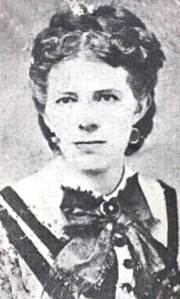
Kate Stone’s Civil War: They will never give up

As Stone awaits final word from the Virginia battlefield, she makes cravats and flirts with Lt. Holmes.

KS26

From 2012 to 2015, Stillness of Heart will share interesting excerpts from the extraordinary diary of Kate Stone, who chronicled her Louisiana family’s turbulent experiences throughout the Civil War era.

Learn more about Stone’s amazing life in 1861, 1862, 1863, 1864, 1865 and beyond. Click on each year to read more about her experiences. You can read the entire journal online here.

(Photo edited by Bob Rowen)

As Stone awaits final word from the Virginia battlefield, she makes cravats and flirts with Lt. Holmes.


April 30, 1865

Tyler, Texas

Lt. Dupre came back yesterday but without his wife who is still in the Federal lines after preparing for months to get out. She was on the boat with her baggage and children when she was ordered back home because the names of the little girls were not in the passport. It is a sore disappointment to the Lieutenant. He has been separated from them so long. But with the elastic Creole temperament, he is as gay as ever. He says he was homesick at Shreveport and was glad to see Tyler again.

He brings more encouraging news. Gen. Johnston is at Augusta, Ga., at the head of 125,000 of the best troops in the world, the veterans of the Confederacy, and will make a gallant fight. The Arkansas, Louisiana, and Missouri troops are passing resolutions declaring they will never give up this side of the river and are ready to enlist for ninety-nine years. And Lee surrendered only 6,000 fighting men. I hope My Brother was one of the band. Capt. Birchett sends us word Col. Tom Manlove was killed in the fight at Hatcher’s Inn, but we think that is a mistake. We have heard of them all since then.

Mrs. Wells and Lt. Holmes spent the day, but he has been here every day for a week. Mollie Moore, the Irvine girls, and I are much interested in the subject of cravats. They wish to make half a dozen for their different “heart’s delights,” and they come over and get Mamma and me to do the embroidery for them. I have just finished a very chaste and elegant affair for Lt. Holmes, payment of a gambling debt, and I am making one for Mollie Sandford to give to her best soldier, a small red-headed warrior. Lt. Holmes showed me this evening a letter from his mother in Maryland. It came out on a flag-of-truce boat, his first letter from her in three years. … I am sorry Lt. Holmes is such a dissipated man. He is gay and pleasant and a gentleman. Why will he drink? He says he intends giving it up forever.


A bow to the King

Elvis Presley was born this week on Jan. 8, 1935, and died on Aug. 16, 1977. What he gave us will live forever.

It’s a feeling that can’t be denied. Sometimes you just have to submit to his reign. The King, who was born on Jan. 8, 1935, and died on Aug. 16, 1977, can dominate your consciousness, infusing his spirit and vitality into your heart and soul, adding an extra sparkle to your days. He shines that spotlight in your eyes, slaps you right across the face, reminds you to wake the hell up, look around, forget the pettiness of everyday life, and savor the world around you.

You have no choice but to sit back with him, laugh at the stardom, laugh at any notion of legacy and fame, and listen to some great music from a true American original. Don’t the fight the urge to do some affectionate impersonations, or just watch Johnny Cash, Jim Carrey, Eddie Murphy, and Val Kilmer do their own.

Several years ago, the National Portrait Gallery recorded a short but very informative introduction to the fascinating and bizarre meeting between Elvis and Richard Nixon (above). Also, Legacy Recordings released a magnificent series of podcasts exploring the rise of Elvis, his gospel roots, his comeback performance in 1968, his 75th birthday, and his Vegas years. Links are included below, along with a few Elvis performances. Enjoy.

1. ELVIS: THE EARLY YEARS Part 1 | Part 2 | Part 3
2. ELVIS: ULTIMATE GOSPEL Part 1 | Part 2 | Part 3
3. RELIVING THE ELVIS ’68 COMEBACK SPECIAL Part 1 | Part 2 | Part 3
4. ELVIS 75 Parts 1 through 20
5. ELVIS AND VIVA LAS VEGAS Part 1 | Part 2 | Part 3

SONGS
1. LOVE ME TENDER (Live) Elvis Presley
2. BABY WHAT YOU WANT ME TO DO (Live) Elvis Presley
3. HEARTBREAK HOTEL Elvis Presley
4. MERRY CHRISTMAS, BABY Elvis Presley

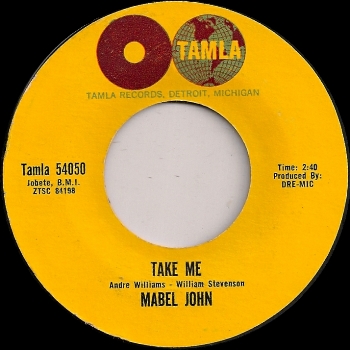
129. Mable John: “Take Me”

I could not agree more with this assessment. Her yearning tears my heart apart. This is one of my all-time favorite songs of any genre.

The Nixon Administration's avatarMotown Junkies

Tamla RecordsTamla T 54050 (B), November 1961

B-side of Actions Speak Louder Than Words

(Written by Andre Williams and Mickey Stevenson)


Note the mis-spelling of 'Mable'. Scan kindly provided by Robb Klein, reproduced by arrangement.  All label scans come from visitor contributions - if you'd like to send me a scan I don't have, please e-mail it to me at fosse8@gmail.com!A complete change of pace and mood from the big balladry of the A-side Actions Speak Louder Than Words, this is a louche, gospel-inflected quasi-blues, occasionally chaotically disorganised and occasionally near-devotional in its direct intensity.

It’s a much better record than the A-side, something which becomes obvious right off the bat. The band are up for it, despite a few lapses (including the bass player dropping right out of time very noticeably at the end, a flub which may have been enough to spike this as a potential A-side), opening the record identically to the Supremes’ Never Again before heading off in a whole different direction.

The backing singers are in full flow too, alternately gospel and blues, reminiscent of the best work of the choir who’d earlier…

View original post 379 more words

Free Love Freefall

The revolutionaries were determined to make lasting changes to the various forms of sexual oppression they perceived. It remains to the current generation to ensure their still-blossoming accomplishments do not wither under cold conservative shadows.

IMG_1475

Allyn’s revolutionaries were determined to make lasting changes to the various forms of sexual oppression they perceived. It remains to the current generation to ensure their still-blossoming accomplishments do not wither under cold conservative shadows.
A review by Fernando Ortiz Jr.

*****

Discussed in the essay:

Make Love, Not War: The Sexual Revolution: An Unfettered History. By David Allyn. New York: Routledge, 2001. Pp. 381. $30.95

David Allyn’s Make Love, Not War intelligently and creatively tours a sexual renaissance that ebbed and flowed throughout the 1960s and 1970s, sparking changes of varying longevity throughout society. Latino and black Americans fought throughout this era for equal rights as citizens and for the freedom to pursue and fully embrace the American Dream. The general public’s gradual tolerance of public gay culture, the rise of swingers movements, the gaveling of obscenity trials, the publication of sex studies, and the embrace of the birth control pill all comprise for Allyn a sexual rights movement, a “revolution” that silenced some prudes, raised legal eyebrows, and brought America a few sultry steps closer to the fulfillment of “life, liberty, and the pursuit of happiness.”1

Allyn designates the early sixties to the late seventies as the era of the sexual revolution, and he links its progression to general economic health in the United States. They rise and fall together. He utilizes dozens of interviews with men and women — some identified and some under pseudonyms — thirty years after their revolution takes place. Sexual histories, sociological studies, essays, novels, and academic reports supplement his study of the birth control pill, lesbian empowerment, gay rights, fights over literary censorship, public excitement over sexually-charged theater and film works, nudist colonies, swinger parties, and the general struggle to strip shame away from anyone’s sexual life.

The revolution was a multi-pronged and disjointed effort that lurched toward sometimes unclear objectives. Critics may condemn Allyn’s book for its seemingly disorganized structure, but it actually properly reflects the messiness of a series of efforts to change social mores and personal prejudices. Allyn’s great strength as a writer is his ability to gracefully transition from one theme of the era to another.

If anyone wanted to read a new sex manual to improve their sex life, Allyn argues that the sexual revolution made that possible. If a gay man or woman wanted to add legal sexual escapades at a sex party into their urban lifestyle, the sexual revolution made that available. If upper and middle-class women wanted to control their fertility, swap their spouses with other couples, or find and buy a book filled with sexual imagery, the sexual revolution eased strictures, opened doors, and soothed public outrage. Americans could fully and freely explore their identities, fulfill their aspirations, find their limits, and live their lives. For almost everyone, Allyn explores, the sexual revolution provided the freedom from fear.2

Allyn is enamored with the term “revolution,” which is his theme as his historical tour widens its scope over American society. From the very beginning, Allyn credibly admits the duality of his terrain, of which some aspects “were not revolutionary at all but evolutionary.” The era’s development of the pill, the rise of the sexual book publishing industry, the debates over obscene literature, the stronger roles women secured for themselves in American society — all were inherited from earlier eras in American history, all far from original movements. He admits this duality and does nothing to compensate for its contradictory influence on his narrative structure except pair stories of triumph with stories of eventual defeat or threat.

The era’s legacy is a mixed success of progression and regression, like all revolutions in American history. American society generally accepts the use of birth control and the popularity of premarital sex, though religious leaders and worried parents still frown on the still-expensive pill. Uncensored pornography — from hard-core videos to the soft sensuality of Anais Nin — is ubiquitous in the online world and easily found in the most popular bookstores, though erotica still faces many “family-oriented” enemies. Celebrities, news organizations, the military, scientific organizations, national leaders, and students across the United States embrace homosexuality as a normal sexual orientation, gay rights for citizens and servicemen, gay adoptions, and gay unions. But legal recognition of gay marriages retains its legal and political polarizing effect.3

Not everything can change all at once. Not everyone is won over when new ideas, new bathing suits, new aspirations, and new freedoms dawn over the raucous American society. When it comes to sex, each citizen had to make his or her own personal journey. People change as they grow older. Love and desire bring their own contradictory and revolutionary effects on one’s understanding and acceptance of the world around them. Jealousy, lust, insecurity, and fear can easily disrupt carefully constructed arrangements among sexual partners.

His interviews with the revolution’s participants best capture these intimate journeys. However biased or self-conscious they may be three decades later, Allyn’s interviewees echo the bittersweet afterglow the revolution’s sunset left in their lives. One father remembered his son loudly declaring in an airport terminal that his mother took a shower with a male sexual friend. One humiliated teenager remembers when her sexually supportive father left condoms on every bed in case she wanted to have sex with her male guest. Allyn deserves credit for including the long, dark slopes of the era’s gleaming aspirations for sexual liberation. He mostly maintained his balance between giddy celebration of short-term sexual bliss and grim acknowledgement of the long-term emotional consequences.4

His book’s duality also demands answers to eternal historical questions: Do changes deserve to be considered revolutionary if they are not all long-lasting? Was the sexual blossoming in the sixties an aberration in social values, enough to be considered revolutionary, or was the real revolution comprised of religious attitudes and social frigidity that put in place decency laws, targeted erotic literature, oppressed gay communities, marginalized women, and put shame into the hearts and minds of millions of sexual beings? Perhaps Allyn’s era was simply a counter-revolution, an attempt to take further the romantic aspirations of early twentieth century struggles for gender equality, sexual freedom, a more-just democracy, and fulfilled personal desires. Perhaps Allyn’s era consisted of a series of moments when Americans again grappled with and consummated fundamental American ideals that the original revolutionary generation left their descendants in a different and better America to achieve.

The book’s focus is mostly on urban upper and middle-class Anglo citizens. Blacks, Latinos, and lower-class citizens are not part of this study, which leaves readers hungering for a greater variety of voices and experiences. However, his study is linked to the economic health of the U.S. When the economy worsened in the seventies, the sexual revolution sputtered, which suggests the sexual revolution belonged only to those who could afford its luxurious promise. Impoverished minorities had larger and more immediate problems to worry about — how to feed their children and themselves, where to find work, how to avoid or at least endure an oppressive and heartless society — that they could not be concerned about swinger parties, literary censorship, or lesbian rights.

Overall, Allyn’s conflicted book is a valuable contribution to the study of postwar America. He brings together a detailed examination of various aspects of a sexual renaissance that benefited and benefited from other struggles for other freedoms. The arguments from this era came down — and still do — to eternal American issues: How much equality is necessary to fulfill our founding principles? How much are Americans entitled to? Where does private control — over our bodies, our gender, our children’s education, our moral principles — end and a democratic society’s standards begin? Allyn’s revolutionaries were determined to make lasting changes to the various forms of sexual oppression they perceived. It remains to the current generation to ensure their still-blossoming accomplishments do not wither under cold conservative shadows.


1. David Allyn, Make Love, Not War: The Sexual Revolution: An Unfettered History (New York: Routledge, 2001), 3-4. Allyn asserts that the every aspect of the sexual revolution “had an impact on how we as a nation have come to think of life, liberty, and the pursuit of happiness.”
2. Allyn, 4-5.
3. Allyn, 8, 295-296.
4. Allyn, 217, 297-299.

Two magnificent fathers

Reading about Theodore Roosevelt’s love for his family proudly reminded me of my father’s love for his own family.

A Father’s Day post from a few years ago …

I spent Father’s Day with my parents in Fredericksburg, Texas. We had a wonderful time.

When I returned home, I reviewed my email, skimmed the latest headlines from the Associated Press (old habit), scrolled for a few moments through Twitter, and numbly drifted through my Facebook newsfeed. A post from the Theodore Roosevelt Association revived me to full attention. They too celebrated Father’s Day. They posted a few touching thoughts on Roosevelt’s love for his family:

Roosevelt always saw his family as the needle of his life’s compass. … The study of Teddy Roosevelt as a father is a testament to his priorities. He did not live to see his face on Mount Rushmore or to appreciate just how much he captured the imagination of the country. But he did live to see the children he loved grow to adulthood and develop into honest, hardworking citizens who built families of their own.

I can think of another loving father who put his family above and beyond anything else he accomplished or experienced in life, who taught me how a man becomes and remains a true father to his children. I’m sure you’ll understand my fervent belief that his face should be on a mountain too.

Happy Father’s Day to all fathers — and to my own.

Kate Stone’s Civil War: Our best fancy yellow organdies

Stone offers a slice of springtime social life in East Texas as friends and neighbors come and go.

KS63

From 2012 to 2015, Stillness of Heart will share interesting excerpts from the extraordinary diary of Kate Stone, who chronicled her Louisiana family’s turbulent experiences throughout the Civil War era.

Learn more about Stone’s amazing life in 1861, 1862, 1863, 1864, 1865 and beyond. Click on each year to read more about her experiences. You can read the entire journal online here.

(Photo edited by Bob Rowen)

Stone offers a slice of springtime social life in East Texas as friends and neighbors come and go.

May 25, 1864

Tyler, Texas

We have bidden Julia and Mrs. Payne farewell this evening. “It may be for years and it may be forever,” as they return to Camden the entire cortege, Negroes and all. Maj. Street sent an ambulance for them and they secured a wagon here. Julia is perfectly delighted to go back, but Mrs. Payne is not so pleased. I surely would let that strong, healthy Major come for me. I would not travel 200 miles over rough jolting roads to meet him. But then I am not in love with him and she is. That makes a vast difference, I suppose. I spent the night with her, and we sat up nearly all night having our last confidential chat together.

Thursday Julia and I, dressed in our best fancy yellow organdies, went calling with Mamma. Found nearly everyone out. Julia and I deserted Mamma and perambulated around town looking for flowers, stealing them through the palings and decorating our heads with them. At Mrs. Wells’, we were regaled on huge slices of poundcake and fine music. Jimmy Stone and I rode out to see Mrs. Prentice. She likes Jimmy very much and says he reminds her so of her young son Horace, who died at about his age. The ride was delightful through the woods, sweet with the wild grape fragrance.

Jimmy Stone has gone to the prairie [Lamar County], and Johnny is lost without him. Our usual succession of visitors — boys, officers, doctors, and ladies.

Kate Stone’s Civil War: Lose our scalps

Stone’s critical eye takes in a town’s beauty, overpriced luxuries, her brother’s love, and a gentleman’s proper language use.

KS29

From 2012 to 2015, Stillness of Heart will share interesting excerpts from the extraordinary diary of Kate Stone, who chronicled her Louisiana family’s turbulent experiences throughout the Civil War era.

Learn more about Stone’s amazing life in 1861, 1862, 1863, 1864, 1865 and beyond. Click on each year to read more about her experiences. You can read the entire journal online here.

(Photo edited by Bob Rowen)

Stone’s critical eye takes in a town’s beauty, overpriced luxuries, her brother’s love, and a gentleman’s proper language use.

Aug. 3, 1863

Lamar County, Texas

Paris is a clean, pretty place in the edge of Blossom Prairie — clumps of trees and deep white sand in the streets.

We went to church and saw a really nice-looking congregation of refined-looking people. We all liked the place so well that Mamma would rent a place there, but it is too near the borderline, the first point for an invasion and right next to the Indian Nation. We do not wish to lose our scalps in addition to everything else. We saw a large party of Indian men dashing through the town. They are nearly all Southern sympathizers, we hear.

We went shopping. There are several well-filled stores, but the prices are beyond anything. We saw a pretty light calico but Mamma could not afford it at $6 a yard. A penknife was very tempting, but who would give $25 for a little Yankee knife? Our nails will have to grow like eagle’s claws before we can afford an extravagance of that kind. We did get a few articles, absolute essentials, and Mamma indulged me in a piece of extravagance a deck of playing cards at $5. They are a different kind from those the girls use out here, but I fancy they will afford us more amusement than the finest pair of cotton cards.

A gentleman gave us a late Louisiana paper containing Mary Gustine’s marriage on July 21. I know she was a beautiful bride, and our best wishes go with her for her future happiness. I wonder how Brother Coley will stand the loss of his sweetheart, his first love affair. Like most boys, he lost his heart to a girl several years the older — fortunately a disease that never kills a boy of that age.

The Baptist meeting has been going on in Paris for seven weeks, and sixty have joined that church. It seems the strongest church of this section. Sunday morning we heard a splendid sermon, the best since hearing Dr. Marshall preach two years ago. I wish Jimmy could have heard it. It was the first real Baptist sermon I ever really listened to. Have heard the preacher, Mr. Buckner — knows what he believes and is not afraid to preach it from the pulpit.

We have made the acquaintance of another Texas gallant. Dr. Bywaters, introduced as a friend by Mr. McGleason, walked home with us from church. One thing in his favor: he does not say “mile” for “miles,” and he does not ignore the plural of “year.”

Recommended reading / viewing / listening

Costa Concordia a personal disaster / Russians reach Antarctic lake / Father/son presidencies / Gingrich and Huckabee / Where does love come from?

Most of these great items come from my Twitter feed or Facebook news feed. Follow me on Twitter and on Facebook for more fascinating videos, articles, essays and criticism. Read past recommendations from this series here.

1. The Flub Watch Never Stops for Obama’s Team
By Helene Cooper | The New York Times | Feb. 5
“In the rarefied world that is dedicated to getting Mr. Obama re-elected, the battle has never been viewed through the prism of how to beat Newt Gingrich or Rick Santorum or Ron Paul. It has always been about Mitt Romney.”

2. Looking for love
By Karen Weintraub | The Boston Globe | Feb. 6
“Surveys also show that whom we fall in love with is largely influenced by who we are; our personality traits and values drive our choices.”

3. Life with Trig
By Sarah Palin | Newsweek | Feb. 6
“He’s nearing his fourth birthday. He has Down syndrome. And he greets every day with a round of applause.”

4. Mike Huckabee is Newt Gingrich’s new role model
By Jonathan Martin | Politico | Feb. 6
“Running a seat-of-his-pants campaign that was short on cash but long on one-liners, the former Baptist preacher enjoyed early 2008 success, hit a rough patch and then had what turned out to be a meaningless rebound when the race turned to his native South.”

5. Earth Station: The Afterlife of Technology at the End of the World
By Alexis Madrigal | The Atlantic | Feb. 6
“This is the story of one of the old, weird ties between Earth and space.”

6. Presidential Fathers and Sons
By Michael Medved | The Wall Street Journal | Feb. 6
“For the seventh consecutive election, the winning candidate will be either a privileged prince with an adored, powerful patriarch, or an up-from-nothing scrapper with no relationship with his biological dad.”

7. 10 Bright Ideas to Get You Through February
Innovations :: Scientific American | Feb. 6
“The Super Bowl is over and now we have to face an ugly reality. It’s February and we’re only one week in. With the hope of lifting your spirits, here are 10 examples of innovative thinking to remind you that better things are coming.”

8. Russians drill into previously untouched Lake Vostok below Antarctica
By Marc Kaufman | The Washington Post | Feb. 6
“It has taken the Russians more than 20 years to drill into the lake, operating in some of the most brutal weather conditions in the world.”

9. For Reporter, Cruise Ship Disaster Is A Local Story
By Sylvia Poggioli | NPR | Feb. 5
“Bad weather has thus far prevented salvage workers from pumping out the half-million gallons of fuel onboard. But the ship has already started polluting the shallow shoreline with leaks of some of the other toxic substances onboard — detergents, paints, solvents, chlorinated swimming pool water and more than 1,300 gallons of olive oil.”

10. Vincent Cassel: ‘You can’t escape from what you are’
By Elizabeth Day | The Guardian | Feb. 4
“The actor, trained ballet dancer, and husband of Monica Bellucci is a man of hidden depths. In his latest role, he plays an anarchic disciple of Sigmund Freud. ”

Videos I Love: ‘Life is short. Let’s play a song’

If I have any friends left when I die, perhaps they’ll sing this for me.

I’m occasionally sharing some light thoughts on a few videos that make me smile, make me think, or preferably do both. Read more from this special series here.

The season premiere of one of my favorite TV shows, “Treme,” was recently delayed until fall 2012.

Here’s one of my favorite scenes from the heartbreaking series. A guitar player has been killed, and his friends gather to remember him in the only way they know how. If I have any friends left when I die, perhaps they’ll sing this for me.

Don’t fight back the tears.

Recommended reading / viewing / listening

Romney’s tax returns / Why we love Picasso / Appreciate the introvert / Love and Islam / Final JFK tapes unveiled

Most of these great items come from my Twitter feed or Facebook news feed. Follow me on Twitter and on Facebook for more fascinating videos, articles, essays and criticism. Read past recommendations from this series here.

1. Mitt Romney’s tax returns shed some light on his investment wealth
By Lori Montgomery | PostPolitics :: The Washington Post | Jan. 23
“Mitt Romney offered a partial snapshot of his vast personal fortune late Monday, disclosing income of $21.7 million in 2010 and $20.9 million last year — virtually all of it profits, dividends or interest from investments.”

2. The Rude Welcome That Awaits Rick Perry Back in Texas
By Erica Grieder | The New Republic | Jan. 21
“According to Public Policy Polling, his approval rating in the state now stands at 42 percent. Surprisingly, that is lower than Barack Obama’s, at 44 percent.”

3. JFK library to release last of his secret tapes
By Bridget Murphy | Associated Press | Jan. 24
“The tapes include discussions of conflict in Vietnam, Soviet relations and the race to space, plans for the 1964 Democratic Convention and re-election strategy. There also are moments with his children.”

4. Nerve Endings: Female, 19, New York
Nerve | Jan. 24
“He was taking it well, until he showed up at my door, drunk and sobbing into the buzzer …”

5. Obama can win big with FDR formula
By Robert S. McElvaine | Politico | Jan. 23
“No president for more than 70 years has been reelected with unemployment above 7.5 percent — as it is likely to be in November. If we go a little further back, however, unemployment was at 16.9 percent in 1936.”

6. Lifting Veil on Love and Islam
Ny Neil MacFarquhar | The International Herald Tribune | Jan. 23
“Even as the editors, both American-born daughters of immigrants, sought to fight society’s tendency to consider all Muslims extremists, they also struggled with the cultural proscription against describing private lives in public.”

7. Time for introverts to get some appreciation
By Sharon Jayson | USA Today | Jan. 23
“Because introverts tend to be more socially aloof … introversion is related to certain types of disorders, such as social anxiety or depression.”

8. Why we love Picasso
By Blake Gopnik | Newsweek | Jan. 23
“Pablo Picasso was the most inventive artist the West has ever known, and his drawings let us watch him inventing.”

9. This much I know: Kazuo Ishiguro
By Chris Sullivan | The Observer | February 2011
“As the film adaptation of his bestselling novel Never Let Me Go hits the screens, the author reflects on past passions, fatherhood and critical abuse”

10. What Makes Teeth Chatter
By C. Claiborne Ray | Q&A :: The New York Times | July 2011
“What might cause teeth to chatter other than the cold?”

Rebecca Aguilar

#CallingAllJournalists Initiative | Reporter | Media Watchdog | Mentor | Latinas in Journalism

Anna Fonte's Paper Planes

Words, images & collages tossed from a window.

Postcards from Barton Springs

Gayle Brennan Spencer - sending random thoughts to and from South Austin

The Flask Half Full

Irreverent travelogues, good drinks, and the cultural stories they tell.

Government Book Talk

Talking about some of the best publications from the Federal Government, past and present.

Cadillac Society

Cadillac News, Forums, Rumors, Reviews

Ob360media

Real News That Matters

Mealtime Joy

bringing joy to family meals

Øl, Mad og Folk

Bloggen Øl, Mad og Folk

a joyous kitchen

fun, delicious food for everyone

A Perfect Feast

Modern Comfort Food

donnablackwrites

Art is a gift we give ourselves

Fridgelore

low waste living drawn from food lore through the ages

BeckiesKitchen.com

MUSINGS : CRITICISM : HISTORY : NEWS

North River Notes

Observations on the Hudson River as it passes through New York City. The section of the Hudson which passes through New York is historically known as the North River, called this by the Dutch to distinguish it from the Delaware River, which they knew as the South River. This stretch of the Hudson is still often referred to as the North River by local mariners today. All photos copyright Daniel Katzive unless otherwise attributed. For more frequent updates, please follow northriverblog on Facebook or Instagram.

Flavorite

Where your favorite flavors come together