Remembering Helen Cloud Austin

Katie Rojas's avatarThe Top Shelf

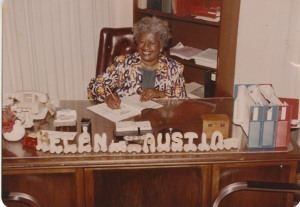
UTSA Special Collections staff was sad to learn of the recent passing of Helen Cloud Austin on February 22, 2016. Special Collections had a long relationship with Austin, beginning in 1997 when she donated the first portion of her papers to the University. However, prior to 1997, Austin had already completed a prolific career in social work in San Antonio and beyond, earning local and national recognition for her dedication.

txsau_ms00061_00570

Austin was born in 1925 in Kentucky, and earned her Masters of Science degree in 1953 from the University of Louisville’s Raymond A. Kent School of Social Work, where she was only the second African-American to attend. After graduation she began work in Chicago at Cook County Hospital. In 1957 she moved to Cincinnati, Ohio, where she became Chief of the Outpatient Department at Longview State Hospital. Her husband’s civil service work led the couple to San Antonio in 1962…

View original post 311 more words

Recommended reading / viewing / listening

This week: Jeb Bush’s failure / Bloomberg’s hinted candidacy / Obama and Cuba / The accomplishments of novelists Eco, Lee, and Spiotta

IMG_0445

This week: Jeb Bush’s failure / Bloomberg’s hinted candidacy / Obama and Cuba / The accomplishments of novelists Eco, Lee, and Spiotta

Most of these great items come from my social media networks. Follow me on Twitter, Tumblr, LinkedIn, MySpace, and Facebook for more fascinating videos, photos, articles, essays, and criticism.

1. Inside Jeb Bush’s $150 Million Failure
By Eli Stokols | Politico Magazine | Feb. 20
“His closest aides failed to predict Trump and never changed course, guiding a flawed candidate into a corner he couldn’t escape.”

2. Harper Lee, Author of ‘To Kill a Mockingbird,’ Dies at 89
By William Grimes | The New York Times | Feb. 19
“Lee, like her alter ego Scout, was a tough little tomboy who enjoyed beating up the local boys, climbing trees and rolling in the dirt.”

3. Michael Bloomberg Hints at Reasons for Candidacy, but Doesn’t Announce It
By Maggie Haberman and Alexander Burns | First Draft :: The New York Times | Feb. 18
“The most pressing problems in the country, he said, were ‘wage stagnation at home, American retreat around the world’ and a ‘corrupt gridlock and two-party system that answers to lobbyists and special interests instead of the American people.’ ”

4. Obama to Cuba: A gamble to end the embargo
By Ted Piccone | Order from Chaos :: The Brookings Institution | Feb. 18
“It is a big prize for the Castros, but in exchange for what? Why now? What can we expect to see happen on the island before and after he visits? How will the visit impact the relationship?”

5. An Interview with Dr. William Blair, Founding Editor of the Journal of the Civil War Era
Muster :: The Journal of the Civil War Era | Feb. 15
“You were the editor of Civil War History for ten years before founding and editing The Journal of the Civil War Era. Did you have a vision for JCWE that differed from CWH?”

6. The Nation He Built
By Michael Grunwald | Politico Magazine | January/February 2016
“Over the past seven years, Americans have heard an awful lot about Barack Obama and his presidency, but the actual substance of his domestic policies and their impact on the country remain poorly understood.”

7. The Quietly Subversive Fictions of Dana Spiotta
By Susan Burton | The New York Times Magazine | Feb. 19
“Over the course of her career, the author has created a new kind of great American novel.”

8. Umberto Eco, Italian novelist and intellectual, dies aged 84
By Kevin Rawlinson | The Guardian | Feb. 20
“The revered literary critic, author and essayist — most famous for 1980 novel The Name of the Rose — had been suffering from cancer.”

9. Why I love… Winona Ryder
By Bim Adewunmi | The Guardian | Feb. 20
“It’s very difficult to look away when she’s on screen. She looks like a woodland creature, a startled deer — plus, she can act”

10. Historical Lessons for a President Forced to Deal With a Hostile Congress
By Michael Beschloss | HistorySource :: The New York Times | November 2014
“The Democratic nominee of 2016, whoever she or he is, might want President Obama to adopt the [Gerald] Ford veto strategy. … It would give the party’s nominee the opportunity to argue that in 2017, only a Democratic president can hold back the excesses of a Republican-controlled House and Senate.”

The Early Life of Hattie Elam Briscoe

An incredible story.

Katie Rojas's avatarThe Top Shelf

In honor of Black History Month, Top Shelf is featuring a look at the early life and educational accomplishments of Hattie Elam Briscoe.

MS67_01-06_groupphoto-justBriscoe Hattie, upon her graduation from St. Mary’s Law School, 1956.

Hattie Ruth Elam Briscoe was born to Cloral Burton Elam and Willy Perry Elam in Shreveport, Louisiana on November 13, 1916. She was the second of five children. Hattie’s mother taught her children to read and write before entering school, which resulted in Hattie skipping a grade level upon entering elementary school. Her mother also encouraged and inspired Hattie to go to college. Sadly, her mother suffered a stroke and passed away at the age of thirty-three. Hattie was just nine years old. After her mother’s passing, her father moved the family to Marshall, Texas. Her father remarried, but unfortunately Hattie’s new stepmother was not terribly kind to her. When she was sixteen, her father “whipped” her…

View original post 515 more words

Scalia is dead – who benefits

Initial reaction, and plenty of important questions.

laveriteest's avatarThe truth is…

The death of Antonin Scalia will surely create endless Obama-Congress disputes when Obama will present his new choice(s). Also, many cases are to be decided during the elections cycle of 2016 and having 8 judges on board, with one less very conservative judge will make the decisions very close or tied or unforeseen postponements.

It will not be good for Congress, as it will show the American people and the world how even in jurisprudence, the American way is all about politics and personal tendencies instead of the true application of the law.

The Republican debates now will have the added feature of gay marriage at the top of the agenda and Trump is most likely to say stupid things and tweet ridiculous idea that will expose even further the bigotry and racism that are latent in the United States.

View original post

Recommended reading / viewing / listening

This week: Henry Kissinger / George Washington and whiskey / Scorsese’s love for the Rolling Stones / Beyonce’s hot sauce / The drama of gravitational wave detection

IMG_1535

This week: Henry Kissinger / George Washington and whiskey / Scorsese’s love for the Rolling Stones / Beyonce’s hot sauce / The drama of gravitational wave detection

Most of these great items come from my social media networks. Follow me on Twitter, Tumblr, LinkedIn, MySpace, and Facebook for more fascinating videos, photos, articles, essays, and criticism.

1. The Dawn of a New Era in Science
By Matthew Francis | The Atlantic | Feb. 11
“By announcing the first detection of gravitational waves, scientists have vindicated Einstein and given humans a new way to look at the universe.”

2. Shut Up and Press Play
By Mary-Louise Parker | Esquire Classic | September 2006
“If you want to rock this girl (or yours), these are the songs you need to know”

3. William Shatner Opens Up About Deathbed Rift With Leonard Nimoy and Their Long Friendship
By Katie Wilson Berg | The Hollywood Reporter | Feb. 12
“Shatner spoke … about his respect for Nimoy as an artist and the mystery of why the man he calls ‘the only friend I ever had’ shut him out in the last years of his life.”

4. A History of Martin Scorsese’s Love Affair with the Rolling Stones
By Dan Reilly | Vulture | Feb. 12
“‘My films,’ the man himself once said, ‘would be unthinkable without them.’ ”

5. We All Need Beyonce’s Hot Sauce
By Goldie Taylor | The Daily Beast | Feb. 8
“It’s a flavorful essence — proud, black, and full of social justice.”

6. InstaTexas: The Stars At Night…
By Jordan Breal | Texas Monthly | Feb. 11
“Are big and bright — and ready for their close-up.”

7. George Washington, the Whiskey Baron of Mount Vernon
By Michael Beschloss | The Upshot :: The New York Times | Feb. 12
“It was not exactly in keeping with Washington’s public image to enter the whiskey trade.”

8. Gravitational Waves Exist: The Inside Story of How Scientists Finally Found Them
By Nicola Twilley | Elements :: The New Yorker | Feb. 11
“It took years to make the most sensitive instrument in history insensitive to everything that is not a gravitational wave. Emptying the tubes of air demanded forty days of pumping. The result was one of the purest vacuums ever created on Earth, a trillionth as dense as the atmosphere at sea level.”

9. Henry Kissinger: Good or Evil?
Politico Magazine | October 2015
“10 historians assess the controversial statesman’s legacy”

10. T.R.’s Son Inspired Him to Help Rescue Football
By Michael Beschloss | HistorySource :: The New York Times | August 2014
“T.R.’s intervention … helped lead to … the enforcement of new rules, which included the forward pass, a neutral zone at the line of scrimmage, another referee on the field and later prohibitions against brutal maneuvers like kneeing and punching opponents by using locked hands.”

Hillary Clinton’s Clarification: More Confusion?

Not a great week for Hillary Clinton.

Brooks D. Simpson's avatarCrossroads

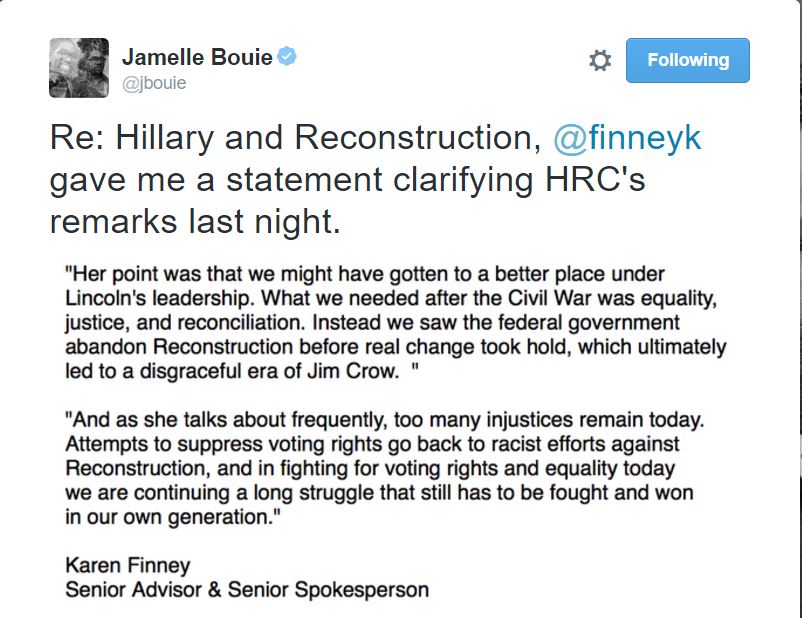
As you might have expected, Hillary Clinton issued a clarification of her controversial remarks about Reconstruction, made in the context of her speculation on what might have happened had Abraham Lincoln not been assassinated:

HRC clarification

Nice try, but strike two.

Ms. Clinton’s statement now indicts the federal government, saying it gave up too soon, and its lack of persistence “led to a disgraceful era of Jim Crow.”

That this was due in part to the behavior of “defiant” white southerners, including terrorist activity, is a link she’s unwilling to make, although one can make it when she reminds us about “racist efforts against Reconstruction.” How exactly a president could achieve “equality, justice, and reconciliation” while protecting black rights — not exactly a good way to reconcile white southerners — remains unanswered. Nor does her response consider the role played by the racism of some white northerners, most of whom were Democrats…

View original post 158 more words

“The depths of human turbulence”

Muster, the excellent blog for the Journal of the Civil War Era, recently interviewed the historical adviser to the new Civil War drama Mercy Street

IMG_1499

Muster, the excellent blog for the Journal of the Civil War Era, recently interviewed Dr. Jane E. Schultz, professor of English at Indiana University-Purdue University Indianapolis and historical adviser to Mercy Street, the PBS drama about women in Civil War hospitals. She perceptively argues that the series “is trying to show the depths of human turbulence that lay beneath the surface of military etiquette.”

Read the entire interview here. It offers intellectual depth and understanding to the process of shaping the drama’s narrative, location, characters, and era.

National Archives Awards UTSA Libraries $146k to Support Major Research Collection on Latino Vote

Wonderful news. Congratulations.

UTSA Special Collections's avatarThe Top Shelf

In May 2015 we announced the acquisition of the Southwest Voter Registration Education Project/William C. Velásquez Records. The collection–one of the largest archival acquisitions in UTSA Libraries’ history—consists of 500 linear feet of documents and 154 pieces of audiovisual material. The collection covers the organization’s first 20 years, from 1974 to 1994, and includes redistricting maps, voter exit surveys, GOTV campaign planning materials, pre-election surveys, office files, research files, research publications, and newsletters.

We are very excited to announce that The National Archives of the United States has awarded the UTSA Libraries a $145,650 grant to process the records and digitize the audiovisual material in the collection.

The grant is one of the largest awarded by the National Archives this year, and will cover the additional staff needed to process the collection so it can be used for research. The work is expected to take approximately two years.

View original post 57 more words

How Woody Allen Saved New York

Great commentary

Colin E. Woodward's avatarColin E. Woodward's Official Site

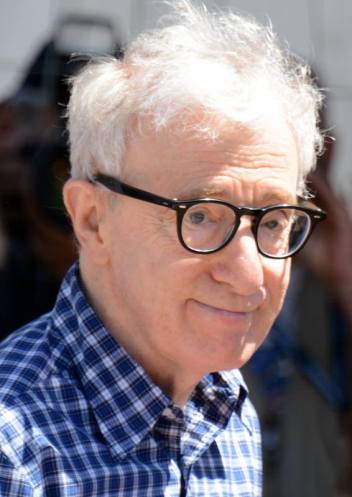
Woody_Allen_Cannes_2015.jpg

I recently finished watching Woody Allen’s most recent film, Irrational Man. The movie illustrates how far Allen has come from his earlier work. Irrational Man, which is a serious and heady, is neither funny nor set in New York. Maybe it’s time for Woody to return to the Big Apple.

Some people say that Rudy Giuliani, by implementing the so-called “Broken Window Theory” of police enforcement, cleaning up Times Square, and staying calm in the wake of the 9-11 catastrophe–saved New York City.

Actually, it was Woody Allen who saved New York. And he rescued the place long before anyone knew who Rudolph Giuliani was.

In the 1970s, movies exploited the darker aspects of New York. Films like Dog DayAfternoon, The French Connection, Taxi Driver, and Death Wish, depicted NYC as a gritty, tense, and violent place, where desperate men could do little…

View original post 996 more words

Looking Back: Work that mattered

Today in 1921, Carmen Romero Phillips was born. She fulfilled her dream of becoming a nurse, but war gave her work more significance than she ever imagined.

7218-8

Today in 1921, Carmen Romero Phillips was born. She fulfilled her dream of becoming a nurse, but war gave her work more significance than she ever imagined.

******

LOOKING BACK
A special series

During my time as a contributing editor to the magnificent Voces Oral History Project at the University of Texas at Austin, I came across some amazing stories. The project, which I celebrated in 2011, collects the stories of Latino veterans and civilians who saw and felt the effects of war, from World War II to Vietnam. This occasional series highlights a few of these fascinating lives.

******

Carmen Romero Phillips, born on Jan. 19, 1921, was recruited as a military nurse even before she graduated from nursing school in 1943, and she was so good that her boss, an Air Force surgeon at her posting in California, requested her by name.

She served through 1945, caring mostly for wounded troops from the Pacific Theater. She also joined the Red Cross. In 1946, she moved to Corpus Christi to start a new nursing job, met her future husband, and settled in the Texas coastal city, eventually marrying and raising four children.

She never lost her determination to help wherever she could. On Sept. 11, 2001, when she was 83, she called the local Red Cross chapter and volunteered to help one more time.

******

Visit the Voces website. Like them on Facebook. Follow them on Twitter.

Behind The Wall

Tabletop Games

Rebecca Aguilar

#CallingAllJournalists Initiative | Reporter | Media Watchdog | Mentor | Latinas in Journalism

Anna Fonte's Paper Planes

Words, images & collages tossed from a window.

Postcards from Barton Springs

Gayle Brennan Spencer - sending random thoughts to and from South Austin

The Flask Half Full

Irreverent travelogues, good drinks, and the cultural stories they tell.

Government Book Talk

Talking about some of the best publications from the Federal Government, past and present.

Cadillac Society

Cadillac News, Forums, Rumors, Reviews

Ob360media

Real News That Matters

Mealtime Joy

bringing joy to family meals

Øl, Mad og Folk

Bloggen Øl, Mad og Folk

a joyous kitchen

fun, delicious food for everyone

A Perfect Feast

Modern Comfort Food

donnablackwrites

Art is a gift we give ourselves

Fridgelore

low waste living drawn from food lore through the ages

BeckiesKitchen.com

MUSINGS : CRITICISM : HISTORY : NEWS

North River Notes

Observations on the Hudson River as it passes through New York City. The section of the Hudson which passes through New York is historically known as the North River, called this by the Dutch to distinguish it from the Delaware River, which they knew as the South River. This stretch of the Hudson is still often referred to as the North River by local mariners today. All photos copyright Daniel Katzive unless otherwise attributed. For more frequent updates, please follow northriverblog on Facebook or Instagram.