Recommended reading / viewing / listening

This week: Blind people’s sexuality / The end of civilization / Lagos: the future city / Breaking down “The Shining” / Remaking the TLS

This week: Blind people’s sexuality / The end of civilization / Lagos: the future city / Breaking down The Shining / Remaking the TLS

Most of these great items come from my social media networks. Follow me on Twitter, Instagram, Tumblr, LinkedIn, and Facebook for more fascinating videos, photos, articles, essays, and criticism.

1. Are Blind People Denied Their Sexuality?
By M. Leona Godin | Catapult | July 2018
“The contortions that people will undergo to desexualize me, a blind woman, can be overwhelming.”

2. Data isn’t the new oil — it’s the new nuclear power
By James Bridle | Ideas :: TED.com | July 2018
“Data is a valuable, powerful commodity — but unlike oil, it is unlimited in quantity and in its capacity for harm”

3. When the End of Human Civilization Is Your Day Job
By John H. Richardson | Esquire | July 2018
“Among many climate scientists, gloom has set in. Things are worse than we think, but they can’t really talk about it.”

4. The Pap test could eventually be replaced by the HPV test, some experts say
By Laurie McGinley | The Washington Post | July 2018
“The HPV infection is the most common sexually transmitted infection and is usually eliminated by the immune system within a year or two. But when an infection persists, it can cause cellular changes that develop into precancerous lesions and, eventually, malignancies.”

5. ‘You can’t just gloss over this history’: The movement to honor Ida B. Wells gains momentum
By Peter Slevin | The Washington Post | June 2018
“This stone is the rare marker in Chicago that honors Wells, a hero in an unending battle against racial injustice who died in 1931. Born into slavery in Holly Springs, Miss., Wells became a crusading African American journalist who exposed the crime and shame of lynching and fought for women’s suffrage.”

6. Lagos: Hope and Warning
By Armin Rosen | City Journal | July 2018
“Nigeria’s mega-city, bursting with opportunity but strained with disorder, offers a cautionary preview of the future.”

7. Scientists defy ‘force of nature’ to unlock secrets of Hawaii volcano
By Terray Sylvester and Jolyn Rosa | Reuters | July 2018
“Scientists have been in the field measuring the eruptions 24 hours a day, seven days a week since Kilauea first exploded more than two months ago.”

8. Kubrick’s The Shining in 6 parts: The Obsessively-controlled sequences that unravel Jack’s mind
By Roger Luckhurst | Salon.com | July 2018
“At the crucial core of the horror masterpiece, time collapses and Jack Torrance’s madness blooms.”

9. A Scrappy Makeover for a Tweedy Literary Fixture
By Dwight Garner | The New York Times | May 2018
“The Times Literary Supplement was founded in 1902. Its editor, Stig Abell, was hired to usher it into a new era.”

10. Billie Holiday
By Elizabeth Hardwick | The New York Review of Books | March 1976
“Her whole life had taken place in the dark. The spotlight shone down on the black, hushed circle in a café; the moon slowly slid through the clouds.”

Recommended reading / viewing / listening

This week: Rum from India? / Earth’s coldest place / Inventor of Liquid Paper / Madonna and Harry Dean Stanton / Other people’s problems

This week: Rum from India? / Earth’s coldest place / Inventor of Liquid Paper / Madonna and Harry Dean Stanton / Other people’s problems

Most of these great items come from my social media networks. Follow me on Twitter, Instagram, Tumblr, LinkedIn, and Facebook for more fascinating videos, photos, articles, essays, and criticism.

1. Forget the Caribbean: Was Rum Invented in India
By David Wondrich | The Daily Beast | July 2018
“Newly discovered evidence suggests that rum production predates the Caribbean by at least 1,000 years and may have actually started in South East Asia.”

2. Coldest Place on Earth Found — Here’s How
By Alejandra Borunda | National Geographic | June 2018
“It’s a place where Earth is so close to its limit, it’s almost like another planet.”

3. How Ancient Mummies Helped This Soccer Player Get to the World Cup
By Sarah Gibbens | National Geographic | June 2018
“After Paolo Guerrero tested positive for cocaine, scientists used Inca mummies to argue that the result may have been influenced by something else.”

4. How Is the Declaration of Independence Preserved
By Tim Palmieri | Scientific American | July 2018
“The National Archives and Records Administration uses science and technology to keep one of America’s most important historic documents safe.”

5. Do You Like ‘Dogs Playing Poker’ Science Would Like to Know Why
By Tom Mashberg | The New York Times | July 2018
“The mysteries of the aesthetic response, and the creative impulse, have become a burgeoning area of inquiry for scientific researchers across many disciplines.”

6. What lies in the lab: The gruesome murder at Harvard that transfixed New England
By Paul Collins | The Boston Globe Magazine | July 2018
“Wealthy George Parkman vanished into thin air one day. Then a janitor started snooping around a Harvard lab and made a grisly discovery.”

7. Ask Yourself This: What Burdens Is That Other Person Carrying
By Carl Richards | Sketch Guy :: The New York Times | July 2018
“And how would I treat them differently if I knew”

8. Bette Nesmith Graham, Who Invented Liquid Paper
By Andrew R. Chow | Overlooked :: The New York Times | July 2018
“Graham brought it to market and by the end of her life led an international business out of Dallas that produced 25 million bottles a year at its peak, with factories in Toronto and Brussels. She would sell the company for $47.5 million and donate millions to charity.”

9. ‘He Pretty Much Gave In to Whatever They Asked For’
By Michael Kruse | Politico Magazine | June 2018
“Trump says he’s a master negotiator. Those who’ve actually dealt with him beg to differ.”

10. Madonna talks to Harry Dean Stanton about her newfound stardom
By Harry Dean Stanton | Interview | May 2018
“I laugh at myself, I don’t take myself completely seriously. I think that’s another quality that people have to hold onto, you have to laugh, especially at yourself.”

Recommended reading / viewing / listening

This week: Genius procrastination / Democrats face themselves / Women explain their abortions / Bittersweet breastfeediing / Future of Democracy

This week: Genius procrastination / Democrats face themselves / Women explain their abortions / Bittersweet breastfeediing / Future of democracy

Most of these great items come from my social media networks. Follow me on Twitter, Instagram, Tumblr, LinkedIn, and Facebook for more fascinating videos, photos, articles, essays, and criticism.

1. Many Creative Geniuses May Have Procrastinated — but That Doesn’t Mean You Should
By Casey Lesser | Artsy.net | July 2018
“Some believe in a form of procrastination that fosters well-being and creativity, but others argue that certain types of behavior, in which someone intentionally delays their creative work, don’t actually constitute procrastination at all.”

2. A Watershed Moment in American History
By Matt Ford | The New Republic | July 2018
“Trump nominee Brett Kavanaugh will deliver Republicans a majority on the Supreme Court. Will he also prompt a reckoning among Democrats”

3. ‘I Couldn’t Tell Anyone’: Women Around the World Reveal Intimate Stories of Abortion
By Josephine Sedgwick | The New York Times | July 2018
“When we invited readers to share their own stories, more than 1,300 responded from over 30 countries, showing the vast range of reasons, means and outcomes for abortion.”

4. Why breast-feeding is a mix of joy and suffering
By Maya Uppaluru | The Lily :: Washington Post | July 2018
“Is breast-feeding anti-feminist”

5. Reporting Is Ugly
By Barry Petchesky | The Concourse :: Deadspin | October 2015
“It is invaluable and messy and it not only doesn’t diverge from the most basic principles of journalism, it exemplifies them.”

6. The Democratic Coming Apart
By David Runciman and Joshua Cohen | Boston Review | July 2018
“Democracy … could either fail while remaining intact or evolve into something different — and possibly even better.”

7. And Now, Some Little-Known Facts About Texas
By David Courtney | Texas Monthly | July 2018
“In our new video series, David Courtney takes you into some of the weird, whimsical, and lesser-known aspects of our beloved state.”

8. Is Punching Nazis Impolite
By Barry Purcell | Arc Digital | July 2018
“Exploring the limits of civility”

9. The Americanization of Alfredo Corchado
By Sergio Troncoso | Texas Monthly | June 2018
“By telling his own story, the widely admired Dallas Morning News reporter reveals how Mexican Americans have changed the United States — and how the United States has changed Mexican Americans.”

10. What does ‘normal’ mean in abnormal times
By Steven Poole | The Guardian | April 2018
“From Donald Trump to Syrian bombs — in modern political times, ‘normal’ carries an extra moral nuance”

Recommended reading / viewing / listening

This week: FEMA and Hurricane Maria / Dear Abby and #MeToo / Learn to be happy at Yale / Understanding Sarah Huckabee Sanders / Summer books, movies, and TV

This week: FEMA and Hurricane Maria / Dear Abby and #MeToo / Learn to be happy at Yale / Understanding Sarah Huckabee Sanders / Summer books, movies, and TV

Most of these great items come from my social media networks. Follow me on Twitter, Instagram, Tumblr, LinkedIn, and Facebook for more fascinating videos, photos, articles, essays, and criticism.

1. FEMA Was Sorely Unprepared for Puerto Rico Hurricane, Report Says
By Francis Robles | The New York Times | July 2018
“The Federal Emergency Management Agency’s plans for a crisis in Puerto Rico were based on a focused disaster like a tsunami, not a major hurricane devastating the whole island. The agency vastly underestimated how much food and fresh water it would need, and how hard it would be to get additional supplies to the island.”

2. Plane Bae Teaches Us That Other People’s Lives Are Not a Movie for Us to Watch
By Dan Solomon | Texas Monthly | July 2018
“How a chance encounter on a flight to Dallas turned into an internet sensation, and why it shouldn’t happen again.”

3. Dear Abby, #MeToo
By Jessica Weisberg | The New York Times | April 2018
“[#MeToo] created room for the sort of discussions that once were restricted to, essentially, just one type of public space: advice columns. For decades, the columns were where women with creepy bosses or abusive husbands went to air their grievances.”

4. At Yale, you can take a course on being happy
By Billy Baker | The Boston Globe | April 2018
“The success of the class has been unprecedented. So many students signed up that the meeting space had to be moved to Woolsey Hall, a cavernous, cathedral-like auditorium typically used for things like symphony concerts. The sheer volume of students requires two dozen teaching fellows.”

5. Margaret Atwood on How She Came to Write The Handmaid’s Tale
By Margaret Atwood | The Folio Society :: LitHub | April 2018
“The origin story of an iconic novel”

6. The Puzzle of Sarah Huckabee Sanders
By Jason Schwartz | Politico Magazine | May/June 2018
“How a bright, competent and likable young operative became the face of the most duplicitous press operation in White House history.”

7. Hear Stanley Kubrick Explain the 2001: A Space Odyssey Ending In a Rare, Unearthed Video
By Matt Miller | Esquire | July 2018
“The director famously refused to give his interpretation of the sci-fi masterpiece.”

8. Summer Reading: Movies & TV
By Ben Dickinson | The New York Times Book Review | June 2018
New books about Bruce Lee, David Lynch, The Wire and 2001: A Space Odyssey, along with recommendations on new thrillers, true crime, travel, sports and more.

9. How Syria Came to This
By Andrew Tabler | The Atlantic | April 2018
“A story of ethnic and sectarian conflict, international connivance, and above all civilian suffering”

10. The Woman Who Brought Down Bill Cosby
By Neeti Upadhye | The New York Times | April 2018
“Andrea Constand is the only woman among more than 50 accusers whose complaint against Mr. Cosby has resulted in a conviction. A jury found him guilty of three counts of aggravated indecent assault.”

Special Collections travels to Mexico City

Beautiful

Alyssa Franklin's avatarThe Top Shelf

During the first week of this month, Rare Books Librarian Agnieszka Czeblakow and I had the opportunity to travel to Mexico City for the annual Seminar on the Acquisition of Latin American Library Materials (SALALM) conference. This year’s theme was “Sites/Cites, Texts, and Voices in Critical Librarianship: Decolonizing Libraries and Archives.”

As a first-time attendee, I was excited to learn that SALALM is so interdisciplinary; the event brought together librarians, archivists, book dealers, curators, scholars, and other professionals. Our shared goal was to think critically about how processes of selection, organization, and description give shape to research and teaching on Latin America, Iberia, and the Caribbean.

I was able to participate in a wide variety of activities, including panels composed of experts discussing issues relevant to all institutions that collect Latin American materials (UTSA included). I learned how other institutions think critically about their holdings, develop innovative workflows…

View original post 97 more words

A pocket guide to Totonac, an endangered language.

Fascinating. What an amazing find.

Alyssa Franklin's avatarThe Top Shelf

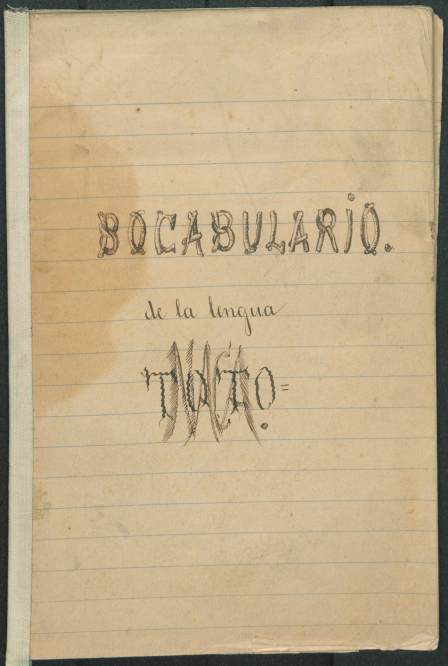
As the digitization of the Sons of the Republic of Texas Mexican Manuscript Collection (SRT) in its entirety progresses, I continue to be amazed and pleasantly surprised by some of the hidden gems that are buried in the unassuming SRT filing cabinets in the Special Collections vault. One of those wonderful moments happened recently when I came upon document 5794, “Vocabulario de la lengua Totonaca.” The vague title featured in the metadata does not do this incredibly interesting document justice. Document 5794 is so much more than just a “vocabulary.” Its cover contains a striking  example of calligraphy, the contents are interesting, unique, and exciting. The document provides a glimpse into the diversity of eighteenth-century Mexico. It features one of the 68 indigenous languages officially recognized by the Mexican government that are still spoken today.

txsau-srt-5794_00001 not cropped

The name Totonac ecompasses a cluster of approximately 9 closely-related languages still spoken by…

View original post 474 more words

HemisFair Exhibit at the McNay Art Museum

UTSA Special Collections's avatarThe Top Shelf

Install1 “Synchronetic” by Fletcher Benton

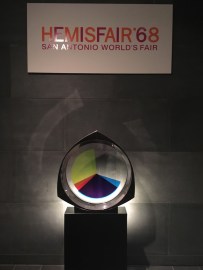
UTSA Libraries Special Collections has partnered with the McNay Art Museum to present HemisFair ’68: San Antonio World’s Fair, an exhibit organized in celebration of the 50th anniversary of HemisFair ’68 and of San Antonio’s Tricentennial.  The exhibit primarily draws from the archival holdings of UTSA Special Collections.

Highlighting artists and designers who contributed to the Fair, HemisFair ’68: San Antonio’s World’s Fair features small selections of artworks, architectural drawings, conceptual site plans, costume and graphic designs, ephemera, souvenirs, and audiovisual materials, including film and sound recordings, that document the early planning for HemisFair ’68.

The exhibit runs from May 3, 2018 to July 29, 2018

Install3

The exhibition is organized by Heather Ferguson, former Archivist for the McNay Art Museum, with Amy Rushing, Head of Special Collections for UTSA Libraries.

Install2

Lead funding is most generously provided by the Elizabeth Huth Coates Exhibition Endowment and the Arthur and Jane…

View original post 4 more words

Alamo Arcade: Portal to the Alamo Gardens

Tom Shelton's avatarThe Top Shelf

With various proposals for the new Alamo Master Plan in the news today, we look back to an earlier time when there were similar efforts to redesign the area around the Alamo.  The idea for a park adjacent to the Alamo chapel received serious attention when the Alamo Mission Chapter of the Daughters of the Republic of Texas and the San Antonio Conservation Society presented the idea to the mayor and city commissioners in 1925.  Among the leaders was Clara Driscoll Sevier, who had provided money to preserve the Alamo Long Barrack over 20 years earlier.  Mrs. Sevier, chairman of the Alamo Park Commission, again advanced considerable money toward purchase of the property immediately south of the Alamo for what would become part of the Alamo State Park, now called the Alamo Gardens.  The long process of bringing the park to fruition is chronicled in numerous articles in the San…

View original post 372 more words

Recommended reading / viewing / listening

This week: Fidel Castro’s love affair / Celebrating the brilliance of “Scarface” / The secret power of ISIS / Molly Ringwald looks back / The British Empire’s shadow on today’s world

This week: Fidel Castro’s love affair / Celebrating the brilliance of Scarface / The secret power of ISIS / Molly Ringwald looks back / The British Empire’s shadow on today’s world

Most of these great items come from my social media networks. Follow me on Twitter, Instagram, Tumblr, LinkedIn, and Facebook for more fascinating videos, photos, articles, essays, and criticism.

1. ‘My Dearest Fidel’: An ABC Journalist’s Secret Liaison With Fidel Castro
By By Peter Kornbluh | Politico Magazine | April 2018
“The untold story of how Lisa Howard’s intimate diplomacy with Cuba’s revolutionary leader changed the course of the Cold War.”

2. Revisiting the Controversy Surrounding Scarface
By Jason Bailey | Vulture | April 2018
“It landed on VHS and Betamax the following summer, at what may have been the perfect moment, as home video reached a penetration point and videotape rentals were becoming part of the average moviegoer’s diet.”

3. End of the American dream? The dark history of ‘America first’
By Sarah Churchwell | The Guardian | April 2018
“When he promised to put America first in his inaugural speech, Donald Trump drew on a slogan with a long and sinister history — a sign of what was to follow in his presidency”

4. How Trump Moved the Mexican Border North
By Emily Gogolak | Politico Magazine | April 2018
“It started in Texas. And the rest of the country is next.”

5. The ISIS Files
By Rukmini Callimachi | The New York Times | April 2018
“We unearthed thousands of internal documents that help explain how the Islamic State stayed in power so long.”

6. ‘The Clock Is Ticking’: Inside the Worst U.S. Maritime Disaster in Decades
By William Langewiesche | Vanity Fair | April 2018
“A recording salvaged from three miles deep tells the story of the doomed ‘El Faro,’ a cargo ship engulfed by a hurricane.”

7. What About ‘The Breakfast Club’?
By Molly Ringwald | The New Yorker | April 2018
“Revisiting the movies of my youth in the age of #MeToo.”

8. 5 Reasons Why a Writer Should Move to Tampa
By Arielle Silver | LitHub | April 2018
“Welcome to the lightning capital of North America.”

9. My Caribbean trip opened my eyes to the legacy of the British empire
By Lenny Henry | The Guardian | March 2018
“After Brexit, the Commonwealth could play a crucial trading role. But the historic associations with slavery still resonate.”

10. Essential Writing Advice from Virginia Woolf
By Emily Temple | LitHub | March 2018
“Woolf was a once-in-a-generation mind, and as both a writer and publisher, she had strong opinions about what made a piece of literature great (or, more often, mediocre). Luckily for us, she wrote many of her ideas down, in some of the many essays and letters she penned over the course of her life.”

Recommended reading / viewing / listening

This week: Revisiting the Pentagon Papers / Short walks are good for you / James Mattis: Roman hero / A memory of Baghdad / Touring Clinton country

This week: Revisiting the Pentagon Papers / Short walks are good for you / James Mattis: Roman hero / A memory of Baghdad / Touring Clinton country

Most of these great items come from my social media networks. Follow me on Twitter, Instagram, Tumblr, LinkedIn, and Facebook for more fascinating videos, photos, articles, essays, and criticism.

1. Lying in Politics: Reflections on The Pentagon Papers
By Hannah Arendt | The New York Review of Books | November 1971
“The quicksand of lying statements of all sorts, deceptions as well as self-deceptions, is apt to engulf any reader who wishes to probe this material, which, unhappily, he must recognize as the infrastructure of nearly a decade of United States foreign and domestic policy.”

2. Those 2-Minute Walk Breaks? They Add Up
By Gretchen Reynolds | The New York Times | March 2018
“But improving endurance is not the same thing as improving health.”

3. Women Writing the West
By Sarah Boon | LitHub | March 2018
“6 nonfiction writers you should know — from the turn of the century to today”

4. James Mattis Is an Ancient Roman Action Hero
By Robert Zaretsky | Foreign Policy | March 2018
“In dealing with President Trump, the defense secretary seems to have done his reading on Emperor Nero.”

5. Something attacked my son while he was sledding in the woods. But what?
By Mark Shanahan | The Boston Globe Magazine | March 2018
“My child went sledding alone and emerged from the trees bloody and dazed. He still can’t remember what happened.”

6. Why So Many Public Libraries Are Now Giving Out Seeds
By Katherine Davis-Young | Atlas Obscura | March 2018
“Seed-sharing programs aim to expand access to crops and educate the public, while also protecting scarce agricultural resources.”

7. Did scientists really just discover a new organ in he human body?
By Rich Haridy | New Atlas | March 2018
“Using a new microscopic technique, a team of scientists has identified a previously unknown human anatomical feature. Dubbed the interstitium, the discovery reveals that what was previously thought to be simply dense connective tissue sitting below the skin’s surface, and surrounding our organs, is actually a complex series of interconnected, fluid-filled compartments.”

8. One Morning in Baghdad
By Adam Exum | The Atlantic | March 2018
“Fifteen years after the U.S. invasion, there’s no satisfying answer to the question: What were we doing in Iraq anyway?”

9. My 72-Hour Safari in Clinton Country
By Adam Wren | Politico Magazine | March 2018
“More than a year into Trump’s presidency, the bubble has closed back over the Acela Corridor, where voters say they do not regret not voting for Trump.”

10. History of a Conversion: A Political Profile of Mario Vargas Llosa
By Felipe Restrepo Pombo | Words Without Borders | March 2018
Read Part 1 and Part 2

Behind The Wall

Tabletop Games

Rebecca Aguilar

#CallingAllJournalists Initiative | Reporter | Media Watchdog | Mentor | Latinas in Journalism

Anna Fonte's Paper Planes

Words, images & collages tossed from a window.

Postcards from Barton Springs

Gayle Brennan Spencer - sending random thoughts to and from South Austin

The Flask Half Full

Irreverent travelogues, good drinks, and the cultural stories they tell.

Government Book Talk

Talking about some of the best publications from the Federal Government, past and present.

Cadillac Society

Cadillac News, Forums, Rumors, Reviews

Ob360media

Real News That Matters

Mealtime Joy

bringing joy to family meals

Øl, Mad og Folk

Bloggen Øl, Mad og Folk

a joyous kitchen

fun, delicious food for everyone

A Perfect Feast

Modern Comfort Food

donnablackwrites

Art is a gift we give ourselves

Fridgelore

low waste living drawn from food lore through the ages

BeckiesKitchen.com

MUSINGS : CRITICISM : HISTORY : NEWS

North River Notes

Observations on the Hudson River as it passes through New York City. The section of the Hudson which passes through New York is historically known as the North River, called this by the Dutch to distinguish it from the Delaware River, which they knew as the South River. This stretch of the Hudson is still often referred to as the North River by local mariners today. All photos copyright Daniel Katzive unless otherwise attributed. For more frequent updates, please follow northriverblog on Facebook or Instagram.