Soft serenity

Watching last evening’s sunset reminded me of some not-so-deep yet from-the-heart thoughts from 2008 on how much I love the serene, soft colors of a day’s end.

Watching last evening’s sunset reminded me of some not-so-deep yet from-the-heart thoughts from 2008 on how much I love the serene, soft colors of a day’s end.

TUNES

My soundtrack for today included:
1. FAMILY AFFAIR Mary J. Blige
2. NO DIGGITY (Capricorn 2 Mix) Morcheeba & Blackstreet
3. HEAD DOCTOR Snoop Dogg
4. AYO Bossman
5. SALT SHAKER Ying Yang Twins
6. YOU KNOW HOW WE DO IT Ice Cube
7. IN THE CLUB 50 Cent & Beyonce
8. VATO Snoop Dogg
9. AROUND THE WAY GIRL LL Cool J
10. YOU KNOW WHAT IT IS T.I. & Wyclef Jean

Recommended reading / viewing / listening

Lessons from a Turkish grandmother … the Churchill we thought we knew … the release of all Pentagon Papers … Anna Nicole Smith and her doomed life … what not to say to the editor that fired you …

Most of these great items come from my Twitter feed or Facebook news feed. Follow me on Twitter and on Facebook for more fascinating videos, articles, essays and criticism.

1. My ‘Confession’
By Fang Lizhi | The New York Review of Books | June 2011
“From reading Henry Kissinger’s new book On China,1 I have learned that Mr. Kissinger met with Deng Xiaoping at least eleven times—more than with any other Chinese leader—and that the topic of one of their chats was whether Fang Lizhi would confess and repent.”

2. Jessi Arrington: Wearing nothing new
By Jessi Arrington | TED Talks | June 2011
“Designer Jessi Arrington packed nothing for TED but 7 pairs of undies, buying the rest of her clothes in thrift stores around LA. It’s a meditation on conscious consumption — wrapped in a rainbow of color and creativity.”

3. Chile’s Puyehue Volcano: A slideshow
Time | June 6
“After laying dormant for nearly half a century, the Puyehue volcano in southern Chile erupted on Saturday, shooting a column of ash and gas six miles into the sky and prompting the evacuation of more than 3,500 residents. … Here’s some of the best images photographers captured in the past 24 hours.”

4. “I Would Have Loved To Piss on Your Shoes”
By Jack Shafer | Slate | June 6
“In honor of every journalist who flipped the boss off on the way out the door, I’ve collected a few of their best kiss-off notes and gestures from the recent past. If, after reading, you don’t turn in your badge and burn every bridge and causeway behind you and fill with sewage every tunnel and viaduct that connects you to your former place of employment, I’ve failed in my mission.”

5. After 40 Years, the Complete Pentagon Papers
By Michael Cooper and Sam Roberts | The New York Times | June 7
“It may be a first in the annals of government secrecy: Declassifying documents to mark the anniversary of their leak to the press. But that is what will happen Monday, when the federal government plans to finally release the secret government study of the Vietnam War known as the Pentagon Papers 40 years after it was first published by The New York Times.”

6. Paw Paw & Lady Love
By Dan. P. Lee | New York Magazine | June 5
“Has the Supreme Court ever heard such a peculiarly American story as that of Anna Nicole Smith? And they didn’t know the half of it.”

7. Film directors are embracing TV
By Nicole Sperling and Melissa Maerz | Los Angeles Times | June 5
“Let the major movie studios have their superheroes and pirates. Cable TV has become more innovative, and top moviemakers such as Martin Scorsese, Michael Mann and Gus Van Sant are taking advantage.”

8. The Forgotten Churchill
By George Watson | The American Scholar | June 6
“The man who stared down Hitler also helped create the modern welfare state.”

9. Marriage Lessons from My Turkish Grandmother
By Sevil Delin | Granta | June 7
“The stories my grandmother, my anneanne, told me when I was a child are anything but children’s stories. They are folktales that have a common theme – the triumph of wily wives over evil husbands (jealous, repressive skinflints) through crafty subterfuge.”

10. Clever Girl
By Tessa Hadley | The New Yorker: Fiction | June 6
“My stepfather wasn’t a big man, not much taller than my mother. He was lithe and light on his feet, handsome, with velvety dark brows, a sensual mouth, and jet-black hair in a crewcut as thick and soft as the pelt of an animal (not that I ever touched it, though sometimes, out of curiosity, I wanted to).”

TUNES

My soundtrack for today included:
1. MANDINGA (Live) Buena Vista Social Club
2. A LA LOMA DE BELEN El Gran Combo de Puerto Rico
3. LA NOCHE DE LA IGUANA Lucrecia
4. DOS GARDENIAS Ibrahim Ferrer
5. PATRIA QUERIDA Los Guaracheros De Oriente
6. SON FO Africando All Stars
7. LA LIBELULA Mariana Montalvo
8. GUAJIRA LINDA Celina Gonzalez
9. BOOM BOOM BOOM The Iguanas
10. LA ULTIMA COPA Felipe Rodriguez

Recommended reading / viewing / listening

Recommended reading / viewing / listening, Part 1: China’s naval power … ‘Weinergate’ cartoons … the perfect Father’s Day present …Peru’s new president … what disasters can teach us.

Most of these great items come from my Twitter feed or Facebook news feed. Follow me on Twitter and on Facebook for more fascinating videos, articles, essays and criticism.

1. Apocalypse: What Disasters Reveal
By Junot Diaz | Boston Review | May/June 2011
“Apocalyptic catastrophes don’t just raze cities and drown coastlines; these events, in David Brooks’s words, “wash away the surface of society, the settled way things have been done. They expose the underlying power structures, the injustices, the patterns of corruption and the unacknowledged inequalities.” And, equally important, they allow us insight into the conditions that led to the catastrophe, whether we are talking about Haiti or Japan. ”

2. Damon Horowitz calls for a ‘moral operating system’
By Damon Horowitz | TED Talks | May 2011
“At TEDxSiliconValley, Damon Horowitz reviews the enormous new powers that technology gives us: to know more — and more about each other — than ever before. … Where’s the moral operating system that allows us to make sense of it?”

3. Book review: ‘State of Wonder’
By Carolyn Kellogg | Los Angeles Times | June 5
“In her new novel, Ann Patchett’s gives readers almost a feminized version of ‘Heart of Darkness,’ but without the savagery.”

4. What kind of leftist president for Peru?
By Frank Bajak | Associated Press | June 6
“In his first, failed run to be Peru’s president, Ollanta Humala projected the image of a radical leftist in Hugo Chavez’s mold. This time, he called the Venezuelan leader’s socialist-oriented economic model flawed, and sought moderate allies and courted Washington. Yet many Peruvians wonder if this 48-year-old political novice … is really a market-friendly populist. Many skeptics fear he will renege on his promises and spring revolutionary change on an unsuspecting nation.”

5. The Only Father’s Day Gift You Need: A Letter of Appreciation
By Andrew Snavely | Primer | June 6
“Man to man, especially with a dad can be impossible. Some fathers are gruff and won’t tolerate the awkwardness or the sentiment. Others put up walls to shield their emotions from others. These guys are from a different generation. A letter allows you to say everything you need to, just the way you want to.”

6. Death and Drugs in Colombia
By Daniel Wilkinson | The New York Review of Books | June 2011
“In February 2003, the mayor of a small town on Colombia’s Caribbean coast stood up at a nationally televised meeting with then President Álvaro Uribe and announced his own murder.”

7. Stargazer: A story
By Eliot Treichel | Narrative | June 6
“As the pickup truck approached, Walters raised his free hand and motioned for the vehicle to stop. In his other hand he clutched the stock of a lever-action Winchester, the gun barrel angled over his shoulder.”

8. Why China’s Growing Naval Presence Is To Be Expected
By Wesley Clark | Big Think | June 6
“We don’t know exactly what the aim of the Chinese shipbuilding program is, but they are building a Navy. And they do have commerce and it’s a very natural thing.”

9. The most eye-catching ‘Weinergate’ cartoons so far …
By Michael Cavna | Comic Riffs | The Washington Post | June 6
“Sure, the target might be like shooting kingfish in a barrel, but some satirists are hitting their marks with especial flair.”

10. Critics’ Picks Video: ‘Lawrence of Arabia’
Arts Beat | The New York Times | June 6
” ‘Revolution in the Arab world is inspiring, dramatic and confusing,’ says A.O. Scott, the co-chief film critic for the New York Times. ‘The Arab Spring of 2011 is not the first time that political upheaval in the Middle East has captured the imagination of the West. Mr. Scott is referring to the events that inspired the 1962 Academy Award-winning film, “Lawrence of Arabia,” a movie he calls “a remarkably sophisticated investigation into revolution itself.’ “

Recommended reading / viewing / listening

Recommending reading: What happens when we sleep … remembering the Civil War … the ultimate Twitter archive … some Roman history … Peru’s impossible choice

1. How the Library of Congress is building the Twitter archive
By Audrey Watters | O’Reilly Radar | June 2
“In April 2010, Twitter announced it was donating its entire archive of public tweets to the Library of Congress. … That’s led to a flood of inquiries to the Library of Congress about how and when researchers will be able to gain access to the Twitter archive. These research requests were perhaps heightened by some of the changes that Twitter has made to its API and firehose access. But creating a Twitter archive is a major undertaking for the Library of Congress, and the process isn’t as simple as merely cracking open a file for researchers to peruse.”

2. The Mind after Midnight: Where Do You Go When You Go to Sleep?
Scientific American | June 3
“Based on new sleep research, there are tantalizing signposts. Join us in exploring this slumbering journey. We’ll delve into the one-eyed, half-brained sleep of some animals; eavesdrop on dreams to understand their cognitive significance; and investigate extreme and bizarre sleeping behaviors like “sleep sex” and “sleep violence.’ ”

3. Roman Ship Carried Live Fish Tank
By Rossella Lorenzi | Discovery News | June 3
“The ancient Romans might have traded live fish across the Mediterranean Sea by endowing their ships with an ingenious hydraulic system, a new investigation into a second century A.D. wreck suggests.”

4. Peruvians facing worst possible choices
By Andres Oppenheimer | The Miami Herald | June 3
“It’s hard to tell which of the presidential candidates running in Peru’s runoff elections Sunday — right-of-center Keiko Fujimori and left-of-center Ollanta Humana — would be worse for their country’s democratic institutions. Both have strong authoritarian backgrounds.”

5. Remembering the Civil War
To the Best of Our Knowledge | Feb. 20
“It’s the sesquicentennial of the Civil War — it’s been 150 years since that epic war began. Americans will commemorate and remember it from different points of view. … We’ll talk about soldiers’ experiences on the battlefield, and their reconciliation afterwards. We’ll debate the controversial legacy of the abolitionist, John Brown. And we’ll reflect on why the Civil War still has a living — and highly contested — history … even today.”

TUNES

My soundtrack for today included:
1. TEXAS FLOOD Stevie Ray Vaughan
2. STORMY WEATHER Etta James
3. THE JACKAL Ronny Jordan & Dana Bryant
4. THESE ARMS OF MINE Otis Redding
5. A SUNDAY KIND OF LOVE Etta James
6. SWEET SIXTEEN (Live) B.B. King
7. SOMETHING INSIDE ME Robert Bradley
8. I COVER THE WATERFRONT John Lee Hooker
9. THE PREACHER Nitin Sawhney
10. I JUST WANT TO MAKE LOVE TO YOU Etta James

The perfect mojito for me

The other day a certain someone slipped this recipe to me, perhaps hinting that I should make more than a few servings for her and her friends. It certainly looks like someone I’d whip up for the poolside party.

img_0237

The other day a certain someone slipped this recipe to me. It certainly looks like someone I’d whip up for the poolside party.

Black & Blue Mojito

Ingredients
— 3 blackberries, plus additional for garnish
— 10 blueberries, plus additional for garnish
— Pinch of mint, plus a sprig for garnish
— 1 ounce lime juice
— 1 ounce simple syrup
— 2 ounces 10 Cane Rum
— Splash of soda water

Directions
— In a mixing glass, muddle the berries and mint with the lime juice and simple syrup.
— Add rum.
— Top with crushed ice.
— Add a splash of soda water and stir.
— Garnish with mint sprig and additional berries.

Also see: When you’re done, consider serving alongside the drinks some homemade ice cream with a recipe courtesy of … guess who. 🙂

Passion for the pages

In early April, the Theodore Roosevelt Association posted a note on its Facebook page, asking “Ever Wonder What Roosevelt Liked to Read?” “Oh, yes,” I replied aloud. “I’m always interested.”
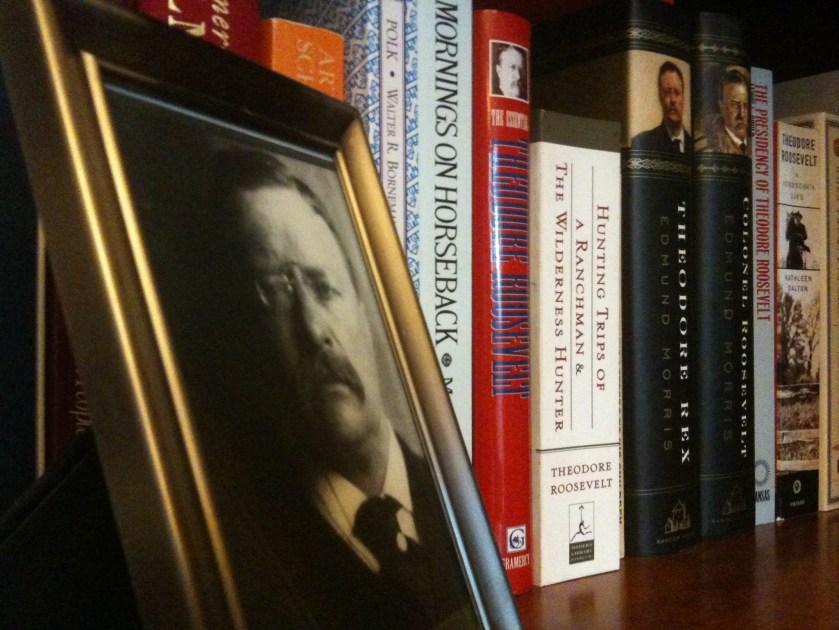
In early April, the Theodore Roosevelt Association posted a note on its Facebook page, asking “Ever Wonder What Roosevelt Liked to Read?”

“Oh, yes,” I replied aloud. “I’m always interested.”

The note began, “In 1905, a contributor to The Century Magazine (1881-1930), reported a two-year ‘pretty full, but far from complete’ list of what the president had read (or reread), ‘purely for enjoyment’. The list did not include all the books, magazines and papers the president had to read in the daily course of the nation’s business. The list included 83 different authors and approximately a couple hundred volumes, estimating TR devoured 35,000 pages a year or about 100 pages a day. …”

In the book “When Trumpets Call,” Patricia O’Toole explored Roosevelt’s life after his presidency, beginning with his March 1909 African safari. The account includes one of the more famous examples of Roosevelt’s love for books: the so-called Pigskin Library. It was, she wrote, a collection of about 50 volumes “to be taken apart, trimmed at the margins, and bound anew in pigskin, the material he thought most likely to withstand the beating of a year on safari.” Roosevelt stored the books in an alumnium container, and the whole collection weighed less than 60 pounds.

During the expedition “TR read with the intensity he gave to everything else,” O’Toole wrote, “his wattage focused on the book. He read before going to sleep at night, on rainy afternoons, aboard trains and ships, and whenever he needed a few minutes’ escape. The Pigskin Library was stocked with reading matter that took time to ingest,” including Homer, Dante, novels by Walter Scott, poetry from Keats and Browning, the works of Shakespeare and Mark Twain and Dickens, and works in their original French, German or Italian — languages in which he was fairly fluent. “He always carried a book into the field, reading under a tree during the noonday halt or next to a fresh kill as he waited” for the team that skinned his safari trophies.

The library would grow as the intense weeks and months in Africa passed, absorbing works from Montaigne, Cervantes and Charles Darwin, among many others. In “Colonel Roosevelt,” Edmund Morris wrote that by mid-August, the “intense physicality of Africa so stimulates (Roosevelt) intellectually that he has already read most of his Pigskin Library — some covers stained with blood, oil, ashes and sweat till they look like saddle leather.”

Volume 14 of the Memorial Edition of “The Works of Theodore Roosevelt” collected his literary essays, including one on the Pigskin Library (page 463). “[The books] were for use,” Roosevelt wrote, “not ornament. I almost always had some volume with me, either in my saddle-pocket or in the cartridge-bag which one of my gun-bearers carried to hold odds and ends. Often my reading would be done while resting under a tree at noon, perhaps beside the carcass of a beast I had killed, or else while waiting for camp to be pitched …”

Like the many books he took on other long trips, there were no complex reasons for selecting the books he took to Africa. “The choice,” he recalled in the essay, “would largely depend upon what I had just been reading.” Collections of German poetry would inspire Roosevelt to take more German poetry. Essays on Greek history would inspire him to take works by Polybius, the Greek historian. Reading Melville’s “Typee” would inspire him to read “Moby Dick” once again.

Having offered a casual list of his favorite books, Roosevelt’s essay segued into comments on Harvard President Charles Eliot’s then-recently published 50-volume Harvard Classics. “Let me repeat,” he said near the end of his observations, “that Mr. Eliot’s list is a good list, and that my protest is merely against the belief that it is possible to make any list of the kind which shall be more than a list as good as many scores or many hundreds of others.” Eliot’s list seemed too stuffy and too bland for Roosevelt, who loved funny novels as much as dense classical texts. “There are many thousands of good books” Roosevelt concluded, “and any list of such books should simply be accepted as meeting a given individual’s needs under given conditions of time and surroundings.”

I think Roosevelt sometimes saw himself as the perfect intellectual and moral example for his countrymen to follow on their march into the new century. Throughout his strenuous life, Roosevelt felt starved not only for the culture, literature, landscape and character of his own nation and society but for the world’s as well. If Americans were to emerge as the new leaders of the international community, they had to push themselves farther and expand their intellects beyond borders, oceans and languages, just like he had done. An expansive and ravenous intellect was, for Roosevelt, the foundation for a fully formed citizen of the world — certainly far too big to be limited to petty and proper Harvard book lists. Like him, that citizen was always reaching out for more, desperate to taste new writers, new opinions, and new challenges to preconceived notions. Life was too short — and too much fun — for anything less.

Total immersion

One of the several excellent books I read on my recent tour of Turkey was Orhan Pamuk’s memoir “Istanbul.” It’s a wonderful exploration of the sad, crumbling remnant of a city in which his childhood and early adulthood was rooted, and the novelist and Nobel laureate remains both enamored with and haunted by its grim and powerful dominance over his life.

One of the several excellent books I read on my recent tour of Turkey was Orhan Pamuk’s memoir “Istanbul.” It’s a wonderful exploration of the sad, crumbling remnant of a city in which his childhood and early adulthood was rooted, and the novelist and Nobel laureate remains both enamored with and haunted by its grim and powerful dominance over his life.

One of my favorite passages is a moment of black humor from Chapter 22, titled “On the Ships That Passed Through the Bosphorus, Famous Fires, Moving House, and Other Disasters,” where he recalls, during research for this book, reading old newspaper articles about people killing themselves by jumping into or otherwise ending up in the Bosphorus.

“However many cars that have flown into the Bosphorus over the years, the story is always the same: It’s passengers are dispatched to the watery depths, from where there is no return. …

“I should remind readers that, once cars start sinking, it’s impossible to open their doors because the pressure of the water against them is too great. At a time when an unusual number of cars were flying into the Bosphorus, one refined and thoughtful journalist, wishing to remind readers of this fact, did something rather clever: He published a survival guide, complete with beautifully drawn illustrations:

” ‘HOW TO ESCAPE FROM A CAR THAT’S FALLEN INTO THE BOSPHORUS
” ‘1. Don’t panic. Close your window and wait for your car to fill with water. Make sure the doors are unlocked. Also ensure that all passengers stay very still.
” ‘2. If the car continues to sink into the depths of the Bosphorus, pull up your hand brake.
” ‘3. Just as your car has almost filled with water, take one final breath of the last layer of air between the water and the car roof, slowly open the doors, and, without panicking, get out of the car.’ “

Pamuk concludes wryly, “I’m tempted to add a fourth pointer: With God’s help, your raincoat won’t get caught on the hand brake.”

“Istanbul” is a beautiful book. I’d also recommend Pamuk’s short stories, some published in the New Yorker, and his Nobel Prize acceptance speech, “My Father’s Suitcase,” also reprinted in the magazine.

Rebecca Aguilar

#CallingAllJournalists Initiative | Reporter | Media Watchdog | Mentor | Latinas in Journalism

Anna Fonte's Paper Planes

Words, images & collages tossed from a window.

Postcards from Barton Springs

Gayle Brennan Spencer - sending random thoughts to and from South Austin

The Flask Half Full

Irreverent travelogues, good drinks, and the cultural stories they tell.

Government Book Talk

Talking about some of the best publications from the Federal Government, past and present.

Cadillac Society

Cadillac News, Forums, Rumors, Reviews

Ob360media

Real News That Matters

Mealtime Joy

bringing joy to family meals

Øl, Mad og Folk

Bloggen Øl, Mad og Folk

a joyous kitchen

fun, delicious food for everyone

A Perfect Feast

Modern Comfort Food

donnablackwrites

Art is a gift we give ourselves

Fridgelore

low waste living drawn from food lore through the ages

BeckiesKitchen.com

MUSINGS : CRITICISM : HISTORY : NEWS

North River Notes

Observations on the Hudson River as it passes through New York City. The section of the Hudson which passes through New York is historically known as the North River, called this by the Dutch to distinguish it from the Delaware River, which they knew as the South River. This stretch of the Hudson is still often referred to as the North River by local mariners today. All photos copyright Daniel Katzive unless otherwise attributed. For more frequent updates, please follow northriverblog on Facebook or Instagram.

Flavorite

Where your favorite flavors come together