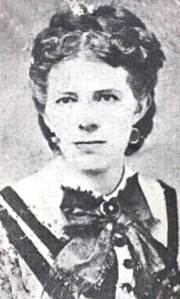
Loreta’s Civil War: Lavish affection bestowed upon me

Velazquez realizes she is willing to pay any price to begin her new life with her beloved, even in the face of family rejection.

KS33

Throughout 2016 and 2017, Stillness of Heart will share edited excerpts from the extraordinary memoir of Loreta Janeta Velazquez, who chronicled her adventures throughout the Civil War — either as herself, as a Confederate spy, or in disguise as Confederate Lt. Harry T. Buford. She fought and led men in terrible battles, fell in love, bore and lost children, and traveled throughout the U.S. and Europe, ultimately fulfilling her childhood dream of a rich and adventurous life.

You can read the entire 1876 memoir online here. Learn more about Velazquez (and the incredible documentary film Maria Agui Carter made about her) here.

Part 3: Velazquez realizes she is willing to pay any price to begin her new life with her beloved, even in the face of family rejection.

******

When my lover began to appear at my aunt’s as a pretty constant visitor, Raphael was quick to suspect him as a rival, who was more highly appreciated than himself, and became furiously jealous. I cannot tell what torture I suffered in endeavoring to be amiable to a man whom I hated, in order that I might prevent an explosion which would deprive me of the society of the one I really loved with the most devoted fondness. Finally Raphael, unable to endure the sight of his rival constantly in attendance upon me, and evidently finding extreme favor in my eyes, prevailed upon my aunt to forbid him admittance to the house, on the plea that he was becoming altogether too intimate with the betrothed of another. This gratified Raphael’s malignity, and it was a severe blow to both of us. …

In spite of my aunt’s endeavors to keep us apart, and in spite of Raphael’s jealous vigilance, William — for that was my lover’s name — found means to carry on a correspondence with me, to meet me at the houses of mutual friends, and to speak to me on the street on my way to and from school. …

[O]ne evening, as I was sitting at my window, in company with a young French Creole girl, I saw William pass and look up. I waved my handkerchief in salutation, and he recognized the signal by raising his cap. I then asked the young lady if she would not do me the favor of taking a letter to him, and of permitting us to have an interview at her home. She readily consented; and carrying a hastily written note to William, soon returned with an answer, to the effect that he would meet me in an hour’s time. My aunt did not permit me to go out alone in the evening; but as she suspected nothing wrong in the proposed visit to my friend’s house, she consented, without hesitation, for me to go under the escort of one of the servants. As my escort, of course, on our arrival at the rendezvous, remained with the servants of the house, I was able to converse with William without fear of espial, or of being interrupted.

My lover informed me that he expected soon to be ordered to one of the frontier posts. He declared that he could not exist without me, and proposed that we should elope, and get married privately. As this was my own plan exactly, I gave my consent, without any hesitation, the moment the proposition was made. On a little reflection, however, my conscience began to trouble me, for I knew that I should not be doing right; so I told him I would prefer that he should make an open and straightforward proposition for my hand to my parents. I considered that it was a duty I owed them to ask their consent first, but promised, if they opposed the marriage, that I would not let their disapprobation interfere with the consummation of our wishes. William himself thought that this was the proper and honorable course to pursue, and he accordingly wrote to my father, and asked his permission to marry me. A reply to his request was not long forthcoming, in which he was reprimanded in very harsh terms for daring to make it, knowing me to be the betrothed of another. This settled the matter; and accordingly, on the 5th of April, 1856, we were clandestinely married. …

My aunt was extremely indignant; and finding me obdurate, threatened to put me in the convent at Baton Rouge. I was terribly frightened at this, and concluded that it was time for me to act with decision. I accordingly informed my husband of the situation, and he came immediately and claimed me as his wife, presenting the certificate of marriage to my horror-stricken relative.

This was a terrible blow to my aunt, but a greater one to my parents, especially to my father, who idolized me. My father’s indignation got the better of his affection, and he promptly informed me that I might consider myself as repudiated and disinherited. The pangs this cruel message caused me were intense, but I was consoled with the lavish affection bestowed upon me by my handsome young husband, and with the thought that, in course of time, my parents would relent, and be willing to again receive me as their daughter. …


Loreta’s Civil War: The woman in battle

Throughout 2016, “Stillness of Heart” will share edited excerpts from the extraordinary memoir of Loreta Janeta Velazquez, who chronicled her adventures throughout the U.S. Civil War — either as herself, as a Confederate spy, or in disguise as Confederate Lt. Harry T. Buford.

KS59

Throughout 2016, Stillness of Heart will share edited excerpts from the extraordinary memoir of Loreta Janeta Velazquez, who chronicled her adventures throughout the U.S. Civil War — either as herself, as a Confederate spy, or in disguise as Confederate Lt. Harry T. Buford. She fought and led men in terrible battles, fell in love, bore and lost children, and traveled throughout the U.S. and Europe, ultimately fulfilling her childhood dream of an adventurous life.

You can read the entire 1876 memoir online here. Learn more about Velazquez (and the incredible documentary film Maria Agui Carter made about her) here.

Part 1: Velazquez introduces us to her life, her heroes, and her aspirations. She is ambitious, confident, romantic, and determined to live life on her terms.

******

The woman in battle is an infrequent figure on the pages of history, and yet, what would not history lose were the glorious records of the heroines — the great-souled women, who have stood in the front rank where the battle was hottest and the fray most deadly — to be obliterated? When women have rushed to the battlefield they have invariably distinguished themselves; and their courage, their enthusiasm, and their devotion to the cause espoused, have excited the brave among the men around them to do and to dare to the utmost, and have shamed the cowards into believing that it was worthwhile to peril life itself in a noble cause, and that honor to a soldier ought to be more valuable than even life.

The records of the women who have taken up arms in the cause of home and country; who have braved the scandals of the camp; who have hazarded reputation — reputation dearer than life — and who have stood in the imminent deadly breach, defying the enemy … are glorious nevertheless; and if steadfast courage, true-hearted loyalty, and fiery enthusiasm go for anything, women have nothing to blush for in the martial deeds of those of their sex who have stood upon the battlefield. …

Catalina de Eranso, the Monja Alferez, or the nun-lieutenant, who was born in the city of Sebastian, Spain, in 1585, was one of the most remarkable of the heroines who have distinguished themselves by playing the masculine role, and venturing into positions of deadly peril. This woman, becoming disgusted with the monotony of convent life, made her escape, and in male garb joined one of the numerous expeditions then fitting out for the New World. Her intelligence and undaunted valor soon attracted the notice of her superior officers, and she was rapidly promoted. Participating in a number of hard-fought battles, she won the reputation of being an unusually skillful and daring soldier, and would have achieved both fame and fortune, were it not that her fiery temper embroiled her in frequent quarrels with her associates. …

After traversing a large portion of the New World, and encountering innumerable perils, she returned to Europe, where she found that the trumpet of fame was already heralding her name, and that there was the greatest curiosity to see her. Traveling through Spain and Italy, she had numerous exceedingly romantic adventures, and while in the last named country she managed to obtain an interview with Pope Urban VIII., who was so pleased with her appearance and her conversation that he granted her permission to wear male attire during the balance of her life. …

From my early childhood Joan of Arc was my favorite heroine; and many a time has my soul burned with an overwhelming desire to emulate her deeds of valor, and to make for myself a name which, like hers, would be enrolled in letters of gold among the women who had the courage to fight like men — ay, better than most men — for a great cause, for friends, and for fatherland.

At length an opportunity offered, in the breaking out of the conflict between the North and the South in 1861, for me to carry out my long-cherished ideas; and it was embraced with impetuous eagerness, combined with a calm determination to see the thing through, and to shrink from nothing that such a step would involve. …

So many persons have assured me that my story is full of romance, and that it cannot fail to interest readers both South and North. … they will find in these pages an unaffected and unpretending but truthful and I hope interesting narrative of what befell me while attached to the army of the Confederate States of America, and while performing services other than those of a strictly military character under the pseudonym of Lieutenant Harry T. Buford. …

[I]t is probable that a vast number of my late associates will now for the first time learn that the handsome young officer — I was accounted an uncommonly good-looking fellow, when dressed in my best uniform, in those days — was a woman, and a woman who was mentally making some very uncomplimentary notes with regard to much of their very naughty conversation. My experience is that the language used by the very best men in masculine society is too often not such as pure-minded women would like to listen to, while that of the worst is so utterly revolting, that it is a pity some men cannot always have decent women at their elbows to keep their tongues from being fouled with blasphemy and obscenity. …

1864: Day to Day

Exiled in Texas, Kate Stone refused to dwell on death. ‘People do not mourn their dead as they used to,’ she wrote. ‘Everyone seems to live only in the present — just from day to day — otherwise I fancy many would go crazy.’

This is Part 4 of a five-part essay series on Kate Stone and her Civil War which was modified from a paper I presented at the New York Military Affairs Symposium in October 2011.

Learn more about Stone’s amazing life in 1861, 1862, 1863, 1865 and beyond. Click on each year to read more about her experiences.

As the war ground on into 1864, the men and women around Stone made the most of their lives of exile in East Texas. Dances were held. Men and women married. new boys studied for classes.

In Tyler, Texas, Stone cleaned the house, played chess, and read. The wall Stone built in her mind to hold back the crush of mounting tragedies in the Eastern Theater became a permanent fixture. Not even the drama of death breached the barrier anymore.

(Photo edited by Bob Rowen)

“People do not mourn their dead as they used to,” she wrote. “Everyone seems to live only in the present — just from day to day — otherwise I fancy many would go crazy.”

In 1864, Confederate victories brightened the situation in the Trans-Mississippi Theater. In the spring of 1864, Federal forces under Maj. Gen. Nathaniel Banks began the Red River Campaign, in which Federal forces from Vicksburg, New Orleans and Arkansas were supposed to meet near Shreveport, seize Louisiana once and for all, amputate Texas from the Confederacy, and then abort any nascent relationship between the Confederacy and the French-controlled Mexican government.

But the plan failed to consider Confederate audacity. In early April 1864, Maj. Gen. Taylor beat back the Federal invasion at the Battles of Mansfield and Pleasant Hill.

Stone practically leapt for joy in her journal. “It is our first great success on this side of the river. … We will never laugh at our soldiers on this side of the Mississippi again. …”

The Confederate conscription act lowered the age range for enlistment to seventeen, and in August, Kate Stone lost a third brother to the Confederate Army. James Stone joined a unit named Harrison’s Brigade at Monroe, La.

She and her mother accompanied him to Louisiana, and Federal raids through the area frightened her, especially when conducted by black soldiers.

“The Paternal Government at Washington,” she wrote, “has done all in its power to incite a general insurrection throughout the South, in the hopes of thus getting rid of the women and children in one grand holocaust. We would be practically helpless should the Negroes rise, since there are so few men left at home.”

******

Works cited or consulted for this essay series:
Faust, Drew Gilpin. Mothers of Invention: Women of the Slaveholding South in the American Civil War. Chapel Hill: North Carolina UP, 1996. Print.
. Southern Stories: Slaveholders in Peace and War. Columbia, Mo.: University of Missouri, 1992. Print.
Foote, Shelby. The Civil War: A Narrative. New York: Vintage, 1986. Print.
Johnson, Ludwell H. Red River Campaign: Politics and Cotton in the Civil War. Baltimore: Johns Hopkins, 1958. Print.
Kronk, Gary W. “C/1861 J1 (Great Comet of 1861).” Cometography.com. n.d. Web. 11 Sept. 2011.
Long, E.B. and Barbara Long. The Civil War: Day by Day. Garden City, N.Y.: Doubleday, 1971. Print.
McPherson, James M., ed. The Atlas of the Civil War. New York: Macmillan, 1994. Print.
. Battle Cry of Freedom. New York: Oxford UP. 1988. Print.
Parrish, T. Michael. Richard Taylor: Soldier Prince of Dixie. Chapel Hill: North Carolina UP. 1992. Print.
Stone, Kate. Brokenburn: The Journal of Kate Stone, 1861-1868. Ed. John Q. Anderson. Baton Rouge: Louisiana UP. 1995. Print.
Sullivan, Walter. The War the Women Lived: Female Voices from the Confederate South. Nashville: J.S. Sanders & Company. 1995. Print.
Wilson, Edmund. Patriotic Gore: Studies in the Literature of the American Civil War. New York: W.W. Norton, 1962. Print.
Wooster, Ralph A. Civil War Texas. Texas State Historical Association. 199. Print.

Kate Stone’s Civil War: They call us all renegades

Two carriage accidents, a large rattlesnake, and a dirty house all inspire Stone to call Texas “the dark corner of the Confederacy.”

KS33

From 2012 to 2015, Stillness of Heart will share interesting excerpts from the extraordinary diary of Kate Stone, who chronicled her Louisiana family’s turbulent experiences throughout the Civil War era.

Learn more about Stone’s amazing life in 1861, 1862, 1863, 1864, 1865 and beyond. Click on each year to read more about her experiences. You can read the entire journal online here.

(Photo edited by Bob Rowen)

Two carriage accidents, a large rattlesnake, and a dirty house all inspire Stone to call Texas “the dark corner of the Confederacy.”

Aug. 30, 1863

“Elysian Fields,” Lamar County, Texas

I must record the first instance of liberality that has come under our notice since entering the state. The first night after leaving Tyler we stayed at a Mr. Fowler’s, a very nice place, and they did not charge us a cent. But we were picked up the next night. We lost our way and traveled until 8 o’clock when we asked to stay at a pretty, large, white house, white only on the outside. I despair of giving any idea of the dirt. We tried to eat without seeing or tasting and to sleep without touching the bed. They gave us coffee, a horrid decoction of burnt wheat and milk without sugar, in saucers and water in the halves of broken bottles. The table was set in the dirtiest of kitchens with a dirt floor and half a dozen half-naked little Negroes and numberless cats and dogs scampering through the room and under the table. The rafters were festooned with old hoop skirts and worn-out, rough boots. It surpassed any place we have been in yet. We certainly had found the dark corner of the Confederacy.

We lost our way again one evening and traveled until way in the night, through a wild woods road dotted with stumps. But it was cool and bright moonlight and really more pleasant than a stuffy dirty room, but the mules and Hoccles did not enjoy it.

Our next adventure was not so pleasant. The mules were rushing down a long, rocky, red hill. Hoccles is a wretched driver and lets them do pretty much as they please when crash! over went the Jersey, and we rolled out on the ground, along with a confused medley of baskets, bundles, palmetto, corn, bonnets, and boxes. Fortunately no serious damage was done, and after a few repairs to the Jersey we journeyed on. Hoccles is a right good tinker for wagons.

But our troubles were not yet over. The mules were trotting briskly along through the white sand, Mamma was asleep sitting in the foot of the Jersey, and I was knitting away, when there was a sudden cluck and tearing sound. I looked up to see the whole top of our devoted Jersey folding back like a fan. While Hoccles was nodding in the sultry heat, we had run into a tree and broken the top nearly entirely off. Mamma gave a groan and exclaimed, “Now Hoccles, just run us over a stump and break the wheels and maybe you will be satisfied. You have broken the bottom racing down the hill. But that would not do you. You had to go and break the top. Now run over a rock and break the wheels and you will be fixed!”

I could not help laughing. It was funny in spite of our bad plight, and poor Hoccles looked so humble and apologetic. We thought he would be forced to take the entire top off, but he was equal to the emergency. With hammer, nail, and strings, he patched it up so it lasted until we reached home. But it is a most forlorn, lopsided affair. If we just had our own good carriage, but we hear it is a smallpox ambulance now.

Our last day we just missed driving over the largest rattlesnake, stretched across the road basking in the sun. It was larger than my arm and had twelve rattles. That frightened us most of all. It might have glided into the carriage as we drove over it. …

A long letter from Julia Street was awaiting me. … She says she hates Arkansas and wants to come to Texas. I am sure she will hate this state ten times more. If she is a wise girl, she will stay where she is as long as possible. The more we see of the people, the less we like them, and every refugee we have seen feels the same way. They call us all renegades in Tyler. It is strange the prejudice that exists all through the state against refugees. We think it is envy, just pure envy. The refugees are a nicer and more refined people than most of those they meet, and they see and resent the difference. That is the way we flatter ourselves. …

Kate Stone’s Civil War: My pen is powerless

Stone had little respect for anyone who lacked her sense of style and bearing. She hardly sympathized with the people of East Texas.

KS31

From 2012 to 2015, Stillness of Heart will share interesting excerpts from the extraordinary diary of Kate Stone, who chronicled her Louisiana family’s turbulent experiences throughout the Civil War era.

Learn more about Stone’s amazing life in 1861, 1862, 1863, 1864, 1865 and beyond. Click on each year to read more about her experiences. You can read the entire journal online here.

(Photo edited by Bob Rowen)

Stone had little respect for anyone who lacked her sense of style and bearing. She hardly sympathized with the people of East Texas.

Aug. 16, 1863

“Elysian Fields,” Lamar County, Texas

We went to church this morning at a tumbledown schoolhouse called Liberty expecting to hear the funeral sermon of Mrs. Alexander, who was a near neighbor. The poor woman has been dead four months, and her husband married again six weeks after her death. But he says he is determined to pay proper respect to dear Mary and so will have her funeral preached, with the new wife sitting decorously near to hear it.

It was the oddest-looking crowd one could imagine, and the very funniest dressing we ever saw. My pen is powerless to describe it: one girl airy in pink tarleton and another sweltering in red woolen; high horn combs with long ribbon streamers waving from the top; immense hoops; and strand after strand of beads, all colors, wound around their necks.

Many of the men were barefooted, and nearly all of their slouched wool hats were decorated with ribbons or an artificial flower. There were few coats but many vests and a display of homemade knit galluses. It was a most unusual-looking crowd, all sitting on puncheons laid on supports, some of them constantly slipping down. …

Kate Stone’s Civil War: Conquer or die

As a Texas summer storm approaches, Stone angrily vows that the Confederacy will never surrender to the Union forces that shattered her family.

OLYMPUS DIGITAL CAMERA

From 2012 to 2015, Stillness of Heart will share interesting excerpts from the extraordinary diary of Kate Stone, who chronicled her Louisiana family’s turbulent experiences throughout the Civil War era.

Learn more about Stone’s amazing life in 1861, 1862, 1863, 1864, 1865 and beyond. Click on each year to read more about her experiences. You can read the entire journal online here.

(Photo edited by Bob Rowen)

As a Texas summer storm approaches, Stone angrily vows that the Confederacy will never surrender to the Union forces that shattered her family.

Aug. 10, 1863

Lamar County, Texas

Nearly the close of summer and we are still in our first Texas retreat. We have dubbed it “Elysian Fields.” Mr. Smith has been away nearly a week looking for another location. No matter where we may go, we are almost sure to meet some of our old friends or acquaintances, for everybody about Monroe is moving out this way, we hear, scattering over Texas. How good the sight of a familiar face will be. I would feel like kissing nearly anybody I had ever seen before. …

Our list of victories last month were all a mistake. Gen. Lee has recrossed into Virginia, and our march into Pennsylvania seems to have been barren of results. We do not hold nor have we destroyed a single Northern city, as we so much hoped. A dark hour for the Confederacy. The loss of Vicksburg has stunned the whole country. It is a grievous blow, and there is great discouragement at least on this side of the Mississippi River. But the reaction will come. The people will rally to strike a more deadly blow, to fight till the last armed foe expires, to conquer or die.

Mamma, Sister, and Johnny are just in from their round of investigation. Instead of renting Mrs. White’s house they rented a book. The house was already taken, but she had quite a library of books that she would hire out for fifty cents a week. She would not think of lending them. The book Mamma brought was a most worthless thing, but the engravings in it are fine. Mrs. White is an educated woman, lives in a nice house, and is well to do, but a regular skinflint. She is living from day to day on the verge of the grave, suffering from some incurable complaint, and is still very eager to make money, extorting the last cent. She has one of our women hired to wait on her. She is a Yankee. That explains all. …

We look out tonight on a windy, stormy sky. Dark clouds go scudding by, and the wind whistles through our frail tenement. The boards have shrunken until daylight shines through. Lightning flashes continuously, thunder is rolling overhead, and the whole prairie is ablaze with the fireflies, weaving in and out like fairy shuttles.

Kate Stone’s Civil War: Lose our scalps

Stone’s critical eye takes in a town’s beauty, overpriced luxuries, her brother’s love, and a gentleman’s proper language use.

KS29

From 2012 to 2015, Stillness of Heart will share interesting excerpts from the extraordinary diary of Kate Stone, who chronicled her Louisiana family’s turbulent experiences throughout the Civil War era.

Learn more about Stone’s amazing life in 1861, 1862, 1863, 1864, 1865 and beyond. Click on each year to read more about her experiences. You can read the entire journal online here.

(Photo edited by Bob Rowen)

Stone’s critical eye takes in a town’s beauty, overpriced luxuries, her brother’s love, and a gentleman’s proper language use.

Aug. 3, 1863

Lamar County, Texas

Paris is a clean, pretty place in the edge of Blossom Prairie — clumps of trees and deep white sand in the streets.

We went to church and saw a really nice-looking congregation of refined-looking people. We all liked the place so well that Mamma would rent a place there, but it is too near the borderline, the first point for an invasion and right next to the Indian Nation. We do not wish to lose our scalps in addition to everything else. We saw a large party of Indian men dashing through the town. They are nearly all Southern sympathizers, we hear.

We went shopping. There are several well-filled stores, but the prices are beyond anything. We saw a pretty light calico but Mamma could not afford it at $6 a yard. A penknife was very tempting, but who would give $25 for a little Yankee knife? Our nails will have to grow like eagle’s claws before we can afford an extravagance of that kind. We did get a few articles, absolute essentials, and Mamma indulged me in a piece of extravagance a deck of playing cards at $5. They are a different kind from those the girls use out here, but I fancy they will afford us more amusement than the finest pair of cotton cards.

A gentleman gave us a late Louisiana paper containing Mary Gustine’s marriage on July 21. I know she was a beautiful bride, and our best wishes go with her for her future happiness. I wonder how Brother Coley will stand the loss of his sweetheart, his first love affair. Like most boys, he lost his heart to a girl several years the older — fortunately a disease that never kills a boy of that age.

The Baptist meeting has been going on in Paris for seven weeks, and sixty have joined that church. It seems the strongest church of this section. Sunday morning we heard a splendid sermon, the best since hearing Dr. Marshall preach two years ago. I wish Jimmy could have heard it. It was the first real Baptist sermon I ever really listened to. Have heard the preacher, Mr. Buckner — knows what he believes and is not afraid to preach it from the pulpit.

We have made the acquaintance of another Texas gallant. Dr. Bywaters, introduced as a friend by Mr. McGleason, walked home with us from church. One thing in his favor: he does not say “mile” for “miles,” and he does not ignore the plural of “year.”

Kate Stone’s Civil War: Makes us tremble for Texas

Stone at last confirms the Confederate defeat at Vicksburg, three weeks later. In her mind, Robert E. Lee is the only Confederate commander that still holds the torch of hope for final victory.

KS28

From 2012 to 2015, Stillness of Heart will share interesting excerpts from the extraordinary diary of Kate Stone, who chronicled her Louisiana family’s turbulent experiences throughout the Civil War era.

Learn more about Stone’s amazing life in 1861, 1862, 1863, 1864, 1865 and beyond. Click on each year to read more about her experiences. You can read the entire journal online here.

(Photo edited by Bob Rowen)

Stone at last confirms the Confederate defeat at Vicksburg, three weeks later. She and her mother worry about the vulnerability of Texas to Union forces. More immediately, they’re worried for their family. If Texas is invaded, how much farther west should they go to escape emancipating Union forces? In Stone’s mind, Robert E. Lee is the only Confederate commander that still holds the torch of hope for final victory.

As Stone bemoans the lack of decent shoes, she gets in one more dig at barefooted Texan women.

July 29, 1863

Lamar County, Texas

Vicksburg is taken without a doubt. If our men had held out only one day longer, they might have been relieved, as Gen. Johnston fought the enemy the following day, in ignorance of the fall of the city, taking 5,000 prisoners and winning a decided victory. But that is not an offset to the 20,000 of our men said to have been captured at Vicksburg. How has the mighty fallen, and to give up on the Fourth of July to make it even worse. We wish they could have held on at least one day longer, but we know nothing of the hardships our soldiers have endured there in the last eight months. We are satisfied, however, that the Confederate soldiers held on as long as possible. The fall of Vicksburg makes us tremble for Texas. She can be invaded from so many points that Mamma knows not where to look for a place of greater safety.

Our only hope is in Lee the Invincible. If he has only taken Washington or Philadelphia as we hear he has, we can stand the loss of our Gibraltar, but to lose it and gain nothing in return is insupportable. We will hope for the best. May God defend the right. …

July 31

Mamma has been sick since her return. … Tomorrow we are going up to Paris with Mr. Smith to see if Mamma can get him off from militia duty. He is drafted to go off on Wednesday for six month’s service. We do not see how Mamma can get on without him, and so she is anxious to get him detailed. Mrs. Smith is also anxious to get him off, but their eagerness is as nothing to Mr. Smith’s. I never saw a man with such a dread of the army.

The fruit that Mamma and Mr. Smith collected on their journey and they were most thoughtful is just out. We did so enjoy it. Our fare is not of the best. Mamma bought me a pair of $25 shoes, but unfortunately I cannot wear them. Not anything of a fit, and I must still cling to my calfskin chaussures, homeknit stockings, and brogans, something different from the lace-like clock stockings and French slippers of the olden times. I miss nice things for my feet now more than anything. I feel so slovenly with these horrors on exhibition. But a truce to complaints. I might be dight out in a large hoop and bare feet.

Kate Stone’s Civil War: Despondent and chicken-hearted

Stone is wary of “chicken-hearted” rumors of a defeat at Vicksburg. She also receives her first “Texas beau.”

KS27

From 2012 to 2015, Stillness of Heart will share interesting excerpts from the extraordinary diary of Kate Stone, who chronicled her Louisiana family’s turbulent experiences throughout the Civil War era.

Learn more about Stone’s amazing life in 1861, 1862, 1863, 1864, 1865 and beyond. Click on each year to read more about her experiences. You can read the entire journal online here.

(Photo edited by Bob Rowen)

Stone is wary of “chicken-hearted” rumors of a defeat at Vicksburg. She also receives her first “Texas beau.”

July 26, 1863

Lamar County, Texas

I had my first call from a Texas beau yesterday evening.

A smooth-faced, rosy-cheeked, young dandy, dressed in the height of Paris fashion and dotingly proud of his jet-black imperial. Several of the elite of Blue’s Prairie have called on us. I wonder, shall we look as old-fashioned as they after a year or two of prairie life? Even Blue’s Prairie is looking lovely now. It is covered with a flower, looking like feathery, white plumes laced and tangled together with a yellow love vine and purple maypop vines.

There are some most disquieting rumors believed by the despondent and chicken-hearted, but we do not give them credence. It is said both Vicksburg and Port Hudson have been taken, with a number of prisoners. We have heard it affirmed and contradicted half a dozen times. We will wait to see Gen. Johnston’s official report of such disaster before believing it.

Unionism is rampant about here. There was a company of Jayhawkers for the Federal side raised in this county. Half of the militia have been drafted for six months, and oh, the moaning and bewailing of the feminine population. But I cannot be sorry for the militia. My sympathies are all with the soldiers in the field.

Kate Stone’s Civil War: Scowling, revengeful faces

One minor but interesting element of Stone’s diary is how long it took for her to learn of developments on the battlefield.

KS26

From 2012 to 2015, Stillness of Heart will share interesting excerpts from the extraordinary diary of Kate Stone, who chronicled her Louisiana family’s turbulent experiences throughout the Civil War era.

Learn more about Stone’s amazing life in 1861, 1862, 1863, 1864, 1865 and beyond. Click on each year to read more about her experiences. You can read the entire journal online here.

(Photo edited by Bob Rowen)

One minor but interesting element of Stone’s diary is how long it took for her to learn of developments on the battlefield. As her old world crumbled, as she was cut off from traditional letters and newspapers, and as she moved farther and farther away from Brokenburn, it took longer for her to learn about rumors of defeats and victories and even longer to gain accurate information about such events.

For example, the Battle of Gettysburg ended on July 3, 1863, and Vicksburg surrendered to Grant’s siege on July 4. Note what Stone says of Lee in Pennsylvania and of Vicksburg’s defenders, almost two weeks after both Confederate defeats.

July 16, 1863

Lamar County, Texas

The atmosphere has been most peculiar for several days. The air is cool and damp. The earth, the air, the sky — all are a dull dead grey. The sun seems to emit neither heat nor light, gleaming with a dim red glare like a blood-red moon. We thought at first it was one phase of the Texas climate, but the natives are as much puzzled by it as the strangers in the land. Some think it portentous, a sign of great victories or defeats. Others think it the smoke from burning grain in Mississippi. No one really knows anything about it.

We hear that we have won a glorious victory back of Vicksburg, repulsing one wing of Grant’s army and opening communication with Vicksburg and replenishing her supplies. Also we hear of surprising the enemy in south Louisiana and capturing many men and stores. We also hear that Gen. Lee’s army is laying waste [to] Pennsylvania. If only the Pennsylvanians may feel some of the horrors of war and know the bitterness of defeat. We live in hopes that our day of triumph may come but we fear not in the near future. …

Texas seems a hard land for women and children. They fly around and work like troopers while the men loll on the galleries and seemingly have nothing to do. Mamma cannot start on her search for a new home for a week yet, and it is disagreeable living here … their ways are not our ways.

As we sat on the gallery tonight, gazing across the darkening prairie into the gleaming west, the very air was brilliant with fireflies. The fancy came that they were the eyes of the departed Indians, come to look again on their old hunting grounds, flashing through the night, looking with scowling, revengeful faces on the changes wrought by their old enemies, the palefaces. I fancy I can see the ghostly shapes one minute taking the form of an Indian brave with bended bow and flying arrow, the next fading into thin air leaving only the fiery eyes. …

Rebecca Aguilar

#CallingAllJournalists Initiative | Reporter | Media Watchdog | Mentor | Latinas in Journalism

Anna Fonte's Paper Planes

Words, images & collages tossed from a window.

Postcards from Barton Springs

Gayle Brennan Spencer - sending random thoughts to and from South Austin

The Flask Half Full

Irreverent travelogues, good drinks, and the cultural stories they tell.

Government Book Talk

Talking about some of the best publications from the Federal Government, past and present.

Cadillac Society

Cadillac News, Forums, Rumors, Reviews

Ob360media

Real News That Matters

Mealtime Joy

bringing joy to family meals

Øl, Mad og Folk

Bloggen Øl, Mad og Folk

a joyous kitchen

fun, delicious food for everyone

A Perfect Feast

Modern Comfort Food

donnablackwrites

Art is a gift we give ourselves

Fridgelore

low waste living drawn from food lore through the ages

BeckiesKitchen.com

MUSINGS : CRITICISM : HISTORY : NEWS

North River Notes

Observations on the Hudson River as it passes through New York City. The section of the Hudson which passes through New York is historically known as the North River, called this by the Dutch to distinguish it from the Delaware River, which they knew as the South River. This stretch of the Hudson is still often referred to as the North River by local mariners today. All photos copyright Daniel Katzive unless otherwise attributed. For more frequent updates, please follow northriverblog on Facebook or Instagram.

Flavorite

Where your favorite flavors come together