Stone finally embraces in writing her Tyler, Texas, community as she and her mother help residents raise money for home Confederate veterans.
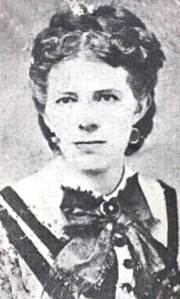
From 2012 to 2015, Stillness of Heart will share interesting excerpts from the extraordinary diary of Kate Stone, who chronicled her Louisiana family’s turbulent experiences throughout the Civil War era.
Learn more about Stone’s amazing life in 1861, 1862, 1863, 1864, 1865 and beyond. Click on each year to read more about her experiences. You can read the entire journal online here.
(Photo edited by Bob Rowen)
Stone finally embraces in writing her Tyler, Texas, community as she and her mother help residents raise money for home Confederate veterans.
It is astonishing, given her vivid condescension to and disdain for Texans recorded in past entries, to see Stone not just befriend Tyler residents but to also dismiss any potential disparagement from her fellow Louisiana refugees.
Note her new friendship with Mollie E. Moore, who will eventually become a celebrated poet and successful writer.
March 3, 1865
Tyler, Texas
Our interest for the last ten days has centered on the all-engrossing theme of tableaux. All the society young folks of the town with Mamma as head and front of the affair are busy getting up an entertainment, tableaux, music, and charades, to raise money for establishing a soldiers’ home. The natives, very unexpectedly, asked us to take part; and as Mamma knows more of such things than all the rest of them put together, she soon found herself sole manager of the affair and I am her [deputy]. I have taken no part but they kindly allow me to attend all rehearsals, and I have had a gay time but for being bored to extremity by Dr. Weir, whom I nearly hate.
We have become acquainted with all the creme de la creme of the city, and from one to a dozen are always dropping in to discuss something or ask Mamma’s advice. I know most of the love affairs of Tyler now. I hope Janie Roberts and Lt. Alexander will make a match. They are very much in love with each other and it would be quite suitable. The young people have rehearsed here several times when it was too bad to go to the church. …
Anna Meagher was asked to play at the entertainment but some feeling of pique prevented her, and they all speak most contemptuously of the whole affair. But we are glad the ice is at last broken, and we are friends with the people of the town. It is far more agreeable, and there are many nice people when one finds them out. Mollie E. Moore, a poetess, is a charming girl and we are becoming quite friends. They live near. The other refugees can laugh at us if they like, but we are having the most enjoyable life. …
More food and supplies finally make it to Tyler, and Stone enjoys a crowded concert, if only to drown out the anguish of recent months.
From 2012 to 2015, Stillness of Heart will share interesting excerpts from the extraordinary diary of Kate Stone, who chronicled her Louisiana family’s turbulent experiences throughout the Civil War era.
Learn more about Stone’s amazing life in 1861, 1862, 1863, 1864, 1865 and beyond. Click on each year to read more about her experiences. You can read the entire journal online here.
(Photo edited by Bob Rowen)
More food and supplies finally make it to Tyler, and Stone enjoys a crowded concert, if only to drown out the anguish of recent months.
Note her details on how the slaves make candles from Texas cactus.
Feb. 15, 1865
Tyler, Texas
Our garrison is reinforced and heavily provisioned. Warren reached here tonight after a six-day trip from the prairie with the long looked-for load of comestibles, and never could they have come in better time. The last flour had just been made up into biscuit in Capt. Birchett’s honor, and meat, sugar, candles, and everything else was waxing low. By the way, the servants make such pretty candles now. The candles look almost like wax. They boil a species of cactus in the tallow, and the candles are partly transparent and brittle and give an excellent clear light. Warren says the roads are nearly impassable. Mamma, when he left the carriage, was bogged down a few miles beyond Quitman, but Warren is satisfied that she will reach here today or tomorrow.
Capt. Birchett, after keeping me at home all day and depriving me of the pleasure of a ride with Dr. Weir, came up to tea and soon after bade us adieu for Shreveport and does not expect to be back for some weeks. We will miss him as he has been very sociable. Jolly Col. Hill and his demure, prim little wife called this morning and later Mrs. Benton and Mrs. St. Clair. No news except Mrs. Alexander, who lately lost her husband, will leave in a few days for San Antonio. And Johnny and I are eager to rent that house by the time Mamma arrives. Such a nice two-story affair with a pretty flower yard and in a nice part of town.
Dr. Weir spent yesterday afternoon here playing chess, and after tea I went with him and Capt. Birchett to a concert. Such a crowd. Not another person could have been crammed in and so many soldiers, but they were quiet and behaved well. The gentlemen all had to stand and my escorts were disgusted.
Stone senses the end of the war is coming soon. She predicts the war will end no sooner than October 1865.
From 2012 to 2015, Stillness of Heart will share interesting excerpts from the extraordinary diary of Kate Stone, who chronicled her Louisiana family’s turbulent experiences throughout the Civil War era.
Learn more about Stone’s amazing life in 1861, 1862, 1863, 1864, 1865 and beyond. Click on each year to read more about her experiences. You can read the entire journal online here.
(Photo edited by Bob Rowen)
Stone senses the end of the war is coming soon. She predicts the war will end no sooner than October 1865.
Feb. 13, 1865
Tyler, Texas
Great Peace rumors are afloat, and Gen. Lee has certainly given Grant’s army a good drubbing. If he could only have annihilated them, we could sing. … God grant our dear boys may be unhurt. Dame Rumor is furloughing every fifth man in the Virginia Army who lives on this side of the Mississippi, and there is so much good news that the multitudes are jubilant. The more hopeful predict peace by July, but I think it will not come before October is painting the woods in autumn hues. What a lovely season it will be to journey home with peace blessed peace quieting all the land and nothing to molest or make us afraid. How joyfully will we take up our line of march for dear old Louisiana. What a merry cavalcade we shall be.
How the shriek of that steam whistle startled me, transporting me for the minute to the bank of the far rolling Mississippi.
Mrs. Bruce must think we are agents for renting houses. A letter from her introducing Capt. Pritchard, and one from him asking us as a great favor to rent a house for his family, who are on the way and will be here in about two weeks. Will wait until Mamma gets back, and then we will go on another house-hunting expedition. It is rather a trying job as the owners of the houses wish us to be responsible for the rent, and in this case we do not even know the people. These wily Texans want to bind one with all kinds of written documents, unintelligible but terrible in my eyes. I would not sign one for anything. Mamma attends to all that. …
Yesterday Little Sister fell off the gallery striking her head on a rock pile, making several deep gashes, and today it pains too much for her to attend school, though she took her music lesson. Little Sally has improved so much. She is a pretty curly-headed little thing with golden hair and blue eyes and is a great pet with us all. But she can never take Beverly’s place in our hearts — the perfect little child only lent to earth to show mortals how fair are the angels in Heaven. …
With Mamma away, Stone remains in command of the Tyler home, and with that duty comes caring for sick friends.
From 2012 to 2015, Stillness of Heart will share interesting excerpts from the extraordinary diary of Kate Stone, who chronicled her Louisiana family’s turbulent experiences throughout the Civil War era.
Learn more about Stone’s amazing life in 1861, 1862, 1863, 1864, 1865 and beyond. Click on each year to read more about her experiences. You can read the entire journal online here.
(Photo edited by Bob Rowen)
With Mamma away, Stone remains in command of the Tyler home, and with that duty comes caring for sick friends.
Feb. 12, 1865
Tyler, Texas
Mamma is still away, and from the condition of the roads we know not when to expect her. We miss her dreadfully, but we have had much company. Mrs. Carson has been sick, and we walk over there nearly every evening. Poor Mr. Alexander died recently, and Mrs. Hull, who had been sitting up all night, sent for me early one rainy morning to come and relieve her. I remained until dark, a most dreary day, for though Mr. Alexander was the merest acquaintance, we felt for his wife and children. The duty of visiting the sick and afflicted is one of life’s greatest trials.
Met a delightful gentleman when I spent the day at Mrs. Savage’s. He is Dr. Boone, a Missourian, handsome, elegant, the Medical Director for the Northern District, and is stationed at Bonham. He is trying to get Dr. McGregor to exchange with him. I only wish they will. He would be a social acquisition. He called with Dr. Weir yesterday morning and soon challenged me to a game of chess. I won the first and he the second and so the championship is undecided. He is to come as soon as he returns to play the decisive game. …
We hear today the enemy are advancing on Monroe. If so, we do not know when Henry will find Harrison’s brigade. Reports of a great battle between Lee and Grant. Our forces victorious.
There is no sewing hurrying us now. Sister gets off early to school after our usual breakfast, beef and biscuit, syrup, and homemade coffee monotonous, but the best we can do. …
Foreign recognition, a cease-fire, slave emancipation: Stone captures the desperate rumors in the air as the Confederacy falls to its knees.
From 2012 to 2015, Stillness of Heart will share interesting excerpts from the extraordinary diary of Kate Stone, who chronicled her Louisiana family’s turbulent experiences throughout the Civil War era.
Learn more about Stone’s amazing life in 1861, 1862, 1863, 1864, 1865 and beyond. Click on each year to read more about her experiences. You can read the entire journal online here.
(Photo edited by Bob Rowen)
Foreign recognition, a cease-fire, slave emancipation: Stone captures the desperate rumors in the air as the Confederacy falls to its knees.
Feb. 1, 1865
Tyler, Texas
An occasional letter from Jimmy. He had just returned from our old home near the river. How strange it seems for the boys to be going home and wandering at will over the whole country, not a Yankee to be seen. The army worms were our best allies. They made the enemy abandon the country when our soldiers were powerless to drive them off. There are rumors of an armistice, recognition by the powers, and emancipation of the slaves.
Raining today. Could not start Jimmy’s boy back. Jimmy must think Henry is never coming. Have nearly finished Jimmy Carson’s gloves. His hands are none of the smallest and knitting the gloves has been a task.
Have been reading the life of Stonewall Jackson. He was worthy to be idolized by all classes as he is. Have just finished The Hour and the Man by Miss Martineau, purporting to be a historical novel with Toussaint L’Overture, the leader of the insurrection in San Domingo, as the hero. He is represented as superhumanly good and great beyond all heroes of ancient or modern times. He and Napoleon were contemporaries and comparisons are constantly drawn between them, all in favor of this darkie saint. Napoleon is completely overshadowed by Toussaint. It is a disgusting book. The Negroes are all represented as angelic beings, pure and good, while the whites are the fiends who entered in and took possession of their Eden, Haiti.
Anna Meagher returned recently and sent for me to come and see her. She saw Jimmy several times. He is quite well. Her only news was about the Terrapin Neck cutoff which, if true, will place all our plantations above possible overflow. The Yankees are all gone and some of the old planters still at home. Jimmy sent by Anna the box of papers left concealed and all are in good order. We have written him to bring out the silver if possible. It is buried there. The old Negroes are still on the place, and Uncle Hoccles and Aunt Liza want to come out to Texas. Mrs. Newman was about to give a Yankee party. Both girls are at home and reported engaged to Yankee officers. One cannot believe that news. Nous verrons. We hear that Annie Newman is a beauty and a belle. Surely the age of miracles has not passed.
The pouring rains continue, and the house leaks dreadfully. We rather wade than walk.
Stone begins the new year with a diary entry — one of her longest — filled with details, cautious hope, and determination to hold out for ultimate Confederate victory.
From 2012 to 2015, Stillness of Heart will share interesting excerpts from the extraordinary diary of Kate Stone, who chronicled her Louisiana family’s turbulent experiences throughout the Civil War era.
Learn more about Stone’s amazing life in 1861, 1862, 1863, 1864, 1865 and beyond. Click on each year to read more about her experiences. You can read the entire journal online here.
(Photo edited by Bob Rowen)
Stone begins the new year with a diary entry — one of her longest — filled with details, cautious hope, and determination to hold out for ultimate Confederate victory.
Jan. 29, 1865
Tyler, Texas
Uncle Johnny and Kate have just gone to their room after a lengthy discussion of the comparative merits of modern poets and novelists. Johnny has kissed me goodnight, Sister is wandering in dreamland, I am alone with a cheerful fire and a wakeful spirit, and so I may as well resume my neglected diary.
Mamma, with Sarah as her maid, started on Wednesday for the prairie to be absent two weeks, and I am left to administer affairs during her absence. The office of housekeeper is not entirely a sinecure now that there are so many to be provided for our family, Uncle John’s, and Mr. Gary’s. We tease Mamma and Mrs. Savage by telling them they are keeping boarding houses, a fact they indignantly deny. But it looks that way to an outsider. We hoped to get Mr. Smith’s house and live to ourselves, but he now declines to rent. But for the hall, we are as much crowded here as at the Ranch, which we had to give up to the owner as he wished to move back. This is a pretty-looking place if the house was painted but new and unfinished, a large yard with the native trees left. Mr. and Mrs. Gary, from whom Mamma rented it, are quite nice people. They have one little girl and they give very little trouble. We rarely see them except at meals, which is a relief, for we did so dread her living in our room. Even Kate leaves us to ourselves sometimes, and so we find it much easier to live together. Though both Uncle Johnny and Kate utterly ignore Johnny’s existence, it is wonderful that they will behave so.
Jimmy and Joe Carson have rejoined their command. It is Jimmy’s first trial as a soldier. I am trying to finish a pair of the prettiest riding gloves to send him by Jimmy Stone’s boy, who will get off Wednesday. I am sending Jimmy Stone a famous pair. Dr. Weir would feel himself awfully slighted and retire in disgust could he peep behind the scenes and see what becomes of the precious gauntlets he forced on my acceptance. He flattered himself I would knit a pair of gloves to them and kindly bestow them on him. But oh no, they go with the best I can make to Jimmy. I have knitted so many gloves, and Mamma knits socks in all her spare time. I wish I had kept account of the numbers of pairs. We froth up old black or blue silk, mix it with wool, and have it spun into a pretty silky thread that makes nice-looking gloves or stockings. …
So slowly news comes in that we have heard nothing since Sherman’s occupation of Savannah more than a month ago and Gen. Hood‘s retreat across the Tennessee River. … Hood is relieved from command and Gen. Johnston reinstated, a rumor that gives general satisfaction. The very air is rife with rumors but nothing reliable. The favorite is that the Confederacy will certainly be recognized by all foreign powers immediately after the fourth of March, and we may look for a speedy peace with much more to the same. But we have been exalted and depressed by these rumors too often to let them weigh with us now. Another topic of general interest is the subject of gradual emancipation said to be under discussion in the lower house [of the Confederate Congress]. …
Not only had the Confederacy been defeated. Not only had Lee been defeated. Kate Stone had been defeated.
This five-part essay series on Kate Stone and her Civil War is modified from a paper I presented at the New York Military Affairs Symposium in October 2011.
Learn more about Stone’s amazing life in 1861, 1862, 1863, 1864, and beyond. Click on each year to read more about her experiences.
As the new year dawned, Kate Stone held out hope that Southern victory was inevitable, no matter how long the war went on, asserting that “the darkest hour is just before the dawning.” She despised anyone who failed to share her fiery determination to win the war.
The mesmerizing images of handsome young officers, gleaming scabbards, soaring songs and fluttering banners were long since scourged from her mind. What remained was bitter anger and a lust for revenge. For years, her faith had sustained her as she endured one emotional maelstrom after another. Her faith gave a meaning to the destruction, it explained why her family’s suffering had to happen, and it justified in some elemental way the deaths of her brothers, of Ashburn, and of so many young friends.
(Photo edited by Bob Rowen)
Her world was destroyed. Her faith explained why it had to be destroyed. Buried in those ashes were the seeds of a new future. Somehow, she must have repeated to herself, Lee would find a way to defeat the North. Somehow, the light would reach those seeds, and a strong new independent nation would grow and blossom.
It may be true
Kate Stone refused to listen to any dejected opinions. She clung to every rumor that proclaimed success, every prediction that meant one more day of Confederate survival. Rumors began to fly about a possible surrender to the North. Stone remembered how people tried to act normally, and yet “over every pleasure sweeps the shadow of the evil news. It may be true. It may be true.” By April 28, she received news she could easily believe: Lincoln was dead. “All honor to J. Wilkes Booth, who has rid the world of a tyrant and made himself famous for generations.”
By May, the brutal military reality could not be denied. Lee had surrendered to Grant at Appomattox Court House, Va., on April 9. Other Confederate units still limped through the smoldering landscape. Confederate warships still sailed the seas. President Davis and his officials were still unaccounted for. But for those who put their hopes in the Army of Northern Virginia, the war was over.
” ‘Conquered, submission, subjugation’ are words that burn into my heart,” she wrote in mid-May, “and yet I feel that we are doomed to know them in all their bitterness … [W]e will be slaves, yes slaves, of the Yankee Government. The degradation seems more than we can bear.” She may have asked herself what had been gained by the war? “The best and the bravest of the South sacrificed,” she wrote bitterly, “and for nothing.”
Not only had the Confederacy been defeated. Not only had Lee been defeated. Kate Stone had been defeated.
Out of time
Stone had struggled to build a life separate from the war. She was so successful, despite the losses and defeats, that she considered 1865 the “happiest year of my life.”
But her mother was anxious to return to Louisiana. By mid-June, her brother William rejoined the family in Texas. He then headed east to reclaim Brokenburn before the Federal government confiscated the estate.
Stone admitted both regret and dread over the prospect of leaving Texas. She had found a degree of serenity and happiness in Tyler. Perhaps, over time, she realized she had to leave the old Kate Stone behind, the defeated Kate Stone, and create a new woman in Texas. But now, it was time to go back to Brokenburn, and she could only imagine the ruins and memories that awaited her.
Also awaiting her was a new reality in which former slaves were now entitled to a fair wage for their labor. “Our future is appalling,” she wrote on Oct. 10. “[N]o money, no credit, heavily in debt, and an overflowed place.”
By Nov. 10, the Stone family had returned to Brokenburn. Stone was heartbroken over the neglected fields, the echo of empty rooms, the house stripped of furnishings. She admitted the estate was not as devastated as other plantations, and the towering trees and soft grass softened the starkness of a ravaged estate.
Nevertheless, she found herself looking back west with longing. “How I fear that the life at Tyler has spoiled us for plantation life. Everything seems sadly out of time.”
Beyond the war
Brokenburn ultimately failed as a plantation. Kate Stone married Henry Holmes on Dec. 8, 1869, a month before her 29th birthday, and they had four children. She died in 1907. Holmes died in 1912.
Stone’s daughter Amy lived long enough to see her mother’s journal admired as a gem of Southern literature. She was 77 when thousands gathered in Tallulah, La., on March 17, 1955, to celebrate “Kate Stone Day.”
In late 1900, a middle-aged Kate Stone revised her journal, and in November she wrote a sentimental introduction to the new edition. “Life seemed so easy and bright before us,” she mourned, before “the great events that swept away this joyous future and set our feet in new and rugged paths.” As Stone stood on the brink of a new century, she spoke for her generation when she wrote that “we are still walking the same rough path, laden with heavy burdens.”
The losses, tragedies and horrors she encountered and endured on those paths molded her into a strong woman who would withstand with silent defiance a life defined by Confederate defeat and the end of slavery.
Life goes on
John Q. Anderson, editor of Brokenburn, asserted that the journal “records the rosy optimism in the beginning; the dogged determination as war brought shortages, defeat and death; the hazardous flight of women and children before invading armies and their plight as refugees; the death struggle of the Confederacy; the bitter acknowledgement of defeat and the return to a devastated homeland; and finally the struggle against poverty after the war.”
Drew Gilpin Faust, Harvard professor and president who wrote her own introduction to Brokenburn, celebrated Stone’s journal as “an invaluable portrait of the Confederate home front, of the world of women war created, or war’s challenges to accustomed privileges of race and class as well as assumptions and delineations of gender … War forced Kate Stone to question much of what the first two decades of her life had led her to assume about who she was and what she might expect to become.” Faust added that the diary was Stone’s way of playing a role in the war, “to claim the experience as her own.”
Anderson pointed out the tremendous value of the journal as more than a war diary. It was a social history of the upper class Louisiana society, of the frontier life of Texas and its friction with war refugees from its neighbor states. It was a bittersweet illustration of the intricacies of plantation society and a snapshot of how slaves were managed before and after the war. It was a chronicle of an educated Southern woman’s literary history.
We gain from Stone’s book a better understanding of the lives of ordinary people in wartime, enduring war’s physical and psychological violence, tormented by hopeful rumors of military victories, or staring hard across dark frontiers of a looming, unimaginable future. And yet, somehow, life goes on.
Nosy matrons still try to match up single men and women. Tutors still try to teach boys and girls. Thunderstorms rage. Toothaches annoy. Crops are harvested. Fevers decimate families. Babies are born and babies die. Broken, sobbing, contented and loving people move on with the emotional remnants of their lives.







 Stillness of Heart
You must be logged in to post a comment.