

Throughout 2016 and 2017, Stillness of Heart shared edited excerpts from the extraordinary memoir of Loreta Janeta Velazquez, who chronicled her adventures throughout the Civil War — either as herself, as a Confederate spy, or in disguise as Confederate Lt. Harry T. Buford. She fought and led men in terrible battles, fell in love, bore and lost children, and traveled throughout the U.S. and Europe, ultimately fulfilling her childhood dream of a rich and adventurous life.
You can read the entire 1876 memoir online here. Learn more about Velazquez (and the incredible documentary film Maria Agui Carter made about her) here.
Read previous chapters of her incredible story here.
Part 61: Velazquez leaves Venezuela and begins a tour of the Caribbean, visiting her friends from her days as a Confederate blockade runner.
******
The schooner Isabel, in which I sailed for Demerara, had a rather unsavory cargo in the shape of cattle, but being an experienced traveler and accustomed to roughing it, I did not permit myself to be annoyed by my surroundings, and as the weather was fine, I greatly enjoyed this brief cruise along the tropical South American coast.
There were two lady passengers besides myself, whose companionship I found very agreeable, and I had with me a number of pets, whose capers and gambols afforded all on board much amusement. These pets were two monkeys, a young South American tiger, two parrots, and a dozen paroquets. One of the monkeys was named Bob Lee, while the tiger was called Joe Johnston. One of our chief diversions was to get up contests between these animals over their meals. The monkey, being of more mature age and of superior cunning, almost invariably got the better of his antagonist, although the tiger would make a good fight. This tiger was very tame and very gentle, and he liked nothing better than to be taken in my lap and petted.
On landing at Georgetown, we were beset by negroes offering us sapadillos for sale but, disregarding them, I bade adieu to my traveling companions and went to the Prince of Wales Hotel and asked for accommodation. The sapadillo, I may remark here, is a small fruit, shaped something like a pear, the skin is rough, and the flesh inside is of a maroon color, and rather tart to the taste. The Prince of Wales Hotel was kept by a negro, on discovering which I was rather dubious about stopping there. The captain of the schooner told me that there was another hotel kept by white people but, on inspecting it, I concluded that it would be wise for me to take up my quarters at the African establishment.
The hostess of the Prince of Wales Hotel was a mulatto woman of about forty-five years of age. She was quite good-looking and had been the wife of an English sea captain, by whom she had two daughters. Her husband was dead, and one of her daughters was married to a white man, who was extensively engaged in coffee-growing. This woman was very intelligent herself, and she had taken pains to have her children carefully educated. As a hotel keeper, she was much above the average, and during my stay in her house, she did everything possible to make me comfortable.
The captain of the schooner introduced me to a number of prominent people in Georgetown, and I went of my own accord to call on the United States consul. This official was a German by birth, and he was engaged in making a collection of animals for the Zoological Garden of Frankfort-on-the-Main. His wife, a very pleasant woman, took a great deal of interest in his pursuits and devoted a large portion of her time to the care of the numerous pets, in the way of monkeys, dogs, cats, and squirrels, with which the house abounded.
Among the persons with whom I became acquainted was an officer belonging to a United States man-of-war which was lying in the harbor. This gentleman, hearing that I was one of a party of emigrants from the States, and was on my way back, supposed that I must be in destitute circumstances. He accordingly represented my case in such a way, on board his ship, that a considerable sum of money was raised for me, and the commander of the vessel called at the hotel to give it to me and to offer me such other aid as he was able to bestow. The consul, when he heard of this occurrence, was much annoyed that I had not informed him that I was in want of money, in order that he might have assisted me. I had some trouble in making these good gentlemen understand my real position. They were very indignant over the story I told with regard to the manner in which people in the Southern States had been deluded into emigrating to Venezuela and other portions of South America, and [they] promised to use their influence to check the schemes of such men as Johnston and Price.
Having expressed a desire to proceed on my journey northward, the consul introduced me to the captain of a vessel which was shortly to sail for Barbados, and I arranged with him for a passage. …
Like Venezuela, this portion of Demerara is very beautiful to the eye and is very rich in products of the soil. The palm trees grow to a great size and are useful in innumerable ways. The adobe, or mud huts of the poorer classes, are invariably thatched with palm leaves, interwoven with cane, and plastered with mud. This kind of a roof has merits, but it also has some disadvantages, not the least of which is that it affords an admirable habitation for ants, lizards, snakes, roaches, scorpions, and spiders of all colors and sizes. The people, however, do not appear to mind this vermin, and it has seemed to me that they rather enjoyed sharing their habitations with the venomous reptiles and insects. Of the fibers of the palm are made various kinds of cordage, nets, hammocks, lassos, mats, and many household conveniences.
There are a number of different kinds of cactus, some of which grow to a great height. The fruit of the scarlet variety is made into a kind of preserve, which is pleasant eating, resembling in flavor that made from the crab-apple. From this fruit, also, an agreeable drink is prepared, which is very refreshing.
From the candle tree, the natives at certain seasons extract the sap by making incisions in the bark. This sap, which is oily in its nature, is caught in earthen bowls, and after it solidifies, which it does very rapidly on being exposed to the air, is made into candles.
The milk tree is treated in the same manner. The juice, when it is first extracted, is thin and watery, like that of the grape vine. After standing for a short time, it thickens and becomes of the color of goat’s milk. When it is in this condition the natives drink it and are exceedingly fond of it. If permitted to stand a sufficient time, the milk solidifies to the consistency of thick jelly and then twists of cotton are dipped in it and are used for candles.
The guaca is a powerful antidote for poisons and is used to cure the wounds caused by the bite of snakes and insects. It is also said to be an antidote for the virus of a mad dog. The odor is very peculiar but not unpleasant.
The tamarind trees grow to a large size — their fruit greatly resembles the bean of the honey locust of the United States. The tamarind beans, when preserved, make a cooling beverage by being soaked in water, which is useful in the sick-chamber, especially in fever cases.
The pili is used for the manufacture of ropes, cordage, and sacks, and I think would make good paper. Of the divi, cart wheels are made. The nutmeg trees grow luxuriantly without cultivation. These are only a few of the vegetable products of Demerara, but they will suffice to give the reader a general idea with regard to the products of the soil.
The snakes of Demerara are of all sizes, kinds, and colors. One of the most curious is a small snake, which is spotted with twelve different colors — these are chiefly found lodged in the branches of the bamboo. They are said to be harmless — other varieties, however, are exceedingly venomous.
There is a species of red ant which builds its habitations up in the forks of the trees, where they look almost like the prairie dog villages of our western country. The houses are made of mud, which is collected into a ball, and then pushed up the tree by the insect with infinite labor.
The birds of Demerara are as numerous and as gorgeous in their plumage as those of Venezuela. The parrots of all kinds … abound in immense numbers. While I was at Georgetown, my friend Capt. M. shot at some parrots who were in a mango tree feeding on the fruit, and wounded one, which fell and lodged in the fork of two limbs, making such a pitiful cry that he had not the heart to shoot again. The mate of this wounded bird attended to its wants with infinite care, bringing it food and water for several days, until it died. The last day water was brought every hour, and when at length the sick bird died, the mate uttered a most human-like cry of sorrow and despair. The parrots of all kinds go in couples, and like the pigeons they migrate in the rainy season.
The humming-birds appear to be quite as numerous, while there are even more varieties of them than there are of the parrots. They are beautiful little creatures, and I never became tired of watching their motions. Like the parrots, these tiny birds seemed to be gifted with extraordinary intelligence.
My vessel being at length ready, I sailed for Barbados, by way of Trinidad. The weather was very rough for a couple of days, and … I was terribly seasick. I however recovered before we reached Port Spain, and having a tremendous appetite, I made sad havoc between meals with the captain’s sweetmeats, sardines, and crackers. He was a whole-souled, jolly sort of a man, who, in consideration of my being his only lady passenger, paid me particular attention and placed his private larder at my disposal.
When we reached Port Spain, the chief town of the Island of Trinidad, the captain said that we would have to remain there about eight hours, and that I and the other passengers had better step ashore and see the place. We accordingly strolled about the town until it was time for the vessel to leave but were not impressed with its beauty. It was a very dingy-looking settlement, with a very ragged and dirty native population. There were a few Englishmen, but the majority of the people were negroes or half-breeds, whose habitations were disgustingly dirty and squalid.
I was not sorry to get away from Port Spain, although if there had been time I would have taken pleasure in exploring the interior of Trinidad, and especially in visiting the famous pitch lake, in the south-western portion of the island.
A quick run brought us to Bridgetown, Barbados, where I felt at home, having visited the place on blockade-running business during the war and having a number of acquaintances residing there, who, I anticipated, would be glad to see me for the sake of old times. I was not disappointed, for, on taking up my quarters at the Prince Albert Hotel, I soon fell in with friends who welcomed me as heartily as I could have desired, and who exerted themselves to make my visit in all respects a most enjoyable one.
The day after my arrival, Capt. P. of Liverpool came with a handsome carriage and pair and invited me to drive out with him and some other friends on a tour of inspection of the points of interest on the island. We went first to the barracks to see a drill of the British troops stationed there and afterwards drove to Speightstown, over a broad road lined with coconut trees, which presented a truly magnificent appearance. These graceful trees are extensively used in Barbados for dividing the farms instead of fences or hedges, and the use which is made of them adds greatly to the attractiveness of the landscape. On our way, we stopped at two dairy farms, and I obtained some good buttermilk, a beverage of which I am very fond. My companions, however, did not take kindly to it, and in true British fashion quenched their thirst with ale and beer. This trip to the interior was a delightful one in every respect, the country being very beautiful, and I enjoyed it greatly — more, perhaps, than I otherwise would, on account of having just made a sea voyage. …
I said goodbye to my Barbados friends with real regret, for they had been most kind to me and had fairly overwhelmed me with their attentions.


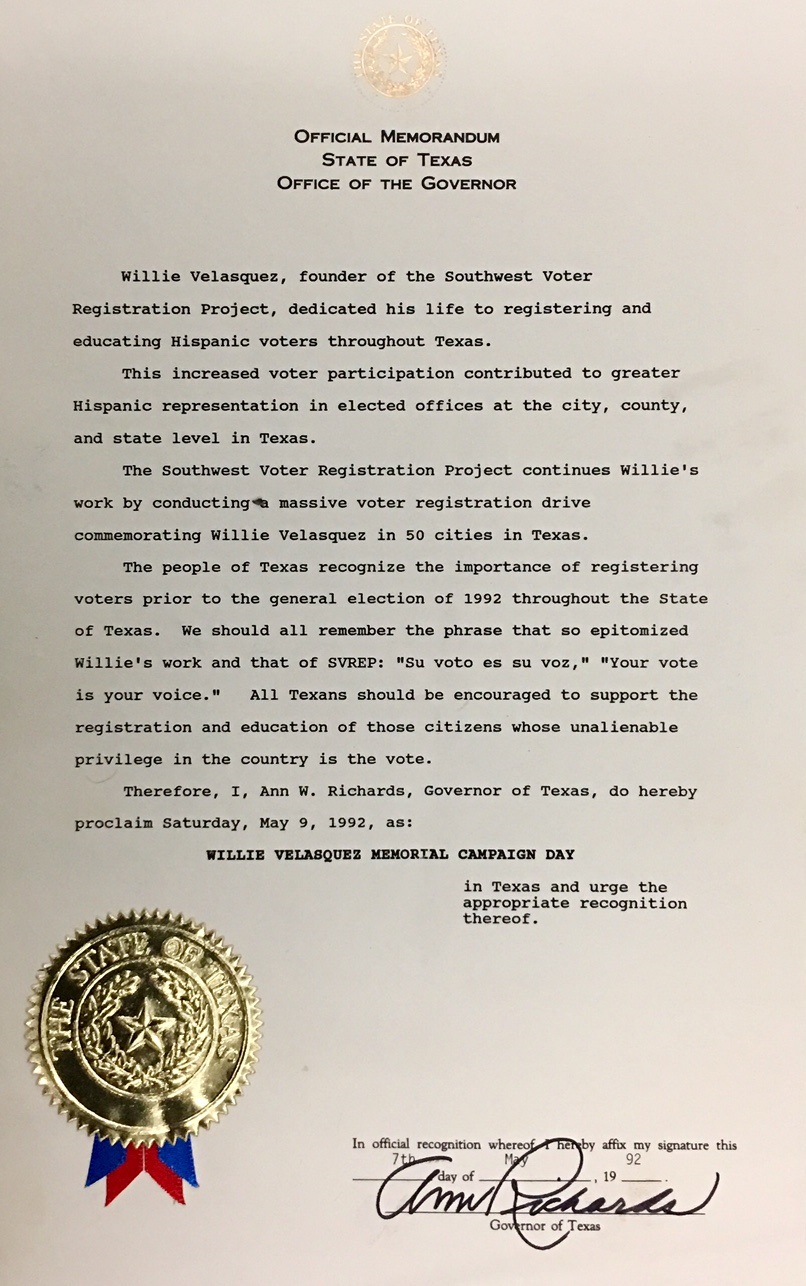 The official memorandum for Willie Velasquez Day from the SVREP Collection



 Stillness of Heart
You must be logged in to post a comment.