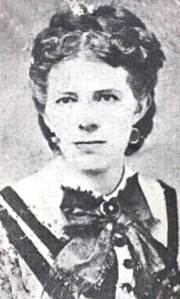
Kate Stone’s Civil War: The flower-wreathed scepter

Stone records the fall of Atlanta along with pitiful rumors of its victorious Confederate recapture. By now the ripples of great battles hardly disturb her social shores.

1862

From 2012 to 2015, Stillness of Heart will share interesting excerpts from the extraordinary diary of Kate Stone, who chronicled her Louisiana family’s turbulent experiences throughout the Civil War era.

Learn more about Stone’s amazing life in 1861, 1862, 1863, 1864, 1865 and beyond. Click on each year to read more about her experiences. You can read the entire journal online here.

(Photo edited by Bob Rowen)

Stone records the fall of Atlanta along with pitiful rumors of its victorious Confederate recapture. By now the ripples of great battles hardly disturb her social shores.

Sept. 27, 1864

Near Oak Ridge, La.

We hear of the lamentable fall of Atlanta and rumors of its recapture, which we trust may be true. There is no further fear of a Yankee raid as there are very few troops left at Goodrich’s Landing, and everyone seems to look for peace in the spring. …

An amusing letter from Missie Morris in which she utterly repudiates the idea of our giving up as “Old Maids” for two years yet, when she will be willing to lay down the flower-wreathed scepter of girlhood and don the badge of spinsterhood.

Capt. Gillispie came in two days ago and has kept the house in an uproar ever since. He is overflowing with fun and frolic but is rather too familiar and something rude. He does not improve on acquaintance. I fear he is fast, a perfect opposite to tiny Mr. Kurrie, who came with him. We thought him at first about twelve years old, so quiet and solemn. He really is twenty. …

The wars over the War

Nine key books and articles taken together can explain what led to the first sparks of civil violence and how those sparks ignited what evolved into the bloodiest and most important war in U.S. history.

Courtesy of David D. Robbins Jr.

Nine key books and articles taken together can explain what led to the first sparks of civil violence and how those sparks ignited what evolved into the bloodiest and most important war in U.S. history. A review essay by Fernando Ortiz Jr.

*****

Works reviewed in this essay:

Alcott, Louisa May. Hospital Sketches. Boston: Bedford/St. Martins, 2004.

Berlin, Ira. “Who Freed the Slaves? Emancipation and Its Meaning.” Union & Emancipation: Essays on Politics and Race in the Civil War Era. Kent, OH: Kent State University Press, 1997.

Dew, Charles B. Apostles of Disunion: Southern Secession Commissioners and the Causes of the Civil War. Charlottesville, VA: University of Virginia Press, 2001.

Fleche, Andre. The Revolution of 1861: The American Civil War in the Age of Nationalist Conflict. Chapel Hill, N.C.: University of North Carolina Press, 2012.

Gallagher, Gary W. The Union War. Cambridge: Harvard University Press, 2011.

Grimsley, Mark. The Hard Hand of War: Union Military Policy Toward Southern Civilians 1861-1865. New York: Cambridge University Press.

Jacobs, Harriet. Incidents in the Life of a Slave Girl. Boston: Bedford/St. Martins, 2009.

Kelly, Patrick J. “The North American Crisis of the 1860s.” The Journal of the Civil War Era 2, no. 3, (September 2012): 337-361.

McPherson, James. “Who Freed the Slaves?” Proceedings of the American Philosophical Society 139, no. 1 (March 1995): 1-10.

*****

The crucial story of U.S. history is the Civil War. But too often readers skip right over the significance of the “Civil” and go right to the “War.” When the spotlight shines only on the armies and the navies, glorious battles and inglorious retreats, and the admirals and generals who won and lost, one can lose sight of why hundreds of thousands of Americans slaughtered each other for years.

Readers forget why and how fundamental cultural and political differences swirled like a hurricane into a galaxy of large and small battles, and how such violence was hardly new in a war-torn nineteenth century world. Scholars forget the transnational democratic movements wafting in the political breezes that inspired or terrified citizens desperately committed to their own visions of American freedom. Students forget why the war was key to measuring the republic’s commitment to preserve the wilting blossoms of international democracy. Everyone forgets that slavery – not states’ rights, not economic domination, not debates over big government — is what steadily fractured every element of antebellum American society, government, economy, and future aspirations.

Fortunately, less than a dozen key books and articles taken together can explain what led to the first sparks of civil violence and how those sparks ignited what evolved into the bloodiest and most important war in U.S. history.

I. The sparks and the fire

White Americans owned black Americans. Slavery as an institution predated the Revolutionary War. Moral debates over its place in the new republic were muted throughout the independence era. The U.S. Constitution legalized the institution of slavery and considered blacks only 60 percent human. Slaves were a massive labor force upon which Southerners built their aristocratic society and King Cotton and sugar industries. Slaves were a highly lucrative commodity that Southern states hoped to sell to new farmers in Western states. Worst of all, slaveholders enjoyed and protected their violent sexual control of the women they owned.

No book better illustrates that horror than Harriet Jacobs’ harrowing account of her life as a slave in Incidents in the Life of a Slave Girl. Her owner, Dr. Flint, sexually harassed her. Her sexual affair with another white man, which produced two slave children, was a desperate attempt to get Flint to sell her off to her lover. She gave up an opportunity to escape to the North to remain near her family. As Flint hunted for her, she hid in an attic for seven years and watched her community, including her children, from a hole in the wall. Her experiences demonstrated how slave women had no control over their sexual lives, their families, or their futures. Their only weapons were their sexuality, their intelligence, and their will to survive. They were trapped in a slaveholding system upheld by national laws, protected by national political leaders, and perpetuated by economic and racial imperatives. Her book, aimed at Northern women, demonstrated the strong and humanizing commitment of black men and women to their families, illustrated the constant sexual threat slavery posed to black women, and explained to her white readers how slavery also destroyed white families by their action and inaction in service of the slaveholding system.

When a new national party, the Republican Party, challenged in the late 1850s the future of slavery in the United States, some Southern leaders raised the old cry for secession from the Union. Since the 1820s, competing economic interests struggled for control over the direction of the quickly growing country. With every era of expansion came carefully-crafted congressional deals delineating into which areas slavery could expand. Some succeeded and some did not. The Louisiana Purchase saw the Missouri Compromise. Territorial gains from the Mexican War saw the doomed Wilmot Proviso. Illinois Sen. Stephen Douglas offered the Kansas-Nebraska Act. With each political generation, the polarization intensified. Southerners were convinced the North sought to contain slavery. Northerners perceived a Slave Power conspiracy that controlled one president after another, dominated both houses of Congress, and infected the Supreme Court’s objective judgment.

Charles B. Dew argues in his slender but powerful Apostles of Disunion that slavery was at the heart of secession. He follows Southern slaveholding speakers as they traveled throughout the South during the presidential election year of 1860, arguing to anyone who would listen that Abraham Lincoln’s election guaranteed the emancipation of the slaves. Emancipation, they insisted, guaranteed race war, racial marriage, and racial equality. Slaves would kill their masters, rape their wives and daughters, and help conceive a nation that held whites equal to blacks. Lincoln’s election marked the end of both Southern civilization and legal subjugation of non-white people, they argued. The only option was Southern separation from a poisoned, doomed republic and the formation of a new one.

After Lincoln’s election, Southern states steadily seceded, and Confederates fired on Fort Sumter in Charleston Harbor. Thousands of Northern citizen-soldiers donned the blue Federal Army uniform and prepared to defend their Union. Looking backwards in history with sympathetic eyes, it is too easy to assume they fought to break the chains of slavery restraining their fellow black citizens. Gary W. Gallagher disagrees. He argues in The Union War that Northern soldiers fought not for slavery but for Union. They fought against a slaveholding aristocracy to preserve their republican government for themselves and for the world, brightening the beacon of democracy sweeping across a dark world of empires and kingdoms. Slavery was ended, yes, but only as a result of the Northern will to strip the South of anything that sustained its resistance to moral and military realities.

II. The reasons

The war ended slavery, but where should history lay the credit for emancipation? James M. McPherson argues in a 1995 essay that Lincoln deserved credit for ultimately freeing the slaves because he directed the war that ensured personally self-emancipated slaves would remain free in a society cleansed of the legalized slave system. Without the Union War, McPherson writes, “there would have been no confiscation act, no Emancipation Proclamation, no Thirteenth Amendment (not to mention the Fourteenth or Fifteenth), certainly no self-emancipation, and almost certainly no end of slavery for several more decades. …” Lincoln was the “political denominator in all the steps” that defeated the Southern slave system.

In 1997 Ira Berlin disagreed with McPherson. His essays insists that grassroots social forces freed the slaves. Union forces would move through Southern communities, and slaves would abandon their homes to join them. When soldiers refused to send the runaways back because they found them useful, the slave system was weakened. When soldiers wrote to their families, and those families as voters helped change congressional and presidential opinion, slavery was weakened. If Lincoln led the way nationally, Berlin argues, it was only because people in immediate contact with the slave system cleared a path for him. If Lincoln had not led, someone else would have.

Lincoln was desperate to bring back the seceded states into the South by any political means necessary. One brilliant historian summarized Lincoln’s thinking with brutal simplicity: If the South came back, Lincoln promised to be the greatest fugitive slave-catcher in history. Even when war began, Mark Grimsley explains in The Hard Hand of War, Lincoln took a conciliatory approach. When armies moved through Southern regions, soldiers would not harm civilians, and they would respect all forms of personal property, particularly slaves.

Lincoln gradually realized that nothing he could do would bring the seceded states back. That crushing realization, coupled with the North’s growing list of defeats in the Eastern Theater, particularly throughout the 1862 Peninsula Campaign, hardened Lincoln’s belief in final victory. He aimed for the Confederacy’s jugular — the slaves — with the ultimate war measure. The Emancipation Proclamation was a clarion call to slaves to abandon their masters and let the entire slaveholding system collapse in on itself.

The conciliatory war gradually became a hard war. As Berlin stresses, soldiers did not return escaped slaves. They took pigs. They took chickens. They ripped down fences for fires. They threw railroad tracks — key for moving Confederate men and material — into those fires. The friction and abrasion of Union forces in Southern territory transformed the way the war was fought. In Georgia, Maj. Gen. William T. Sherman led the transformation from the top with the policy of directed severity. Barns were incinerated. Homes were destroyed. But civilians were not directly harmed. It was violence against property and not people.

III. The women

The war killed and injured hundreds of thousands of soldiers. Northern women cared for Union soldiers with tireless devotion. Louisa May Alcott joined them, and she collected her memories of the experience in Hospital Sketches. The memoir made Alcott famous throughout the North. The book captures the opportunities the war offered to many Northern women, who were expected under normal circumstances to remain in their patriarchal society’s private and domestic sphere. The public sphere was reserved for men. The war was not revolutionary in terms of gender roles, but the extraordinary circumstances made allowances for women willing to walk through the new social cracks. Alcott did exactly that as she joined a Washington D.C. hospital staff. She entered the public sphere as a nurturer — as a nurse. She infantilized her male patients, calling them her boys, and in this temporary wartime sphere she touched their bodies, cleaned their wounds, and guided them from life to death.

Hospital Sketches contributed to the Northern war effort in unique ways. It illustrated for Northern readers the gruesome suffering their soldiers endured in defense of their democratic republic. It celebrated the material, physical, and psychological sacrifices of citizen-soldiers, ennobling them and the nation for which they fought. Alcott portrays one patient as a Christ-like figure — his death for his countrymen makes it possible for a new nation to arise from the ash and blood of a righteous war.

IV. The world

Northerners and Southerners both saw the Civil War as a struggle for the future of freedom in the world, not simply in the United States. Europe’s nationalist revolts in 1848 — and the subsequent monarchical counterrevolutions that crushed them — burned in their memories as North America’s domestic unrest intensified. Andre Fleche’s The Revolution of 1861 and Patrick Kelly’s 2012 article “The North American Crisis of the 1860s” both demonstrate how political leaders and citizens on both sides, standing at the threshold of the revolution of 1861, attempted to align themselves not only with the U.S. revolutionary legacy of the 1770s but also with the revolution of 1848. An era of nationalist revolutionary spirit that streaked around the world — from the mid-1770s to the late-1860s — began and would end in North America.

Both sides, Fleche notes, perceived the Civil War as North America’s opportunity to fulfill the revolution that Europe began. Northerners wanted to destroy New World slaveholding aristocracy. Southerners wanted to escape Northern radicals ready to shatter their racial order. Northerners, as Gallagher emphasizes, viewed their democratic republic as an island of freedom in a treacherous ocean of imperial oppression. Southerners attempted to portray themselves as the freedom fighters, as Dew implies, struggling to uphold the legacy of the Founding Fathers and rebuild anew a self-governing republic.

Sprinkled among the Americans were refugees of the 1848 revolts, particularly Germans, who understood the difficulty of asserting a democratic nation in the shadow of aristocratic oppression. Their enthusiastic participation in the Union war effort, Kelly notes, essentially amounted to a freedom-fighting army at the center of the blue-coated Federal force and a viable political and moral force in Northern cities that supported Republican goals. Unfortunately, Gallagher spends little to no time exploring the 1848 Germans’ contribution to the Union war effort, despite the supreme importance Lincoln placed on the community as a potent source of political and military support.

The war began with both sides seemingly misaligned, with the North defending the status quo and the South fighting for the freedom to break away. But once Lincoln issued the Emancipation Proclamation — temporarily in 1862 and then officially in 1863 — the North leapt past the South on the moral spectrum. The North became the revolutionary force, and the South instantly became the archaic aristocracy, defending the past instead of fighting for the future.

Secession was a dynamiting of the linkages Northerners made to the transnational and transatlantic struggles for nationalism and freedom. When imperial France invaded Mexico and placed a French emperor in charge, Kelly explains, the Confederacy allied itself with the new French rulers. Southerners were desperate for foreign recognition, and not even moral hypocrisy was too high of a price to pay for it. The supposed Southern freedom-fighters promised to support the French government in Mexico — the first crashing counterrevolutionary wave in the New World — if France recognized the Confederacy. Lt. Gen. U.S. Grant’s determination to support Mexican revolutionaries highlights the dual advantage of final Union victory: once the New World aristocratic threat was defeated, the United States would join the fight in driving out Old World aristocratic threat and fulfill the goals of the 1848 struggles for freedom.

The Civil War changed the United States in ways historians are still discovering, if only because it occurred in a world as complex if not more so than today’s. War empowered women as it freed slaves. It illuminated sexual abuse, personal bravery, and inextinguishable devotion. It linked desperate defeats in distant foreign lands to the victories of Northern men marching through Southern valleys. It demanded that Americans view war, race, class, and freedom in new ways. The Civil War was the test every citizen had to pass, and its lessons dare every subsequent generation to fulfill the liberties the war was waged to protect.

Kate Stone’s Civil War: Those terrible battles

The horror of the Overland Campaign hangs over the Stone household but she holds out hope Lee will outsmart Grant in the end.

KS54

From 2012 to 2015, Stillness of Heart will share interesting excerpts from the extraordinary diary of Kate Stone, who chronicled her Louisiana family’s turbulent experiences throughout the Civil War era.

Learn more about Stone’s amazing life in 1861, 1862, 1863, 1864, 1865 and beyond. Click on each year to read more about her experiences. You can read the entire journal online here.

(Photo edited by Bob Rowen)

The horror of the Overland Campaign hangs over the Stone household but she holds out hope Lee will outsmart Grant in the end.

Again Stone impresses with her ability to illustrate everyday life and mores in so few detailed sentences. Note how the Stones and their friends are now regularly visiting Union prisoners at the nearby Confederate camp.

June 19, 1864

Tyler, Texas

A letter from My Brother but dated three months ago. He writes very sadly and thinks he will not see us again until the war is over. He was safe on the fourth of May, but it was on the fifth that those terrible battles commenced. We see from the papers that his corps was engaged every day. The fate of Richmond still trembles in the balance. Lee’s army has fallen back within the fortifications, and Grant is beginning to burrow as they did at Vicksburg. The most thrilling report is that Beauregard has captured Butler and 9,000 men. May it only be true. …

We have quite a trip in contemplation. Mamma is thinking of going to Monroe [La.] on business and taking me and one of the boys on for a pleasure jaunt. Which one of the boys depends on Mrs. Savage, who thinks of joining us with Emily. In that event Mamma will leave Jimmy at home as affairs are getting too interesting with Jimmy and Emily. He is too susceptible, and Mrs. Savage is too much of a matchmaker for Jimmy to be hourly exposed to such fascination for the next two weeks. Emily is a designing, forward girl, exceedingly so for her age. Jimmy is making every preparation to go with us and join the army at Monroe and will be horribly disappointed if Mamma refuses her consent.

Our usual refugee visitors. Yesterday evening returning from a ride, Jimmy and I were called in by Mrs. Carson, who begged us to stay to supper, at which we enjoyed delightful venison, killed by Jimmy Carson, and some of Mrs. Carson’s new style marmalade excellent. Read the papers to Mrs. Carson and rode home in the most glorious moonlight.

Mamma is very sad since receiving My Brother’s letter. She is very anxious about him. We have a nice set of real chessmen, made by one of the prisoners. We loaned them some days ago to the hospital in response to a polite note asking for them. The boys often go there. They have taken a great fancy to Mr. Griffin, a wounded boy. He must be a nice young fellow. Mamma and Mrs. Carson and some of the other ladies go quite frequently.

Endless borderlands

Fifteen essays and books explore the borderlands field with passion and intelligence, daring their readers to leave behind their old worlds and follow them into new ones.

IMG_2335


Fifteen essays and books explore the borderlands field with passion and intelligence, daring their readers to leave behind their old worlds and follow them into new ones. A review essay by Fernando Ortiz Jr.

*****

Works reviewed in this essay

Adelman, Jeremy, and Stephen Aron. “From Borderlands to Borders: Empires, Nation-States, and the Peoples in Between in North American History.” American Historical Review 104, no. 3 (June 1999): 814-841.

Anzaldua, Gloria. Borderlands/La Frontera: The New Mestiza. San Francisco: Aunt Lute, 1987.

Barr, Juliana. Peace Came in the Form of a Woman: Indians and Spaniards in the Texas Borderlands. Chapel Hill: University of North Carolina Press, 2007.

Brown, Wendy. Walled States, Waning Sovereignty. New York: Zone Books, 2010.

Chang, Kornel. Pacific Connections: The Making of the U.S.-Canada Borderlands. Berkeley, CA: University of California Press, 2012.

Hämäläinen, Pekka. The Comanche Empire. New Haven, CT: Yale University Press, 2009.

—. and Samuel Truett. “On Borderlands.” The Journal of American History 98, no. 2 (2011): 338-361.

Hoffnung-Garskof, Jesse. A Tale of Two Cities: Santo Domingo and New York after 1950. Princeton, N.J.: Princeton University Press, 2010.

Johnson, Benjamin H., and Andre R. Graybill, eds. Bridging National Borders in North America: Transnational and Comparative Histories. Durham: Duke University Press, 2010.

Lytle-Hernandez, Kelly. Migra!: A History of the U.S. Border Patrol. Berkeley, CA: University of California Press, 2010.

McManus, Sheila. The Line Which Separates: Race, Gender, and the Making of the Alberta-Montana Borderlands. Lincoln, NE: University of Nebraska Press, 2005.

Mora, Anthony P. Border Dilemmas: Racial and National Uncertainties in New Mexico, 1848-1912. Durham, N.C.: Duke University Press, 2011.

Shah, Nayan. Stranger Intimacy: Contesting Race, Sexuality and the Law in the North American West. Berkeley, CA: University of California Press, 2011.

St. John, Rachel. Line in the Sand: A History of the Western U.S.-Mexico Border. Princeton, N.J.: Princeton University Press. 2011.

Weber, David. Bárbaros: Spaniards and their Savages in the Age of Enlightenment. New Haven, CT: Yale University Press, 2006.

*****

I. Introductions

The borderlands mark divisions of land on maps. They mark divisions of races, communities, economies, and families. But borderlands are also more than dividers. Borderlands are where culture and history collide, dance, and coalesce. They are where nation’s futures are conceived, where risks are taken, and where ideas are born. Borderlands cradle both conflict and peace, friction and abrasion, the past and future. Borderlands are gateways through which to view national, cultural, racial, and imperial histories with fresh and sharper eyes. Fifteen essays and books explore the borderlands field with passion and intelligence, daring their readers to leave behind their old worlds and follow them into new ones.

For the uninitiated, borderlands are dark landscapes. But lighting the way are Jeremy Adelman, Stephen Anon, Benjamin Johnson, Andrew Graybill, Samuel Truett, and the wonderfully-named Pekka Hamalanien. By combining three essays from 1999, 2010, and 2011, their analyses form a grand introduction to the field.

Graybill and Johnson ask why historians take the borders for granted. They worry that that the lines on maps imply inevitability. They fret that the borders do not evoke or inspire historical curiosity into the regions they cut through. They hold up borderlands studies as the antidote to that narrow vision and lack of curiosity.

Adelman and Anon explain that the borderlands approach was meant to challenge Frederick Jackson Turner’s Frontier Thesis, which looked east to west, by turning the axis north to south. Rather than considering unilateral European conquest, the field considered how indigenous and European civilizations met and mixed, bilaterally conquering each other. It implied that nation-building did not end once the necessary territory was declared conquered. The borderlands approach, which inherently challenged historians’ traditional reliance on a nation-state perspective on the world, also embraced border zones once imperial lands became modern nation-states.

In 2011, Hamalanien and Truett critically noted that Adelman and Anon ignored other processes that affect borderlands — cultural shifts, warfare, malleable concepts of nation (like indigenous territories), and natural pressures on societies, like landscape changes and epidemics. They pointed out that borderlands inherently challenge master historical narratives anchored to centers of political and cultural power. Ascribing importance to borderlands questioned the supreme importance of those centers, and of nation-states as a whole. Borderlands historians were willing to consider that perhaps non-state actors made equally significant contributions to the overall political or social entity.

Perhaps historians, borderlands proponents argued, needed to listen with equal care to voices from both the centers and the margins. Power and national identity when viewed through that prism becomes ambiguous and historically revitalized. Borderlands become the alternative centers of nation and empire. The borderlands approach also acts as a spotlight to capture movements between political entities, societies, and cultures that were previously unknown or understudied. It spotlights the violence of that friction and abrasion that takes place between competing peoples desperate for food, water, legitimacy, or shelter. This array of introductory essays urged historians to challenge themselves to find these perspectives.

II. Imperial borderlands

Borderlands are born when two or more powers encounter each other. The Spanish New World burned with borderland dynamics. David J. Weber’s Barbaros explores the Indian-Spanish contact zones, details how Spain attempted to administer them, and concludes that even when the Bourbons reformed Spanish America, the region was never completely conquered. Reforms to the military and church networks were not fully implemented, control and structure never consolidated. Consequently, the borderlands region remained violent, dynamic, and, most importantly, influential to the entire bureaucracy. Indian action dictated imperial reaction.

Beyond the warmth of steady and strong Spanish control, colonists lived difficult lives. Dominant Indian powers manipulated colonial communities, turning them into supply depots or shelters, or forced them to pay tribute, while others simply ravaged poorly protected colonies. Reformers wanted the frontier turned into a borderlands region, where commerce, Christianity, and peace reigned, all on Bourbon Spanish terms, which were never achieved except on paper.

But Bourbons focused on building relationships with Indians, reforming them from barbarians into Christian men, thereby building cultural and economic bridges into stronger indigenous networks. As the Spanish elements grew stronger, enlightened attitudes reverted to racism, rejecting the gradual incorporation of Indians.

Pekka Hamalainen’s The Comanche Empire argues that the Comanches were “an indigenous empire.” They were an association of tribes, he claims, that gradually built themselves into a force that dominated what today is the Southwestern United States and northern Mexico, a force so powerful that it effectively obstructed the expansion of French, Spanish, Mexican, and U.S. power for almost two centuries.

The Comanche Empire, he explains, did not simply exist in an Adelman/Anon borderland of negated imperial power and enhanced indigenous influence — they created a new space where the indigenous Comanches dominated, embraced, and transformed the isolated colonialists.

Key to their steady growth and dominance was the willingness to open their culture to new ideas, languages, and religions, which provided them with new domestic strategies, intelligence on distant neighbors, and conduits into useful economic networks.

Acknowledging Comanche power and its crippling influence on Spanish and Mexican control, he asserts, explains how the young U.S. consumed half of Mexico in the late 1840s. The tragic irony is that the U.S. quickly turned its guns on the Comanches to consume their land and cleanse the landscape of non-whites and non-Christians. Comanche greatness required extreme measures to defeat it.

Juliana Barr examines in Peace Came in the Form of a Woman the gender and kinship expectations Europeans and indigenous faced when interacting with each other in colonial Texas dominated by Indian standards.

Women played central roles in virtually every equation. Spaniards scratching out communities in Indian-controlled territory initially refused to marry Indian women, losing out on the economic advantages Indians placed on kinship connections. Without kinship connections, Indians viewed Spaniards as outsiders. Only by marrying women from competitor French families did they finally tap into those economic networks. Spaniards captured Apache women when Apaches attacked them. When Apaches and Spaniards allied against common enemies, Apache women became the connections between both groups. Women from all indigenous groups symbolized peace offerings, peace emblems, and peace envoys.

Spaniards and Indians also communicated with displays of gender. Martial displays signaled masculinity. They shared masculine codes of honor. A military assembly signaled trouble, but when masculinity was paired with femininity, the assembly signaled peace.

III. Northern perspective

The Line Which Separates and Pacific Connections, respectively authored by Sheila McManus and Kornel Chang, highlight how the Canadian and U.S. power centers struggled to control their borderlands and underestimated the effect the borderlands had on those power centers. Both warn that in the historical search for the source of national character, the borderlands and the methods used to control those borderlands cannot be ignored.

Many excellent books in the historical borderlands field typically focus with a racial lens on the U.S. borders with Latin America. McManus and Chang make invaluable contributions to the U.S. borderlands field simply by focusing instead on the U.S-Canada border and the unique contests for its future. They construct their histories from opposite directions — McManus looking west from U.S. and Canadian capitals and Chang looking east from the Pacific region.

McManus argues that Canada and the U.S. post-structurally reimagined their respective western societies as proving grounds where potential national values were conceived, tested, and sharpened against unwelcome cultures and races, and held up for all citizens to adopt. Their border along the 49th parallel was key to those “nation-making efforts” because it politically delineated where one nation-state ended and the other began. It symbolized their capacity to control who crossed that border, who lived in those critical regions, and what values governed their lives.

Chang argues that the regions along the 49th parallel should not be seen as border zones but as transnational and transpacific crossroads. Chang expands the north south/east-axis of the McManus book to include multiple continents, empires, and commodity chains. Instead of Ottawa and Washington, D.C., or Alberta and Montana, Chang examines Seattle and Vancouver, recasting the Pacific Northwest and the Pacific coast as buzzing economic and imperial hubs. The nation-states’ challenge was to control that chaos to their advantage by employing institutions governing immigration, monitoring borders, and manipulating migration.

One of many rivers of migrants into Canada and the U.S. streamed from South Asia. An examination of cultural influences they brought with them would be fascinating enough. But Nayan Shah takes several steps beyond that in Stranger Intimacy to examine erotic, social, and economic relationships between the immigrants and a variety of other groups throughout Western communities of workers.

His South Asians brought with them into western U.S. and Canadian regions borderlands sensitivities as colonized members of the British Empire, as English speakers amid Mexican and Chinese workers, and as men who moved across racial boundaries put in place by the societies their labor was meant to expand. Using legal and police records produced by the clash of immigrant actions and their societies’ reactions — arrests for sexual activities, questions over immigration status, concerns over white public safety — Shah produces a network of racial and legal borderlands the immigrants overcame or failed to overcome.

Domestic racial attitudes against South Asians’ supposed demoralizing effects on white families tolerated white violence. That violence, coupled with legal surveillance and oppression drove immigrants’ contacts with each other into secret places, turning their stranger interactions into stranger intimacies with glances, movements, and other secret signals. The homosocial regions the legal system identified became border zones of state surveillance, racial oppression, and assumption of criminal activity between legitimate and illegitimate societies. The intensity of sexual oppression bolstered normative white identities and further emphasized the deviancy of foreign entities.

IV. Special cases

Euro-American control over the sections of former Mexico is a vital topic in borderlands studies. In Border Dilemmas, Anthony Mora focused on how Euro-Americans used literature and letters to steadily undermine their cultural, political, and economic control of New Mexico.

They portrayed New Mexican women as sensual beasts, businesswomen as prostitutes, and men as savages who could not control their society. Euro-American colonists, Mora explains, saw themselves as the ones to bring civilized order to this chaos. By sensualizing and dehumanizing the men and women, Euro-Americans justified their invasions of Mexican territory, their racist attitudes toward the Mexican inhabitants, and their attempts to dominate and transform the societies upon which they would build a virtuous American Eden.

By labeling Mexican businesswomen as prostitutes and ignoring the economic agency they enjoyed in Mexican society, Euro-Americans could strip from them any semblance of economic legitimacy or social value, permanently damage their community standing, and generally enhance the threatened patriarchy. By characterizing Mexican men as weak or corrupt, Euro-Americans could portray themselves as saviors of Mexican womanhood, now recast as victims of male Mexican vices. Charitable and heroic white men would save these women with marriage, absorb their Mexican blood (descended from quality European blood, surely) into their white bloodlines and families, thereby improving the overall New Mexican community while conveniently ignoring the insecurities in the white U.S. South over racial mixing with black slaves. Mora captures with subtle humor the ridiculous ironies and hypocrisies at work.

Euro-American attempts to enforce “gendered divisions of space,” Mora explains, were key to their control. Women belonged in the privacy and purity of the home. Mexican women also belonged in the home, but in the homes of white women, where they would learn under white tutelage how to become proper American housewives.

They would share the gendered space and occupy appropriate racial roles within domestic walls. Mora connects this racism to U.S. devotion to domestic power and, by extension, to civilizing power. As white women domesticated the home, they also domesticated (tamed) the white men taming the borderlands. They symbolized the white race reaching into the frontiers of their new empire, bringing domestic stability and the values of a proper white home to savages.

The values of white patriarchy only intensified the existing Mexican patriarchy. Mexican elites saw self-serving opportunities to play the Euro-American game over the New Mexican chessboard. New Mexican women were marginalized socially, sexually, and economically, with little or no role in society except as emblems and tools of the patriarchal nation-building enterprise their men purported to lead. Even the oppressed did their own heinous oppressing.

Gloria Anzaldua’s Borderlands/La Frontera sees the borderlands marking divisions in the hearts and minds of the people who populate them. The men and women who exist on the fringes of nation, religion, and race live with divisions within themselves. Anzaldua urges these borderland citizens to be proud: The Chicano borderlands are where national and racial futures are born. They are special places for homosexual men and women, Indians, the socially and intellectually liberated. It’s a place of many tongues, religions, and talents. Any minority will find a home there because they are borderlands themselves — they exist in multiple worlds simultaneously, always adjusting their gradients to blend in with the larger, more dominant colors. They are the future race of a better nation and society, without constructs, limitations, discriminations, or oppression.

Anzaldua holds herself as the example. She is a gay mestiza who speaks not just English and Spanish but variations of both. She refuses to adhere to expectations of how a mestiza should behave, think, or live. She erases the borderlands within her by embracing what they are expected to keep separate.

Perhaps securing political legitimacy for the borderlands citizens begins there. Borderlands citizens must connect themselves somehow with the political cores of their societies, through moderate allies, social upheavals, or war. Only then can they change their nation from within. Society eventually changes to accept gay men and women, and to view men and women and all races equally. Those who refuse to change are the ones marginalized, dismissed, and rejected. An equitable and just society – perhaps that is the ultimate goal for all borderlands citizens. Buried in the ashes of their anguish are the elements of eventual social greatness.

Jesse Hoffnung-Garskof’s A Tale of Two Cities follows Dominican people as they moved from the countryside to capital city Santo Domingo to the New York neighborhood of Washington Heights and back to Santo Domingo. Within these transnational currents he finds Dominicans navigating the fault-lines of culture, race, and economics in both the United States and the Dominican Republic. Dominicans in both cities were elements of the same transnational entity, confronting different manifestations of the same imperialist power, racially differentiating themselves from other minorities, and struggling to live up to their ideals of progress and culture.

Working-class Dominicans struggled to find and then improve their place in the Dominican Republic or the U.S. The book’s bottom-up approach is structured along two ideals: progress (certain actions would improve one’s life, social standing, and national well-being) and culture (perceived values and the standard that decided who belonged and who did not).

The author gives tremendous agency to Dominicans but also points out the irony in their outlooks. When modernization projects stripped economic opportunities from sugar plantations and ranches, rural people flooded Dominican cities to find new economic opportunities. They embraced the progreso/cultura ideals and demanded paved roads and sanitation in their barrios. Men condemned gangs and women condemned prostitution, but gangs were also seen as a potential defensive force against U.S. incursions and women asked prostitutes for sex advice.

In the U.S., Dominicans combined progreso/cultura virtues — improving their economic lives while also protecting their Dominican national values — by extending their sense of home northward to encompass New York. Dominicans saw little need to assimilate because in their minds they had never left the Dominican Republic. Dark-skinned Dominicans faced racial/ethnic discrimination from Puerto Ricans, African Americans, and Anglos as they made their own distinctions between themselves and Haitians. Dominicans embraced the U.S. consumerism as they blamed the U.S. for the materialism and delinquency they saw in Dominican society.

V. The meaning of borders

Borderlands don’t exist without borders. Rachel St. John’s Line in the Sand offers a multifaceted biography of the western U.S.-Mexico border, from El Paso to the Pacific Ocean. The line is a consequence of military conquest, local warfare, political and economic ambitions, and state-sanctioned policing, much more than the natural divider of the Rio Grande.

The line changed in significance over time. For criminals it was the doorway to freedom. For lovers of vice, it was the gateway to illegality. For U.S. politicians, it was a triumph of a superior society over its inferior neighbor. Indian raids necessitated borderland security forces. Borderland commerce and railroads created twin cities. Nation-state efforts to define and enforce it symbolized the inherent weakness of centered-power perspectives ignoring the significance of borderland entities.

As for the force deployed to regulate who moves across that line and who doesn’t, in Migra! Kelly Lytle Hernandez considers the U.S. Border Patrol as part of state-sanctioned violence against Mexican communities naturally flowing through the artificially imposed borderlands between the U.S. and Mexico. Bi-national economic and political demands coupled with the individual demands of its personnel guided the evolution of the Border Patrol as a predatory borderlands entity. Examining this aspect of borderlands existence further illuminates how borderlands and their inhabitants are perceived and rejected or accepted by their nation-states, and the role of violence in attempting to assert the nation-state’s sovereignty over its territory and society. It also highlights Mexico’s postwar partnership with a foreign security force in an effort to control their northward flow of its own people.

The Border Patrol historically worked with borderlands businesses to ensure a steady supply of cheap Mexican labor while enforcing white standards of behavior among races and genders. Officers shaped official U.S. immigration policies to suit local situations and their own interests, interweaving border control objectives with community and economic life. The focus on Mexican rather than Canadian criminality has more to do with the communities dark-skinned people entered than with the actual act of undocumented crossing.

Wendy Brown examines physical borders and the borderlands they mean to enforce in Walled States, Waning Sovereignty. Wall-building projects throughout the globalized, Internet-dominated world, she argues, is a symptom of a larger insecurity over the loss of nation-state control over territory, people, resources, and security. The concept of sovereignty — of control — and its separation from what it means to be a nation-state is what drives pathetic construction work on the U.S.-Mexico border, and throughout the U.S.

What is to be contained is held up as pure, and then the potential foreign threats are identified, and then the wall is promoted as the solution. Even within the beacon of Western democracy, the rich seal themselves off from the poor, businesses wrap themselves in porous digital security blankets, and religious sects build compounds — retreats — in which to properly indoctrinate their flocks. The psychological comfort of walls, borders, lines, and zones infers a stable order is in place. Control is recovered.

Hamalanien and Truett encourage borderlands historians to embrace the inherent chaos in borderlands. That instability had unintended consequences and created unexpected opportunities. Indigenous groups play roles in creating empires or use their own to control their regions. Marginal groups influence the core. Ignored voices participate in the national discussion. New historical roots are discovered. These fifteen works demonstrate the value borderlands studies bring to the historical field. What may appear to be chaos to outdated historical views is beautiful intellectual symphonies to the cutting-edge borderlands lovers.


Recommended reading / viewing / listening

This week: Deadly Africa / Celebrating ‘Dr. Strangelove’ / Our nation of secrets / Touring the 9/11 museum / Attacking Obama’s drone war

Picture 151

This week: Deadly Africa / Celebrating ‘Dr. Strangelove’ / Our nation of secrets / Touring the 9/11 museum / Attacking Obama’s drone war

Most of these great items come from my social media networks. Follow me on Twitter, Tumblr, LinkedIn, MySpace, and Facebook for more fascinating videos, photos, articles, essays, and criticism.

1. Between Life and Death
Lifeline :: Al Jazeera English | May 15
“Why is Africa still the most dangerous place in the world for mothers and babies?”

2. Robert Capa’s Longest Day
By Marie Brenner | Vanity Fair | June 2014
“Seventy years ago, the great war photographer joined the first slaughterhouse wave of D-Day, recording WWII’s pivotal battle in 11 historic images of blur and grit. But that is only a fraction compared with what he shot — and lost.”

3. The half-century anniversary of ‘Dr. Strangelove’
By David Denby | Culture Desk :: The New Yorker | May 14
“It may be hard to believe now, but Kubrick’s original intention was to do a straight, serious movie. In the late fifties, he became obsessed with the possibility of an accidental nuclear war. …”

4. ‘So Jayson Blair Could Live, The Journalist Had to Die’
By Sridhar Pappu | New York Observer | May 2013
“Why had he done it? Why had a promising 27-year-old reporter with a career in high gear at the most respected news organization in the world thrown it all away in a pathological binge of dishonesty?”

5. A Grandson Traces His Grandfather’s Voyage to Auschwitz
The Takeaway :: WNYC | May 13
“The ship was the MS St. Louis. It departed from Hamburg, Germany on May 13th, 1939, with 937 Jewish refugees seeking asylum abroad. But the ship’s passengers were denied refuge by the United States, Canada, and Cuba. The ship returned back to Europe on June 20, sealing a tragic fate for many aboard.”

6. The United States of Secrets
Frontline | May 13
“How did the government come to spy on millions of Americans?”

7. 9/11 Memorial Museum: an emotional underworld beneath Ground Zero
By Oliver Wainwright | The Guardian | May 13
“Scorched car doors, salvaged firefighters’ uniforms, banners, toys and the hallowed ‘last column’ to be removed from the World Trade Center clearance … the relics of the twin towers have been elevated into art objects at the new museum. …”

8. Jeb 2016: The Bush battle within
By Maggie Haberman | Politico | May 13
“Jeb Bush’s decision whether to run for president in 2016 is being driven by competing impulses within his own family.”

9. #BringBackYourDrones drive launched against FLOTUS
Al Arabiya English | May 14
“A relatively small group of social media users said the first lady was overlooking the victims of the U.S.’s drone program which is operated mainly in Yemen and Afghanistan.”

10. This is the world’s oldest sperm
By Jamie Condliffe | Gizmodo | May 14
“The samples found themselves in the hands of John Neil, a specialist ostracod — that’s fancy for shrimp — researcher at La Trobe University, who realized they may contain something a little more… ballsy.”

The Battle for Boricua

Is Puerto Rico the battleground for America’s intellectual future?
A review by Fernando Ortiz Jr.

IMG_0237

Is Puerto Rico the battleground for America’s intellectual future?
A review by Fernando Ortiz Jr.

******

Discussed in this essay:

Laura Briggs. Reproducing Empire: Race, Empire, and U.S. Imperialism in Puerto Rico. Berkeley: University of California Press, 2002. Pp. 304. $29.95.

I.

Puerto Rico was one of the prizes the U.S. won in its 1898 victory over the Spanish Empire. The U.S. made Puerto Ricans citizens in 1917 and granted the territory an upgrade to commonwealth status in 1952. Debate has raged ever since over how, when, or if Puerto Rico should attempt to move in a new political direction, and over how it should cope with the degree of control the U.S. still wields over its economic and political systems. Like a moon trapped in planetary orbit, bathed only in the solar light reflected from that planet’s surface, struggles for self-definition and conflicting political visions dominate the island’s history.1

Laura Briggs extravagantly explores key components of Puerto Rico’s lurching political evolution in Reproducing Empire, a 2002 book based on her 1998 doctoral thesis composed at Brown University. Her book, standing tall among the work uniting colonial control and gender roles, illustrates Anglo American rulers at first disgusted with Puerto Rico, viewing the island territory as a cesspool of tropical subhumans blinded by rampant sexual desires and staggered by venereal disease, overpopulation endangering their natural and imported resources, and desperate, whether they knew it or not, for American guidance.

Puerto Rico’s social and economic problems were both caused and worsened, Briggs argues, by colonizing Americans who only saw themselves as solutions to those problems. She creatively examines the grinding conflict between the colonizer and the colonized through the prism of Puerto Rican sexuality, particularly the symbolically sexual body of the working-class Puerto Rican woman, whose propensity for sexual “deviancy” was blamed for spreading disease, for having too many children, and for essentially standing in the way of Puerto Rico’s proper Americanization. The fights waged over her sexual body became, Briggs argues, fights over Puerto Rican identity, political autonomy, ethnic equality, forced modernization, and Puerto Rican resistance. The Puerto Rican woman was the greatest battlefield in the titanic struggle over the island, which Briggs calls “the most important place in the world,” where she believes today’s essential debates over globalization issues are rooted in U.S. colonial attitudes.2

Americans saw prostitutes swarming over the men training to fight in World War I, posing their own venereal threat not just to the men but also to the women and children on the mainland, who would eventually be infected by the hapless victims of female Puerto Rican sexuality. U.S. incarceration policies on prostitution, Briggs argues, were one more supplement to colonial control and one more way Americans saw Puerto Ricans as foreigners, as people of lesser value to be kept apart from Americans, and as primitives who needed benevolent guidance. Puerto Rican women were either threats or weaklings needing protection. Islanders protested these prostitution policies, and Briggs sees in the rhetoric islander resistance not simply to the policies but also to the overall colonial project and later over their muddled citizenship.3

Americans saw overpopulation as also caused by these naturally promiscuous and illiterate women, prone to disease, doomed to poverty, and overly attached to the ideal of large hungry families. So, Briggs explains, American scientists developed new sterilization and birth control methods – diaphragms, contraceptive foams and jellies, and eventually the pill – and tested their effectiveness on Puerto Rican women, turning the island into “a social science laboratory.”4

II.

Throughout the Cold War, Briggs argues that Puerto Rico became a “political showcase,” advertising to Latin American nations vulnerable to Soviet seduction the beauty of a society that could result from an alliance (re: economic and military control) with the U.S. Puerto Rico was subjected to development projects — population control, industrialization, export control — again serving as a laboratory where models were analyzed before being sold to Third World nations.5

But the islanders had direct effects on the mainland too. Most importantly, Americans saw a huge post-World War II movement of Puerto Ricans into mainland cities, particularly into New York. The arrival of so many people in only a few decades permanently changed the racial and ethnic makeup of countless neighborhoods, sparked ethnic and political tensions, and re-engineered political activism. New arguments and alliances were born as these citizens struggled to live alongside Americans who saw them as anything but citizens and anything but white.

Overall, despite its strengths and creativity — particularly her intriguing view that the tentacles of colonization in Puerto Rico were only shorter and younger versions of the long American tentacles of globalization now strangling the globe — Briggs could have used a better editor to tighten a muddled narrative that often seems off balance and that could have been much shorter. Briggs often repeats the same points again and again, as if chapters were written months apart and she had to remind herself of the main thesis the latest chapter was supposed to be supporting. Also, the narrative needed more biographical sketches to bring alive the issues of sexuality, gender, and colonial victimization. Her ideas would have been so much more effective if the consequences of colonial decisions were shown in the wreckage of Puerto Rican lives, identities, and outlooks. Briggs bases her arguments on an impressive mountain of essays, books, and governmental studies. She complements a generally solid book with thirty-one pages of entertaining and informative notes and a 23-page bibliography.

One of the book’s best moments comes at the end, when Briggs argues that Puerto Rico illustrates “the explicit disalignment of the components of a nation.” The multidimensional identity of the Puerto Rican man and woman, Briggs seems to say, transcends maps, definitions of nationality, and concepts of national and international place. Imagine a map of the world laid out on a picnic table next to neatly typed definitions of every aspect of foreign affairs, U.S. government, and Latino identity. And then imagine the aurora borealis glowing in the night sky above. Puerto Rico, Briggs essentially argues, is the aurora. The rest of the world is the boring, ordered, defined arrangement on the table far below that celestial beauty.

Alternatively, the unique people of Puerto Ricans must find a unique solution to their unique “ethno-nation” quandary, effectively placing them on the cutting edge in terms of designing effective political entities for the twenty-first century. In that sense, at least, Briggs is absolutely right: Puerto Rico truly is the most important place in the world.6


1. Juan Gonzalez, Harvest of Empire: A History of Latinos in America (New York: Penguin, 2000), 62-63. The Jones-Shafroth Act of 1917 granted citizenship to all Puerto Ricans and established a three-branch government system. An online image of the bill is accessible here: http://tinyurl.com/93rbfx4. A PDF of the commonwealth constitution is accessible here: http://tinyurl.com/yjvo25z.
2. Laura Briggs, Reproducing Empire: Race, Empire, and U.S. Imperialism in Puerto Rico (Berkeley: University of California Press, 2002), 194.
3. Briggs, 17.
4. Briggs, 9.
5. Briggs, 2.
6. Briggs, 195-196.

Kate Stone’s Civil War: A noted flirt

Stone distracts herself from the new year’s cold beginning with some wry observations of an attractive young woman who, she fears, will break many hearts.

KS50

From 2012 to 2015, Stillness of Heart will share interesting excerpts from the extraordinary diary of Kate Stone, who chronicled her Louisiana family’s turbulent experiences throughout the Civil War era.

Learn more about Stone’s amazing life in 1861, 1862, 1863, 1864, 1865 and beyond. Click on each year to read more about her experiences. You can read the entire journal online here.

(Photo edited by Bob Rowen)

Stone distracts herself from the new year’s cold beginning with some wry observations of an attractive young woman who, she fears, will break many hearts.

Jan. 4, 1864

Tyler, Texas

We were glad to see the Old Year go. It had been a year of trial to us, and we rejoiced when we caught the last glimpse of the sail bearing him on to the dim Ocean of Eternity. The New Year came wailing in, borne on the wings of a freezing norther. God grant it may bring peace to our war-worn land and those we love home again.

Mrs. Savage and her cortege, with Dr. Meagher in the train, arrived Tuesday and are busy settling in their new quarters. The little girls have been staying in here with us until today. We found five in the room with insufficient bedclothes rather too much for comfort in this freezing weather. I very foolishly allowed myself to be persuaded to spend the first night out in camp with them, and I have not recovered from it yet. I feel like blushing every time I think of it as we all practically slept together with only a curtain separating the tent into two rooms and the mattresses touching each other. I never felt so out of place.

Anna is the same as ever, but Emily Norris has outgrown the name of little girl. She has developed very rapidly and promises to be a noted flirt. She already has her “trot lines” out for all these boys. Think Jimmy Stone and Eddie will fall easy victims, but I doubt her ability to land such shy, wild specimens as Johnny and Jimmy Carson.

We are so glad to have Johnny and Jimmy start to school today. It worried us all the time seeing Jimmy losing his last year at home learning nothing. We did not mind so much about Johnny’s idleness. He is well advanced and the brightest child I ever saw. He takes the lead. Jimmy Carson and Eddie will follow him anywhere and applaud all he says or does.

Jimmy Carson has been away for a week on business connected with Anderson’s killing that Negro, a dreadful affair, and Mrs. Carson has fretted over his absence as she alone can fret. It is a terrible spell of weather to be traveling. The snow is several inches deep and frozen hard with the keenest wind howling around the house.

Capt. King, the exquisite, has paid us several visits and beaten me a game of chess by my connivance. He came by to tell us good-bye Tuesday on his way to Shreveport and Camden. Sent letters by him and one of introduction to Julia and Carrie Lowry.

Happy New Year

May 2014 be one of the best years of our lives.

Happy New Year, my old and new friends. I wish you all well. May 2014 be one of the best years of our lives.

Write me and tell me more about yourselves.

2013 in review

The WordPress.com stats prepared a 2013 annual report for Stillness of Heart.

The WordPress.com stats prepared a 2013 annual report for Stillness of Heart.

Here’s an excerpt:

The concert hall at the Sydney Opera House holds 2,700 people. This blog was viewed about 11,000 times in 2013. If it were a concert at Sydney Opera House, it would take about 4 sold-out performances for that many people to see it.

Click here to see the complete report.

Recommended reading / viewing / listening

Tracking whale sharks / How Nixon chased women / Dead vice presidents / Man-made eggs, woman-made sperm / Chronicling Syria’s bloodshed / Friday’s blues

IMG_2087

For this week:
Tracking whale sharks / How Nixon chased women / Dead vice presidents / Man-made eggs, woman-made sperm / Chronicling Syria’s bloodshed / Friday’s blues

Most of these great items come from my social media networks. Follow me on Twitter, Tumblr, LinkedIn, MySpace, and Facebook for more fascinating videos, photos, articles, essays, and criticism.

1. Where the Whale Sharks Go
By Christopher Joyce | Morning Edition :: NPR | Aug. 22
“After tagging more than 800 whale sharks over nine years, the team discovered that after feeding, the sharks head off in seemingly random directions. Some travel thousands of miles, and they can dive a mile deep.”

2. How the Nixon Administration Tried to Woo Women
By Emma Green | The Atlantic | Aug. 22
“It turns out that the Republican strategy on women in the 1970s was about as nimble as ‘binders full of women’ ”

3. Have any vice presidents died in office?
By Anthony Bergen | Dead Presidents | August 2013
“Yes, quite a few of our Vice Presidents have died in office, actually — SEVEN out of 47 total, so about 15% of the VPs didn’t survive their term.”

4. Lab-Made Egg and Sperm Precursors Raise Prospect for Infertility Treatment
By David Cyranoski | Nature / Scientific American | Aug. 21
“A technical tour de force, which involved creating primordial germ cells from mouse skin cells, is prompting scientists to consider attempting this experiment with human cells”

5. Syria’s civil war: A chronicle of bloodshed
By Emily Lodish | GlobalPost | Aug. 21
“News of a possible chemical weapons attack in Syria follows a chain of deadly events. Here’s a look at the worst of the worst.”

6. The Latinos turning to Islam
By Katy Watson | Newshour :: BBC World News | August 2013
“With more than 50 million Hispanics living in the US, the Latino community is now the country’s biggest minority. ”

7. Covering Nixon
The New York Review of Books | Aug. 9
“The sheer number, variety, and viciousness of David Levine’s drawings of Nixon provide some sense of his place in The New York Review’s pages during the five and a half years of his presidency.”

8. Bezos, Heraclitus and the Hybrid Future of Journalism
By Arianna Huffington | LinkedIn | Aug. 14
“The future will definitely be a hybrid one, combining the best practices of traditional journalism — fairness, accuracy, storytelling, deep investigations — with the best tools available to the digital world — speed, transparency, and, above all, engagement.”

9. The Man Who Knew Too Much
By Marie Brenner | Vanity Fair | May 1996
“Angrily, painfully, Jeffrey Wigand emerged from the sealed world of Big Tobacco to confront the nation’s third-largest cigarette company, Brown & Williamson. Hailed as a hero by anti-smoking forces and vilified by the tobacco industry, Wigand is at the center of an epic multibillion-dollar struggle that reaches from Capitol Hill to the hallowed journalistic halls of CBS’s 60 Minutes.”

10. Are Apostrophes Necessary?
By Matthew J.X. Malady | Slate | May 2013
“Not really, no.”

******************

TUNES

Tonight I’m spending some time with the blues, specifically with the Texas Blues Café. Check out the line-up and then listen here.

1. Gary Moore — Texas Strut
2. Paul Rodgers & Gary Moore — She Moves Me
3. Dr. Wu — Storm Watch Warning
4. Needtobreathe — Prisoner
5. Rick Huckaby — Can’t Miss Kid
6. The Mark Knoll Band — High Time
7. Preacherstone — Old Fashioned Ass Whoopin’
8. Brian Burns & Ray Wylie Hubbard — Little Angel Comes A-Walkin
9. Cody Gill Band — Crazy
10. Ramblin Dawgs — Worse Without You
11. Pat Green & Cory Morrow — Stuck In The Middle With You
12. Bobby Manriquez — How We Started
13. WSNB — True Love
14. Shane Dwight — Boogie King

Rebecca Aguilar

#CallingAllJournalists Initiative | Reporter | Media Watchdog | Mentor | Latinas in Journalism

Anna Fonte's Paper Planes

Words, images & collages tossed from a window.

Postcards from Barton Springs

Gayle Brennan Spencer - sending random thoughts to and from South Austin

The Flask Half Full

Irreverent travelogues, good drinks, and the cultural stories they tell.

Government Book Talk

Talking about some of the best publications from the Federal Government, past and present.

Cadillac Society

Cadillac News, Forums, Rumors, Reviews

Ob360media

Real News That Matters

Mealtime Joy

bringing joy to family meals

Øl, Mad og Folk

Bloggen Øl, Mad og Folk

a joyous kitchen

fun, delicious food for everyone

A Perfect Feast

Modern Comfort Food

donnablackwrites

Art is a gift we give ourselves

Fridgelore

low waste living drawn from food lore through the ages

BeckiesKitchen.com

MUSINGS : CRITICISM : HISTORY : NEWS

North River Notes

Observations on the Hudson River as it passes through New York City. The section of the Hudson which passes through New York is historically known as the North River, called this by the Dutch to distinguish it from the Delaware River, which they knew as the South River. This stretch of the Hudson is still often referred to as the North River by local mariners today. All photos copyright Daniel Katzive unless otherwise attributed. For more frequent updates, please follow northriverblog on Facebook or Instagram.

Flavorite

Where your favorite flavors come together