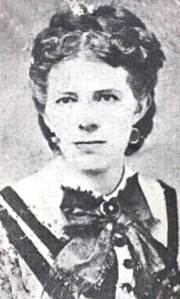
Kate Stone’s Civil War: A piece of amusement

Stone’s mother wishes Stone would stop seeing Lt. Holmes. Stone, surprised, offers her view on how to handle soldiers who may be romantic partners.

KS38

From 2012 to 2015, Stillness of Heart will share interesting excerpts from the extraordinary diary of Kate Stone, who chronicled her Louisiana family’s turbulent experiences throughout the Civil War era.

Learn more about Stone’s amazing life in 1861, 1862, 1863, 1864, 1865 and beyond. Click on each year to read more about her experiences. You can read the entire journal online here.

(Photo edited by Bob Rowen)

Stone’s mother wishes Stone would stop seeing Lt. Holmes. Stone, surprised, offers her view on how to handle soldiers who may be romantic partners.

May 21, 1865

Tyler, Texas

Coming in yesterday evening from the gallery after Lt. Holmes left, Mamma told me that she wished I would send Lt. Holmes off, that she much preferred my marrying Joe to Lt. Holmes, though neither was a suitable match, as Joe is too young and Lt. Holmes too dissipated.

I was surprised. I did not know she was taking it seriously, and I could honestly assure her I had not an idea of marrying either of them. I could have told her the same of Dr. McGregor, Lt. Valentine, and the conceited Capt. Birchett, should he ever make up his mind to propose. She seemed much relieved.

I thought she understood the point of view of most of the girls. One must not distress a soldier by saying “No” when he is on furlough. They have enough to bear. They may be going back to sudden death. Then they will most probably forget you for a sweetheart at the next camp, or their love will grow cool by the time you meet again. So it is just a piece of amusement on both sides.

If Mrs. Carson and Mrs. Savage only knew that I am as determined not to marry Joe as they are determined to prevent it, how much trouble and maneuvering it would save them. But I cannot well explain it to them. Joe can when he gets home, and their minds will be at rest.

Lt. Holmes has stopped drinking for some weeks now, since I asked him to do so one day during rehearsals when I saw ho was going too far. He was very nice about it. His face flushed and he thanked me but did not get angry as I feared.

Kate Stone’s Civil War: We fear it cannot last

Stone savors her new house in Tyler and fears the day when she must leave it behind to return to a ravaged Brokenburn plantation in Louisiana.

KS34

From 2012 to 2015, Stillness of Heart will share interesting excerpts from the extraordinary diary of Kate Stone, who chronicled her Louisiana family’s turbulent experiences throughout the Civil War era.

Learn more about Stone’s amazing life in 1861, 1862, 1863, 1864, 1865 and beyond. Click on each year to read more about her experiences. You can read the entire journal online here.

(Photo edited by Bob Rowen)

Stone savors her new house in Tyler and fears the day when she must leave it behind to return to a ravaged Brokenburn plantation in Louisiana.

Despite Stone’s insistence that she and Holmes are only friends, she spends virtually every moment with him, sews for him, and now even fights off rumors of their engagement.

May 9, 1865

Tyler, Texas

How comfortably our move was accomplished. Mamma gave general orders to the Corps d’Afrique [the Stones’ black servants] to move all our “duds” to the new house. We have only the bare necessaries except servants. They are plentiful. Then Mamma seated herself to the perusal of Burns, Kate went to sewing, I went off calling, returned to dinner, and then went out again.

Late in the afternoon … I went up to meet Mamma and welcome her to her new home, which we have named “The Rest” and which we intend to enjoy to the fullest until stern Fate again casts us out on the world.

Lt. Holmes came to tea, though we had explained to him we would not be ready for visitors before Tuesday. He said he forgot our warning. He has a settled habit of coming every day. I suppose he could not break himself of it. Lt. Holmes and I went over to Mrs. Savage’s to tea the other day taking Sister with us. … Spent rather an uncomfortable evening. Mrs. Savage and Mrs. Carson amuse themselves spreading the news of my engagement to Lt. Holmes. But I cannot really blame them. When two people are as much together, such reports will arise, and it does no good to tell them, as we do, that there is no engagement. Have not an idea of marrying him or anyone else. We are friends, nothing more. Such reports die out after a time and meanwhile we see much pleasure and amusement together. …

We find ourselves so comfortable that we are frightened. We fear it cannot last — a pretty six-room house, nicely improved grounds and surroundings with the flowers in full bloom. We are thankful to be at rest once more. I am busy embroidering a black velvet tobacco bag with scarlet fuchsias for Lt. Holmes.

Kate Stone’s Civil War: He would do anything

Stone’s entries refer to Lt. Holmes more often, and for good reason. Holmes would eventually become her husband.

KS25

From 2012 to 2015, Stillness of Heart will share interesting excerpts from the extraordinary diary of Kate Stone, who chronicled her Louisiana family’s turbulent experiences throughout the Civil War era.

Learn more about Stone’s amazing life in 1861, 1862, 1863, 1864, 1865 and beyond. Click on each year to read more about her experiences. You can read the entire journal online here.

(Photo edited by Bob Rowen)

Stone’s entries refer to Lt. Holmes more often, and for good reason. Holmes would eventually become her husband.

April 16, 1865

Tyler, Texas

All walked to church and were well repaid by an excellent sermon from Mr. Moore. … The tableaux with all their pleasant chat and laughter are a thing of the past. The gay rehearsals and frequent meetings are over, and we cleared about $900. The weather was wretched both evenings and of course kept many away, but we feel repaid for the trouble. The tableaux went off beautifully, not a hitch. Lt. Holmes — the Prince Charming as Mollie Moore and I dubbed him — was invaluable. He would do anything or adopt any suggestion we made. He was in attendance on Mollie and me all the time.

Dr. Weir came up to say good-bye as he is off for good. … He was much pleased with Mollie Moore, whom he met for the first time.

I tell Miss Mollie she always gets ahead of me when she tries the “poetry dodge” on our mutual friends. She is a charming girl. It is such a pleasure to have a friend to chatter nonsense to who enjoys it as much as I and does her full share. …

A bow to the King

Elvis Presley was born this week on Jan. 8, 1935, and died on Aug. 16, 1977. What he gave us will live forever.

It’s a feeling that can’t be denied. Sometimes you just have to submit to his reign. The King, who was born on Jan. 8, 1935, and died on Aug. 16, 1977, can dominate your consciousness, infusing his spirit and vitality into your heart and soul, adding an extra sparkle to your days. He shines that spotlight in your eyes, slaps you right across the face, reminds you to wake the hell up, look around, forget the pettiness of everyday life, and savor the world around you.

You have no choice but to sit back with him, laugh at the stardom, laugh at any notion of legacy and fame, and listen to some great music from a true American original. Don’t the fight the urge to do some affectionate impersonations, or just watch Johnny Cash, Jim Carrey, Eddie Murphy, and Val Kilmer do their own.

Several years ago, the National Portrait Gallery recorded a short but very informative introduction to the fascinating and bizarre meeting between Elvis and Richard Nixon (above). Also, Legacy Recordings released a magnificent series of podcasts exploring the rise of Elvis, his gospel roots, his comeback performance in 1968, his 75th birthday, and his Vegas years. Links are included below, along with a few Elvis performances. Enjoy.

1. ELVIS: THE EARLY YEARS Part 1 | Part 2 | Part 3
2. ELVIS: ULTIMATE GOSPEL Part 1 | Part 2 | Part 3
3. RELIVING THE ELVIS ’68 COMEBACK SPECIAL Part 1 | Part 2 | Part 3
4. ELVIS 75 Parts 1 through 20
5. ELVIS AND VIVA LAS VEGAS Part 1 | Part 2 | Part 3

SONGS
1. LOVE ME TENDER (Live) Elvis Presley
2. BABY WHAT YOU WANT ME TO DO (Live) Elvis Presley
3. HEARTBREAK HOTEL Elvis Presley
4. MERRY CHRISTMAS, BABY Elvis Presley

5 (more) facts about orgasm

2014 in review

Thank you for making 2014 the best year ever. Read the year-end WordPress graphical roundup.

Thank you so much for making 2014 Stillness of Heart‘s best year ever.

Here’s an excerpt:

The concert hall at the Sydney Opera House holds 2,700 people. This blog was viewed about 12,000 times in 2014. If it were a concert at Sydney Opera House, it would take about 4 sold-out performances for that many people to see it.

Click here to see the complete report.

Step by step

One step at a time. That’s all I have to believe in.

KS59

Slowly but surely, I’m building a full and rich life.

I have to believe that. Maybe happiness comes later.

Sophia Loren admits she was afraid Jayne Mansfield’s dress was ‘going to blow’ in infamous photo

IMG_2335

Joe Shere/mptvimages.com

Free Love Freefall

The revolutionaries were determined to make lasting changes to the various forms of sexual oppression they perceived. It remains to the current generation to ensure their still-blossoming accomplishments do not wither under cold conservative shadows.

IMG_1475

Allyn’s revolutionaries were determined to make lasting changes to the various forms of sexual oppression they perceived. It remains to the current generation to ensure their still-blossoming accomplishments do not wither under cold conservative shadows.
A review by Fernando Ortiz Jr.

*****

Discussed in the essay:

Make Love, Not War: The Sexual Revolution: An Unfettered History. By David Allyn. New York: Routledge, 2001. Pp. 381. $30.95

David Allyn’s Make Love, Not War intelligently and creatively tours a sexual renaissance that ebbed and flowed throughout the 1960s and 1970s, sparking changes of varying longevity throughout society. Latino and black Americans fought throughout this era for equal rights as citizens and for the freedom to pursue and fully embrace the American Dream. The general public’s gradual tolerance of public gay culture, the rise of swingers movements, the gaveling of obscenity trials, the publication of sex studies, and the embrace of the birth control pill all comprise for Allyn a sexual rights movement, a “revolution” that silenced some prudes, raised legal eyebrows, and brought America a few sultry steps closer to the fulfillment of “life, liberty, and the pursuit of happiness.”1

Allyn designates the early sixties to the late seventies as the era of the sexual revolution, and he links its progression to general economic health in the United States. They rise and fall together. He utilizes dozens of interviews with men and women — some identified and some under pseudonyms — thirty years after their revolution takes place. Sexual histories, sociological studies, essays, novels, and academic reports supplement his study of the birth control pill, lesbian empowerment, gay rights, fights over literary censorship, public excitement over sexually-charged theater and film works, nudist colonies, swinger parties, and the general struggle to strip shame away from anyone’s sexual life.

The revolution was a multi-pronged and disjointed effort that lurched toward sometimes unclear objectives. Critics may condemn Allyn’s book for its seemingly disorganized structure, but it actually properly reflects the messiness of a series of efforts to change social mores and personal prejudices. Allyn’s great strength as a writer is his ability to gracefully transition from one theme of the era to another.

If anyone wanted to read a new sex manual to improve their sex life, Allyn argues that the sexual revolution made that possible. If a gay man or woman wanted to add legal sexual escapades at a sex party into their urban lifestyle, the sexual revolution made that available. If upper and middle-class women wanted to control their fertility, swap their spouses with other couples, or find and buy a book filled with sexual imagery, the sexual revolution eased strictures, opened doors, and soothed public outrage. Americans could fully and freely explore their identities, fulfill their aspirations, find their limits, and live their lives. For almost everyone, Allyn explores, the sexual revolution provided the freedom from fear.2

Allyn is enamored with the term “revolution,” which is his theme as his historical tour widens its scope over American society. From the very beginning, Allyn credibly admits the duality of his terrain, of which some aspects “were not revolutionary at all but evolutionary.” The era’s development of the pill, the rise of the sexual book publishing industry, the debates over obscene literature, the stronger roles women secured for themselves in American society — all were inherited from earlier eras in American history, all far from original movements. He admits this duality and does nothing to compensate for its contradictory influence on his narrative structure except pair stories of triumph with stories of eventual defeat or threat.

The era’s legacy is a mixed success of progression and regression, like all revolutions in American history. American society generally accepts the use of birth control and the popularity of premarital sex, though religious leaders and worried parents still frown on the still-expensive pill. Uncensored pornography — from hard-core videos to the soft sensuality of Anais Nin — is ubiquitous in the online world and easily found in the most popular bookstores, though erotica still faces many “family-oriented” enemies. Celebrities, news organizations, the military, scientific organizations, national leaders, and students across the United States embrace homosexuality as a normal sexual orientation, gay rights for citizens and servicemen, gay adoptions, and gay unions. But legal recognition of gay marriages retains its legal and political polarizing effect.3

Not everything can change all at once. Not everyone is won over when new ideas, new bathing suits, new aspirations, and new freedoms dawn over the raucous American society. When it comes to sex, each citizen had to make his or her own personal journey. People change as they grow older. Love and desire bring their own contradictory and revolutionary effects on one’s understanding and acceptance of the world around them. Jealousy, lust, insecurity, and fear can easily disrupt carefully constructed arrangements among sexual partners.

His interviews with the revolution’s participants best capture these intimate journeys. However biased or self-conscious they may be three decades later, Allyn’s interviewees echo the bittersweet afterglow the revolution’s sunset left in their lives. One father remembered his son loudly declaring in an airport terminal that his mother took a shower with a male sexual friend. One humiliated teenager remembers when her sexually supportive father left condoms on every bed in case she wanted to have sex with her male guest. Allyn deserves credit for including the long, dark slopes of the era’s gleaming aspirations for sexual liberation. He mostly maintained his balance between giddy celebration of short-term sexual bliss and grim acknowledgement of the long-term emotional consequences.4

His book’s duality also demands answers to eternal historical questions: Do changes deserve to be considered revolutionary if they are not all long-lasting? Was the sexual blossoming in the sixties an aberration in social values, enough to be considered revolutionary, or was the real revolution comprised of religious attitudes and social frigidity that put in place decency laws, targeted erotic literature, oppressed gay communities, marginalized women, and put shame into the hearts and minds of millions of sexual beings? Perhaps Allyn’s era was simply a counter-revolution, an attempt to take further the romantic aspirations of early twentieth century struggles for gender equality, sexual freedom, a more-just democracy, and fulfilled personal desires. Perhaps Allyn’s era consisted of a series of moments when Americans again grappled with and consummated fundamental American ideals that the original revolutionary generation left their descendants in a different and better America to achieve.

The book’s focus is mostly on urban upper and middle-class Anglo citizens. Blacks, Latinos, and lower-class citizens are not part of this study, which leaves readers hungering for a greater variety of voices and experiences. However, his study is linked to the economic health of the U.S. When the economy worsened in the seventies, the sexual revolution sputtered, which suggests the sexual revolution belonged only to those who could afford its luxurious promise. Impoverished minorities had larger and more immediate problems to worry about — how to feed their children and themselves, where to find work, how to avoid or at least endure an oppressive and heartless society — that they could not be concerned about swinger parties, literary censorship, or lesbian rights.

Overall, Allyn’s conflicted book is a valuable contribution to the study of postwar America. He brings together a detailed examination of various aspects of a sexual renaissance that benefited and benefited from other struggles for other freedoms. The arguments from this era came down — and still do — to eternal American issues: How much equality is necessary to fulfill our founding principles? How much are Americans entitled to? Where does private control — over our bodies, our gender, our children’s education, our moral principles — end and a democratic society’s standards begin? Allyn’s revolutionaries were determined to make lasting changes to the various forms of sexual oppression they perceived. It remains to the current generation to ensure their still-blossoming accomplishments do not wither under cold conservative shadows.


1. David Allyn, Make Love, Not War: The Sexual Revolution: An Unfettered History (New York: Routledge, 2001), 3-4. Allyn asserts that the every aspect of the sexual revolution “had an impact on how we as a nation have come to think of life, liberty, and the pursuit of happiness.”
2. Allyn, 4-5.
3. Allyn, 8, 295-296.
4. Allyn, 217, 297-299.

Recommended reading / viewing / listening

This week: Enduring sexism / LBJ and the Secret Service / Exercise and depression / The Roman Empire / The political Eva Longoria

IMG_1475

This week: Enduring sexism / LBJ and the Secret Service / Exercise and depression / The Roman Empire / The political Eva Longoria

Most of these great items come from my social media networks. Follow me on Twitter, Tumblr, LinkedIn, MySpace, and Facebook for more fascinating videos, photos, articles, essays, and criticism.

1. Jessica’s Feminized Atmosphere
By Jessica Williams | The Daily Show | Oct. 2
“Also, that’s redundant.”

2. L.B.J.’s Bravado and a Secret Service Under Scrutiny
By Michael Beschloss | The Upshot :: The New York Times | Oct. 2
“Not long after President Kennedy’s assassination, President Johnson chafed under his Secret Service protection.”

3. What made Japan’s deadly volcanic eruption so unpredictable?
By Judy Woodruff and Miles O’Brien | PBS NewsHour | Sept. 30
“More than 250 people were out hiking and enjoying a nice fall day, when a surprise eruption littered the mountain with falling boulders, thick smoke and piles of ash. At least 36 people were killed.”

4. This Is How Eva Longoria Is Trying to Win the Midterms
By Asawin Suebsaeng | The Daily Beast | Oct. 1
“From working behind the scenes in the midterms to making a new farm labor documentary, the former Desperate Housewife has emerged as a force to be reckoned with in liberal politics.”

5. How Exercise May Protect Against Depression
By Gretchen Reynolds | Well :: The New York Times | Oct. 1
“Exercise may help to safeguard the mind against depression through previously unknown effects on working muscles.”

6. The Elements of Style
By Sasha Weiss | The Sunday Book Review :: The New York Times | Oct. 3
“Watching other women, seeing how they’re dressed and how they pull it off, is the way most of us learn to become ourselves.”

7. Former Haiti president Duvalier dies
By Mike Wooldridge | BBC News | Oct. 4
“Duvalier was just 19 when in 1971 he inherited the title of “president-for-life” from his father, the notorious Francois ‘Papa Doc’ Duvalier. He was accused of corruption, human rights abuses and repression in his rule, which ended in a 1986 uprising.”

8. Catastrophic Coltrane
By Geoff Dyer | NYR Gallery :: New York Review of Books | Oct. 4
“The interest of recordings from this final phase — in which Coltrane’s playing became increasingly frenzied and the accompaniment more abstracted — lies partly in what they preserve and partly in any hints they contain as to where Trane might have headed next.”

9. The Aral Sea’s Disappearing Act
By Anna Nemtsova | The Daily Beast | Oct. 4
“Satellite photos show how the depredations of dictators have turned the world’s fourth largest inland sea into a poisonous desert.”

10. 40 maps that explain the Roman Empire
By Timothy B. Lee | Vox | Aug. 19
“Two thousand years ago, on August 19, 14 AD, Caesar Augustus died. … Under Augustus and his successors, the empire experienced 200 years of relative peace and prosperity. Here are 40 maps that explain the Roman Empire — its rise and fall, its culture and economy, and how it laid the foundations of the modern world.”

Rebecca Aguilar

#CallingAllJournalists Initiative | Reporter | Media Watchdog | Mentor | Latinas in Journalism

Anna Fonte's Paper Planes

Words, images & collages tossed from a window.

Postcards from Barton Springs

Gayle Brennan Spencer - sending random thoughts to and from South Austin

The Flask Half Full

Irreverent travelogues, good drinks, and the cultural stories they tell.

Government Book Talk

Talking about some of the best publications from the Federal Government, past and present.

Cadillac Society

Cadillac News, Forums, Rumors, Reviews

Ob360media

Real News That Matters

Mealtime Joy

bringing joy to family meals

Øl, Mad og Folk

Bloggen Øl, Mad og Folk

a joyous kitchen

fun, delicious food for everyone

A Perfect Feast

Modern Comfort Food

donnablackwrites

Art is a gift we give ourselves

Fridgelore

low waste living drawn from food lore through the ages

BeckiesKitchen.com

MUSINGS : CRITICISM : HISTORY : NEWS

North River Notes

Observations on the Hudson River as it passes through New York City. The section of the Hudson which passes through New York is historically known as the North River, called this by the Dutch to distinguish it from the Delaware River, which they knew as the South River. This stretch of the Hudson is still often referred to as the North River by local mariners today. All photos copyright Daniel Katzive unless otherwise attributed. For more frequent updates, please follow northriverblog on Facebook or Instagram.

Flavorite

Where your favorite flavors come together