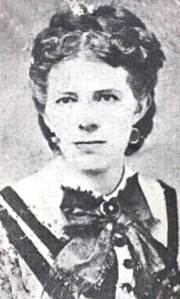
Loreta’s Civil War: Lavish affection bestowed upon me

Velazquez realizes she is willing to pay any price to begin her new life with her beloved, even in the face of family rejection.

KS33

Throughout 2016 and 2017, Stillness of Heart will share edited excerpts from the extraordinary memoir of Loreta Janeta Velazquez, who chronicled her adventures throughout the Civil War — either as herself, as a Confederate spy, or in disguise as Confederate Lt. Harry T. Buford. She fought and led men in terrible battles, fell in love, bore and lost children, and traveled throughout the U.S. and Europe, ultimately fulfilling her childhood dream of a rich and adventurous life.

You can read the entire 1876 memoir online here. Learn more about Velazquez (and the incredible documentary film Maria Agui Carter made about her) here.

Part 3: Velazquez realizes she is willing to pay any price to begin her new life with her beloved, even in the face of family rejection.

******

When my lover began to appear at my aunt’s as a pretty constant visitor, Raphael was quick to suspect him as a rival, who was more highly appreciated than himself, and became furiously jealous. I cannot tell what torture I suffered in endeavoring to be amiable to a man whom I hated, in order that I might prevent an explosion which would deprive me of the society of the one I really loved with the most devoted fondness. Finally Raphael, unable to endure the sight of his rival constantly in attendance upon me, and evidently finding extreme favor in my eyes, prevailed upon my aunt to forbid him admittance to the house, on the plea that he was becoming altogether too intimate with the betrothed of another. This gratified Raphael’s malignity, and it was a severe blow to both of us. …

In spite of my aunt’s endeavors to keep us apart, and in spite of Raphael’s jealous vigilance, William — for that was my lover’s name — found means to carry on a correspondence with me, to meet me at the houses of mutual friends, and to speak to me on the street on my way to and from school. …

[O]ne evening, as I was sitting at my window, in company with a young French Creole girl, I saw William pass and look up. I waved my handkerchief in salutation, and he recognized the signal by raising his cap. I then asked the young lady if she would not do me the favor of taking a letter to him, and of permitting us to have an interview at her home. She readily consented; and carrying a hastily written note to William, soon returned with an answer, to the effect that he would meet me in an hour’s time. My aunt did not permit me to go out alone in the evening; but as she suspected nothing wrong in the proposed visit to my friend’s house, she consented, without hesitation, for me to go under the escort of one of the servants. As my escort, of course, on our arrival at the rendezvous, remained with the servants of the house, I was able to converse with William without fear of espial, or of being interrupted.

My lover informed me that he expected soon to be ordered to one of the frontier posts. He declared that he could not exist without me, and proposed that we should elope, and get married privately. As this was my own plan exactly, I gave my consent, without any hesitation, the moment the proposition was made. On a little reflection, however, my conscience began to trouble me, for I knew that I should not be doing right; so I told him I would prefer that he should make an open and straightforward proposition for my hand to my parents. I considered that it was a duty I owed them to ask their consent first, but promised, if they opposed the marriage, that I would not let their disapprobation interfere with the consummation of our wishes. William himself thought that this was the proper and honorable course to pursue, and he accordingly wrote to my father, and asked his permission to marry me. A reply to his request was not long forthcoming, in which he was reprimanded in very harsh terms for daring to make it, knowing me to be the betrothed of another. This settled the matter; and accordingly, on the 5th of April, 1856, we were clandestinely married. …

My aunt was extremely indignant; and finding me obdurate, threatened to put me in the convent at Baton Rouge. I was terribly frightened at this, and concluded that it was time for me to act with decision. I accordingly informed my husband of the situation, and he came immediately and claimed me as his wife, presenting the certificate of marriage to my horror-stricken relative.

This was a terrible blow to my aunt, but a greater one to my parents, especially to my father, who idolized me. My father’s indignation got the better of his affection, and he promptly informed me that I might consider myself as repudiated and disinherited. The pangs this cruel message caused me were intense, but I was consoled with the lavish affection bestowed upon me by my handsome young husband, and with the thought that, in course of time, my parents would relent, and be willing to again receive me as their daughter. …


Loreta’s Civil War: Cry with rage and vexation

Loreta remembers her betrothal to a boy she did not love and her pursuit of the man with whom she wanted to spend the rest of her life.

KS16

Throughout 2016 and 2017, Stillness of Heart will share edited excerpts from the extraordinary memoir of Loreta Janeta Velazquez, who chronicled her adventures throughout the Civil War — either as herself, as a Confederate spy, or in disguise as Confederate Lt. Harry T. Buford. She fought and led men in terrible battles, fell in love, bore and lost children, and traveled throughout the U.S. and Europe, ultimately fulfilling her childhood dream of a rich and adventurous life.

You can read the entire 1876 memoir online here. Learn more about Velazquez (and the incredible documentary film Maria Agui Carter made about her) here.

Part 2: Loreta remembers her betrothal to a boy she did not love and her pursuit of the man with whom she wanted to spend the rest of her life.

******

How well I did play my part, happily, does not depend upon my own testimony alone, for some of the most distinguished officers of the Confederate Army, and many equally distinguished civilians, can and will testify to the truthfulness of the story I am about to relate, and to the unblemished character I bore while in the Confederate service. I not only assumed the garment of my sex once more with the credit of having done the state some important services, and of having labored with efficiency, courage, and energy to secure the independence of the Confederacy, but, with my womanly reputation unblemished by even a suspicion of impropriety. …

Both in Spain and in the Spanish dominions on this side of the Atlantic, is the name of Velazquez well known and highly honored. Don Diego Velazquez, the conqueror and the first governor of Cuba, under whose superintendence the expedition which discovered Mexico was sent out, was one of my ancestors, and Don Diego Rodriguez Velazquez, the greatest artist that Spain ever produced, was a member of my family. It will thus be seen that I came of excellent, although somewhat fiery and headstrong stock, and, if in assuming the garments of a man, and endeavoring to do a man’s work on the battlefield, I transgressed against the conventionalities of modern society … despite the fact of my being a woman, I might be able to enjoy the excitements of the battlefield, and win for myself a warrior’s fame. …

In 1840, my father was appointed to an official position in Cuba, and two years later I, his sixth and last child, came into the world in a house on the Calle Velaggas, near the walls in the city of Havana, on the 26th of June, 1842. I was christened Loreta Janeta. …

From my earliest recollections my mind has been filled with aspirations of the most ardent possible kind, to fill some great sphere. I expended all my pocket money … in the purchase of books which related the events of the lives of kings, princes, and soldiers. … I wished that I was a man, such a man as Columbus or Captain Cook, and could discover new worlds, or explore unknown regions of the earth. … While residing with my aunt, it was frequently my habit, after all in the house had retired to bed at night, to dress myself in my cousin’s clothes, and to promenade by the hour before the mirror, practicing the gait of a man, and admiring the figure I made in masculine raiment.

I was betrothed to a young Spaniard, Raphael R., in accordance with plans which my relatives had formed with regard to me, and without any action on my part. Indeed, my consent was not asked, my parents, thinking that they were much better qualified to arrange a suitable alliance than I was, and that, provided other things were satisfactory, love was something of minor importance, that could very well be left to take care of itself. They were mistaken, however … I had no difficulty in coming to the conclusion that the choice of a husband was something I ought to have a voice in. …

A marriage by parental arrangement was the last thing in the world to suit a scatter-brained, romantic girl like myself, whose head was filled with all sorts of wild notions, and it is not to be wondered at, therefore, that I rebelled. When I was betrothed to Raphael, however, I had not the slightest notion of objecting; and although I did not feel a particle of affection for him, I accepted him for my future husband, as a matter of course, and received his visits with a proper degree of complacency. … I consequently took no steps to get rid of Raphael until I chanced to make the acquaintance of a young American army officer who was paying particular attention to one of my schoolmates, Nellie V.

Nellie was a beautiful girl, of about sixteen years of age, and a very warm regard subsisted between us up to the time of her discovery that I was endeavoring to capture her lover. Her affection for me did not last long after that, and she said a great many disagreeable things about me, for which I have long since forgiven her, as I doubt not she has [forgiven] me for running away with her handsome young officer.

He was indeed a handsome young officer, and his manly and graceful appearance, especially when attired in his brilliant uniform, made such an impression on my heart, that I soon could think of nothing else. I found now that love was a reality, and my thoughts by day and my dreams by night had no other object than the gentleman who, while paying his assiduous attentions to Nellie, never imagined what ravages he was making in the heart of her schoolmate. I learned to hate Raphael, and his attempts to make himself agreeable to me only served to increase my dislike. Of Nellie I soon became savagely jealous, and was ready to cry with rage and vexation whenever I saw her lover paying her any delicate attentions. We, however, to all appearances, continued fast friends, and it was not for several months that she discovered I was her rival. The object of my devotion was also profoundly ignorant of my feelings towards him, and I had not the courage to tell him. At length I became desperate … to acquaint the young officer with the affection I entertained for him. …

One evening Nellie and I agreed to exchange partners, for the purpose of finding out how much they loved us. Raphael did not fancy this maneuver a bit, but submitted to it with as good a grace as possible. The officer and myself managed to get out of earshot of the other couple, but, now that the opportunity I had sighed for was mine, I was afraid to open my mouth on the subject nearest my heart. I trembled all over, but was determined before we separated to let him know the state of my heart. Finding that I had not courage to speak, I wrote a few words in his pocket diary, which told him everything.

He was intensely surprised but he declared, with much warmth, that he had long wished to speak with me on this very matter, and would have done so, were it not that he thought I was betrothed, and that under any circumstances there would be no chance for an American to win my affections. My new lover behaved in the most honorable manner, for, as soon as he obtained my consent for him to pay his addresses, he went to my aunt, and asked permission to visit at her house. She granted his request, with the condition that he was to understand that I was betrothed, and would demean himself towards me accordingly. This condition he listened to, but with a determination to pay little heed to it, his main object being accomplished in securing the right to see me without fear of being interfered with.

Recommended reading / viewing / listening

This week: Tragedy in Roma, Texas / Less NYC gay clubs / Letters of John Adams / Bernie Sanders and Eugene McCarthy / Google doodles

IMG_2126

This week: Tragedy in Roma, Texas / Less NYC gay clubs / Letters of John Adams / Bernie Sanders and Eugene McCarthy / Google doodles

Most of these great items come from my social media networks. Follow me on Twitter, Tumblr, LinkedIn, and Facebook for more fascinating videos, photos, articles, essays, and criticism.

1. Gay Dance Clubs on the Wane in the Age of Grindr
By Michael Musto | The New York Times | April 26
“Night life veterans point to a variety of reasons, including cultural shifts, real estate pressures and technology.”

2. Prince’s Paisley Park Home to Become a Museum
By Sebastian Modak | Conde Nast Traveler | April 26
“Sheila E., Prince’s longtime musical collaborator, revealed plans to memorialize His Royal Badness within the walls of his estate on the outskirts of Minneapolis.”

3. ‘West Wing’ Meets White House: Allison Janney Greets Reporters in Press Room
Associated Press :: The Hollywood Reporter | April 29
“She took the podium normally reserved for spokesman Josh Earnest and told reporters she hoped to bring attention to the nation’s opioid epidemic.”

4. Roma, Texas: A Smuggler’s Paradise
By Jay Root | The Texas Tribune | April 21
“Multiple inflatable rafts on the water. Emotionally shaken kids in the back of Border Patrol vans. Dope worth a quarter-million dollars on the street, dumped on the river’s edge. Roadside apprehensions. People running, swimming and shouting obscenities in and alongside a river shared by two countries.”

5. Meet the man behind Google’s doodles
By Elizabeth Garone | BBC Capital | April 26
“His job and others like it says a lot about why art matters more than ever to the binary world of technology”

6. Against American exceptionalism: Gordon S. Wood on John Adams
Library of America | April 19
“Library of America sat down with editor Gordon Wood, Alva O. Way Professor of History Emeritus at Brown University and the Pulitzer Prize?winning author of The Radicalism of the American Revolution, to discuss Adams’s complicated legacy, and the enduring appeal of his writings.”

7. The Hitchhiker’s Guide to the Islamic State
By Marwan Hisham | Dispatch :: Foreign Policy | April 20
“An accidental tour into the heart of the caliphate’s oil smuggling economy.”

8. NASA has mapped every eclipse that will occur for the next 1,000 years
By Brian Resnick | Vox | April 29
“They even know the exact time, down to the fraction of a second, that the eclipses will occur.”

9. What Bernie Sanders Should Learn From Eugene McCarthy
By Julian E. Zelizer | Politico Magazine | April 21
“In 1968, the Democratic insurgent refused to support the establishment nominee — and it was disastrous”

10. A Style-Setting J.F.K. Appears With a 2014 Congressional Candidate
By Michael Beschloss | HistorySource :: The New York Times | July 2014
“Recoiling from a famous photograph of President Calvin Coolidge in a Sioux headdress, which he considered comical, Kennedy almost always refused to wear unusual hats in public — including on the last morning of his life, when hosts at a Fort Worth breakfast pressed him, without success, to don a Stetson.”

“The depths of human turbulence”

Muster, the excellent blog for the Journal of the Civil War Era, recently interviewed the historical adviser to the new Civil War drama Mercy Street

IMG_1499

Muster, the excellent blog for the Journal of the Civil War Era, recently interviewed Dr. Jane E. Schultz, professor of English at Indiana University-Purdue University Indianapolis and historical adviser to Mercy Street, the PBS drama about women in Civil War hospitals. She perceptively argues that the series “is trying to show the depths of human turbulence that lay beneath the surface of military etiquette.”

Read the entire interview here. It offers intellectual depth and understanding to the process of shaping the drama’s narrative, location, characters, and era.

Recommended reading / viewing / listening

This week: Bill Cosby / A historic mammoth / ISIS: The Magazine / Benefits of red wine / Cartels and Mexican politics

IMG_2392[1]

This week: Bill Cosby / A historic mammoth / ISIS: The Magazine / Benefits of red wine / Cartels and Mexican politics

Most of these great items come from my social media networks. Follow me on Twitter, Tumblr, LinkedIn, MySpace, and Facebook for more fascinating videos, photos, articles, essays, and criticism.

1. Bill Cosby and His Enablers
By Ta-Nehisi Coates | The Atlantic | Jan. 12
“Even victims of discrimination can look away from — and thereby enable — other forms of violence.”

2. Gingerly, Donald Trump Tries Out Some Campaign Conventions
By Maggie Haberman and Patrick Healy | The New York Times | Jan. 15
“The risk for Mr. Trump is that too much baby-kissing, people-pleasing, Mr. Nice Guy politicking will come across as inauthentic to voters who like that he is, in their view, a tough-talking realist about perceived threats from Muslims, illegal immigrants, and budget-busting Democratic and Republican leaders in Washington.”

3. FDR’s Nate Silver
By David Greenberg | Politico Magazine | Jan. 16
“How a self-taught data whiz from Michigan became the first person ever to poll for an American president — and turned into a national sensation.”

4. A Mysterious Mammoth Carcass Could Change Human History
By Maddie Stone | Gizmodo | Jan. 14
“Its discovery … might push back the timeline for when humans entered the northernmost reaches of the world — including the first entries into North America.”

5. Why Cartels Are Killing Mexico’s Mayors
By Ioan Grillo | Sunday Review :: The New York Times | Jan. 15
“These new cartels continue to traffic drugs. … But they have also used their armies of assassins to move into new endeavors: rackets, extortion, oil theft, even wildcat iron mining. And they are now muscling in on one of Mexico’s most lucrative businesses of all: local politics.”

6. Republican warnings about an electro-magnetic pulse (EMP) attack, explained
By Philip Bump | The Fix :: The Washington Post | Jan. 15
“An EMP requires a very specific combination of things coming together in order to be effective.”

7. Why the United States can’t make a magazine like ISIS
By William McCants and Clint Watts | Brookings and The Daily Beast | Jan. 13
“Can you name a single U.S. government publication or online platform devoted to the anti-ISIS fight that is as informative or as widely-read as Dabiq? … We couldn’t come up with one either.”

8. Moving beyond Obama: How a transformational president became an impediment to change
By Elia Isquith | Salon | Jan. 16
“His romantic vision of America was once his greatest asset. But now it’s holding Obama and his country back”

9. Health Benefits of Red Wine vs. Grape Juice
By Karen Weintraub | Ask Well :: The New York Times | Jan. 8
“We keep hearing about the benefits of drinking red wine. Why not grape juice instead? It has the same benefits, plus no alcohol.”

10. Why Ike Wouldn’t Celebrate the D-Day Anniversary
By Michael Beschloss | HistorySource :: The New York Times | May 2014
“Thus Ike spent the D-Day anniversary of Sunday, June 6, 1954, out of sight, with his family at Camp David.”

CV of Fernando Ortiz Jr.

So far, so good … but there’s so much more to do.

IMG_2893

So far, so good … but there’s so much more to do.

Recommended reading / viewing / listening

‘The Force Awakens’ (of course) / A highway marriage proposal / ‘Thriller’ makes history / Confessions of a cartel killer / Trump’s unpleasant talents

IMG_1938

This week: ‘The Force Awakens’ (of course) / A highway marriage proposal / ‘Thriller’ makes history / Confessions of a cartel killer / Trump’s unpleasant talents

Most of these great items come from my social media networks. Follow me on Twitter, Tumblr, LinkedIn, MySpace, and Facebook for more fascinating videos, photos, articles, essays, and criticism.

1. Trump, Master of the Seven Deadly Sins
By Michael D’Antonio | Politico Magazine | Dec. 16
“How the GOP leader has succeeded for 40 years by bringing out the worst in people.”

2. Libya’s cultural heritage ‘being destroyed and plundered by Isis’
Associated Press :: The Guardian | Dec. 15
“Museums and UN say ancient artefacts and artwork are in danger of obliteration or being looted and sold illegally”

3. A Houston Marriage Proposal Stops Traffic
By Katie Rogers | The New York Times | Dec. 16
“Drivers did not give them more than a few seconds to celebrate. As the ecstatic couple hugged, the blare of car horns could be heard as people in trucks and S.U.V.s began to drive around the couple and their entourage, who were also recording.”

4. Alter Your Reading… Alternate History Picks Sure to Make You Wonder
By Billy Gschlecht | Bibliofile :: New York Public Library | Nov. 5
“Alternate history is an interesting and imaginative look at what might have been, sometimes for the better or worse, but certainly always different.”

5. Michael Jackson’s ‘Thriller’ sets new sales record
By Anthony McCartney | Associated Press | Dec. 16
“The album has sold 30 million copies in the United States, making Jackson the first artist to attain 30-time multiplatinum status …”

6. ‘Ghostbusters,’ ‘Top Gun,’ ‘L.A. Confidential’ Among 2015 National Film Registry Selections
Variety | Dec. 16
“Each year, the Library of Congress adds 25 notable films to its permanent collection, ensuring that the titles will be preserved for generations to come.”

7. 30 lives extinguished, but no regrets: A killer’s story
By E. Eduardo Castillo | Associated Press | Dec. 15
“This is a story from the other side, the tale of a man who kidnaps, tortures and kills for a drug cartel. His story is the mirror image of those recounted by survivors and victims’ families, and seems to confirm their worst fears: Many, if not most, of the disappeared likely are never coming home.”

8. ‘Star Wars: The Force Awakens’: The fanboy dissection of a film that restores faith
By Michael Cavna and David Betancourt | Comic Riffs :: The Washington Post | Dec. 16
“With John Williams’s soaring score still ringing in our ears, and the uplift of this soon-to-be globally embraced film still dizzying our senses, here is Comic Riffs’ fanboy dissection of the Star Wars franchise reawakened …”

9. Revisiting ‘Star Wars’ Before ‘The Force Awakens’
Here & Now :: NPR | Dec. 14
“That was back in the day when the first Apple II computers went on sale and Space Mountain was opening at Disneyland.”

10. When T.R. Saw Lincoln
By Michael Beschloss | HistorySource :: The New York Times | May 2014
“For Theodore Roosevelt’s family, Lincoln’s cortege was no abstract public ceremony. “

Kate Stone’s Civil War: The entire special series

Read Kate Stone’s amazing stories as she defiantly faces Union soldiers, escapes across a Louisiana swamp, falls in love with Texas, and watches the Civil War rip her country and her family apart.

1862

From May 2012 to November 2015, a special series from Stillness of Heart shared excerpts from the extraordinary diary of Kate Stone, who chronicled her Louisiana family’s turbulent experiences throughout the Civil War era.

She defiantly faced Union soldiers, escaped across a Louisiana swamp, fell in love with Texas, and watched the Civil War rip her country and her family apart.

The entire series of excerpts is collected here.

Learn more about Stone’s amazing life in 1861, 1862, 1863, 1864, 1865 and beyond. Click on each year to read more about her experiences. You can read the entire journal online here.

(Photo edited by Bob Rowen)

From 1861
May 15: Death in defense of the South
June 5: The stir and mob of angry life
June 18: Whipped unmercifully
July 1: They thought me so ugly
July 4: The blood of her children
July 26: Gallantly fought and won
Aug 24: The fevers
Sept. 27: The war inches closer
Oct. 19: Gladden our hearts
Nov. 27: The noble, gentle heart
Dec. 22: Rainy days

From 1862
Jan. 6: Sad Christmas
Jan. 8: Happy birthday
Jan. 16: They close in and kill
Feb. 1: The little creature
Feb. 20: Victory will be ours
March 1: A perfect love of a lieutenant
May 9: Burn our cities
May 22: Fashion is an obsolete word
May 23: The sleep that knows no waking
June 6: Trembling hearts
June 20-30: Capable of any horror
July 5: The fire of battle
Aug. 5: Beyond my strength
Sept. 23: Tragedy after tragedy
Oct. 1: His sins against the South
Nov. 7: A lady’s favors
Dec. 3: She was heartbroken

From 1863
Jan. 1: Preparing to run
March 2: Hoodoo woman
March 11: It made us tremble
March 22: The pistol pointed at my head
April 10: Tears on my cheek
April 15: A horrid flight
April 21: The greatest villian
April 26: Flaming cheeks and flashing eyes
April 27: The glory of the family
May 2: His father’s sins
May 3: Baffled beasts of prey
May 22: Useless to resist
May 23: Southern hearts
June 3: Like mad demons
June 15: On the road for Texas
July 7: The dark corner
July 12: The dirtiest people
July 16: Scowling, revengeful faces
July 26: Despondent and chicken-hearted
July 29: Makes us tremble for Texas
Aug. 3: Lose our scalps
Aug. 10: Conquer or die
Aug. 16: My pen is powerless
Aug. 30: They call us all renegades
Sept. 1: It makes us shiver
Sept. 14: Years of grinding toil
Sept. 20: Destroyed by the Yankees
Oct. 2: Two distressed damsels
Oct. 8: This is too disgraceful
Oct. 29: The heart of a boy
Nov. 1: Credulous mortals
Nov. 7: A fear of bad news
Nov. 13: Pride must have a fall
Nov. 15: So little to eat
Dec. 10: Nobly and fearlessly
Dec. 12: Alone in a strange land
Dec. 19: A charming little woman
Dec. 24: A sad 1863 ends

From 1864
Jan. 4: A noted flirt
Jan. 7: Trouble and distress
Jan. 13: The first desideratum
March 8: The mournful whistle
March 20: The petted darling
April 15: A besom of destruction
May 5: The easy conquest of Texas
May 7: To every young lady
May 18: To kill and destroy
May 25: Our best fancy yellow organdies
May 29: That land of desolation
June 1: The breath of flowers
June 14: Strangers in a strange land
June 19: Those terrible battles
June 26: Callous to suffering and death
Aug. 23: We enjoy our ease
Sept. 2: Lazy and languid
Sept. 5: One grand holocaust
Sept. 10: Too disgraceful if true
Sept. 27: The flower-wreathed scepter
Oct. 15: Fairy castles in the air

From 1865
Jan. 29: Kindly bestow them
Feb. 1: Our soldiers were powerless
Feb. 12: One of life’s greatest trials
Feb. 13: Peace blessed peace
Feb. 15: My escorts were disgusted
Feb. 21: Our only hope for peace
March 3: The most enjoyable life
March 9: Full of life and fun
March 24: Eager for a fight
March 30: Its spring decoration
April 1: Out of time
April 7: A blow on my heart
April 16: He would do anything
April 23: God spare us
May 7: Lounged and gossiped
May 9: We fear it cannot last
May 15: We will be slaves
May 17: Restless and wretched
May 20: A fever of apprehension
May 21: A piece of amusement
May 27: Only sadness and tears
May 31: The grand crash
June 12: Words are powerless
June 25: Civilization commences again
July 2: He deserves killing
July 13: It is unavoidable
July 18: A man-flirt is detestable
Aug. 14: No disorder
Aug. 26: Astonish the natives
Sept. 3: Our pleasant Tyler life
Sept. 11: The very poorest people
Sept. 21: A state of insubordination
Oct. 10: The bitterness of defeat
Nov. 16: At home again
Nov. 17: How many idle hours

Epilogue, from 1867 and 1868
I was young again

Kate Stone’s Civil War: I was young again

Stone’s last three entries in her diary are from September 1867 and 1868. They form a somber epilogue to her chaotic journey. They capture a bitter reflection of a shattered Southern slaveholding society, adrift, confused, and afraid of a world in which they no longer rule.

KS10

From 2012 to 2015, Stillness of Heart will share interesting excerpts from the extraordinary diary of Kate Stone, who chronicled her Louisiana family’s turbulent experiences throughout the Civil War era.

Learn more about Stone’s amazing life in 1861, 1862, 1863, 1864, 1865 and beyond. Click on each year to read more about her experiences. You can read the entire journal online here.

(Photo edited by Bob Rowen)

Stone’s last three entries in her diary are from September 1867 and 1868. They form a somber epilogue to her chaotic Civil War journey. They capture a bitter reflection of a shattered Southern slaveholding society, adrift, confused, and afraid of a world in which they no longer rule.

Read her first entry in this series here.

Sept. 22, 1867

Brokenburn

A long silence and a year of hard endeavor to raise a crop, reconstruct the place with the problem of hired labor, high water, and cotton worms. Mamma had little trouble in getting advances in New Orleans to plant. Cotton is so high that merchants are anxious to advance to put in a crop, and there is much Northern capital seeking investment in that field. … The Negroes demanded high wages, from $20 to $25 for men, in addition to the old rations of sugar, rice, tobacco, molasses, and sometimes hams. Many of the old hands left, and My Brother went to New Orleans and brought back a number of ex-Negro soldiers, who strutted around in their uniforms and were hard to control. I was deadly afraid of them.

During the spring while Mamma and I were in New Orleans (Mamma on business and she took me for my pleasure), and Uncle Bo and My Brother and Jimmy were away for a few hours, Johnny had a fight with a young Negro in the field, shot and came near killing him, and was mobbed in return. Johnny would have been killed but for the stand one of the Negroes made for him and Uncle Bo’s opportune arrival just as the Negroes brought him to the house a howling, cursing mob with the women shrieking, “Kill him!” and all brandishing pistols and guns. It came near breaking up the planting, and it is a pity it did not as it turned out. Johnny had to be sent away. He was at school near Clinton [Miss.] and the Negroes quieted down and after some weeks the wounded boy recovered, greatly to Johnny’s relief. He never speaks now of killing people as he formerly had a habit of doing. He came home when school closed and there was no further trouble.

Then the water came up and we were nearly overflowed. The cotton planted was very late, and when it was looking as luxuriant and promising as possible and we saw ease of mind before us, the worms came. In a few days the fields were blackened like fire had swept over them. We made about twenty bales and spent $25,000 doing it. What most distresses me is that none of that money went for our personal comfort. All of it went to the Negroes. Mamma would buy only bare necessaries for the table and plainest clothes for the family. Not a luxury, no furniture, carpets, or anything. We are worse off for those things than even in Texas and such a sum spent! But Mamma said it was not honest to spend the money on anything but making the crop. All in this section have suffered in the same way, and for awhile they seemed stunned by their misfortunes. But now the reaction has come, and all are taking what pleasure offers.

Old neighbors and new ones have come in and all seemed to be anxious to be together and talk over their trials and tribulations. There has been much visiting and various picnics and fish frys. I would not go at first. I felt like I did not want to see anybody or ever dance again. I felt fully forty years old, but Mamma made me go after a good cry. Once there, I was compelled to exert myself, and soon I was enjoying it all. The burden of some of the years slipped from my shoulders, and I was young again. It was pleasant to talk nonsense, to be flattered though one knew it was flattery, and to be complimented and fussed over. So since then, Mamma, the boys, and all of us have been going to everything and have found even poverty in company more bearable than when suffered alone. …

September 1868

Rose Hill

In January My Brother rented this place knowing that Brokenburn would be again overflowed, and we moved out the latter part of the month. My Brother lost money again last year planting, and this year he determined to farm, planting a little of everything.

Johnny and Jimmy are both at home, and having nothing to do pulled off their coats and rolled up their sleeves and went to work to raise a crop of corn and potatoes for themselves. They have succeeded well as they will clear several hundred dollars.

We all regret so much Jimmy’s refusal to go buck to the hospital. … We fear he is throwing away the best chance of his life. The boys are so hot and tired when they come in from the fields. …

Sept. 28, 1868

Rose Hill

Mother has been in Vicksburg for a month on a visit to Aunt Sarah. It is her first outing for eighteen months. We hope it will benefit her — her health has been bad for more than a year. She is seldom out of bed more than a week at a time. It took great persuasion and the pointed urging of the whole family to induce her to go on this visit that Aunt Sarah has been begging her to take for months.

Jimmy is now on the wharf boat, Johnny at Omega, and Sister, My Brother, and I have it all our own way with but little to do. My Brother is making an excellent crop and is much more cheerful. …

How we wish Sister could be sent off to school for two years, but it has been impossible. No money. … Let us hope that now the current will change and success will be our portion, as the outlook is brighter than for three years.

This is a pleasant neighborhood … and everybody has been kind and polite about calling and coming in at all times. [The other day we] had another of those inevitable dances that have been given so often this summer. Mary and Katie Byrnes, Louise Meagher, and the other girls never seem to tire of them, but they wear me out — such a sameness. I doubt not that I am getting too old for such gaieties. The men and boys about here are so silly and boyish in conversation. …

It has been an enjoyable life since we came here in January. It is a pleasant enough cottage house, after we got it thoroughly cleaned. There is a lovely little flower yard and a splendid orchard, and the kindest and most sociable neighbors with various little entertainments and dances. …We have new books and papers ad libitum, a luxury we missed for years.

My Brother has just sent Mamma money to buy our winter clothes, and Sister and I are jubilant at the prospect of new dresses and bonnets. We have lived on very little of late years, little bought that was not absolutely necessary. They have dressed me better than any of the others. I have not wanted for anything indispensable for a young lady, but the only money I have spent really as I wished was five dollars of the ten Uncle Bob gave me when Mamma and I went to New Orleans three winters ago. …

What splendid fellows my brothers are. They are all so good to us and such handsome boys. Sister looks almost the same, scarcely older than three years ago. We hope she can go to school this fall and make her debut next fall. If not, I shall beg Mamma to put long dresses … on her and bring her out this winter. She has a gay cheerful nature, and I hope will have a happy girlhood.

Mamma’s bright hopeful spirit never change. She is us always the ruling power with us all, the center and light of our home. How much she will have to tell us on her return, and maybe Aunt Sarah will come with her.

Well, this is the last page of the book that has gone with me through all our journeying. Looking back to the beginning so many years ago, I realize what an unthankful, wicked girl I was not to be supremely happy. With youth, health, and everything surrounding me for comfort and happiness. with unmistakable blessings, I was yet an unsatisfied, discontented girl. It has taken trouble to teach me my faults, and how earnestly I try now to enjoy instead of repine, to be thankful instead of fault-finding. I will try always to see the silver lining to the cloud. All my life I have been surrounded with love and care, far more than I deserved, and I will try in the future to be more worthy of the blessings that brighten my pathway.

So this is the end — shall I ever care to write again?

FINIS

Kate Stone’s Civil War: How many idle hours

Stone’s last entry of 1865 is filled with sadness and gives hints of what a grim future holds. But amid those dark hints, a small flame of romance stirs.

KS43

From 2012 to 2015, Stillness of Heart will share interesting excerpts from the extraordinary diary of Kate Stone, who chronicled her Louisiana family’s turbulent experiences throughout the Civil War era.

Learn more about Stone’s amazing life in 1861, 1862, 1863, 1864, 1865 and beyond. Click on each year to read more about her experiences. You can read the entire journal online here.

(Photo edited by Bob Rowen)

Stone’s last entry of 1865 is filled with sadness and gives hints of what a grim future holds. But amid those dark hints, a small flame of romance stirs.

Nov. 17, 1865

Brokenburn

My Brother amd Jimmy are off hunting, fishing, and spying on the land. Little Sister is absorbed in papers a month old, and I, having made my afternoon toilet — a habit of old that I may as well forget now that evening visiting is a thing of the past — have literally nothing to do and nothing to read except Shakespeare, and one cannot read him all the time. We certainly conned that book in Texas and on our various carriage trips. Mamma and Johnny should nearly know it by heart. There is no resort but scribbling. How many idle hours this book has filled.

Uncle Bob is the best old darkie. He has done the best he could to care for things and is as humble and respectful as ever. Every now and then he brings up presents of candy, raisins, and nuts. Aunt Laura’s silver service was buried in the yard, and Uncle Bob in walking one day stepped into a hole. He investigated and found the barrel head had decayed and sunken in. He did not say anything as the Yankees were on the place at the time. He quickly covered it up and that night slipped out and took it to his house, carefully hiding it, but it became noised about among the Negroes and a few spoons were stolen. I suppose his wife, Mary Ann, told as she is the real typical free darkie. The next day he packed the silver all up and took it down to Mrs. Graves to keep. He said he could no longer care for it, and now we have it all. He is the only Negro we know that would not at once on finding it have given or sold it to the darkies. He wants to rent some of the land and plant for himself next year. Mamma will let him have the land rent free. He sold his last cotton for $1 a pound. I wish we had a thousand bales.

Mamma should be back today. I wonder what she will bring us. We bought our first piece of Yankee finery in Shreveport, a broad black belt with an immense buckle for me.

In camping out this trip, we had every appliance for camping, and people who like camping would have found it pleasant. …

Shreveport seemed nearly as busy a place as New Orleans in the old times. … From there to Judge N. Richardson’s, the prettiest place on Bayou DeSaird. How more than comfortably they live in that stately comfortable home with the beautiful yard with its trees and shrubbery, splendid orchard, and well-worked garden, and with all the old servants and the most lavish table. … Lt., or Mr. Holmes now, came out twice to see us while we were there. He is looking handsome and was beautifully dressed. But alas, he has been spending a wild summer and fall, and though he assured me marrying would reform him, I believe not, A dreadful risk for any woman. I fear there is little hope for him. Ho expects to go to Maryland soon on a visit to his mother. That may save him. …

Thinking As Leverage

Developing deep and critical thinking.

Behind The Wall

Tabletop Games

Rebecca Aguilar

#CallingAllJournalists Initiative | Reporter | Media Watchdog | Mentor | Latinas in Journalism

Anna Fonte's Paper Planes

Words, images & collages tossed from a window.

Postcards from Barton Springs

Gayle Brennan Spencer - sending random thoughts to and from South Austin

The Flask Half Full

Irreverent travelogues, good drinks, and the cultural stories they tell.

Government Book Talk

Talking about some of the best publications from the Federal Government, past and present.

Cadillac Society

Cadillac News, Forums, Rumors, Reviews

Ob360media

Real News That Matters

Mealtime Joy

bringing joy to family meals

Øl, Mad og Folk

Bloggen Øl, Mad og Folk

a joyous kitchen

fun, delicious food for everyone

A Perfect Feast

Modern Comfort Food

donnablackwrites

Art is a gift we give ourselves

Fridgelore

low waste living drawn from food lore through the ages

BeckiesKitchen.com

MUSINGS : CRITICISM : HISTORY : NEWS