Stone’s critical eye takes in a town’s beauty, overpriced luxuries, her brother’s love, and a gentleman’s proper language use.
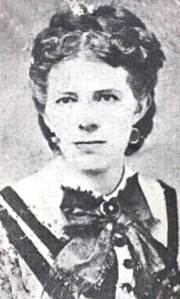
From 2012 to 2015, Stillness of Heart will share interesting excerpts from the extraordinary diary of Kate Stone, who chronicled her Louisiana family’s turbulent experiences throughout the Civil War era.
Learn more about Stone’s amazing life in 1861, 1862, 1863, 1864, 1865 and beyond. Click on each year to read more about her experiences. You can read the entire journal online here.
(Photo edited by Bob Rowen)
Stone’s critical eye takes in a town’s beauty, overpriced luxuries, her brother’s love, and a gentleman’s proper language use.
Aug. 3, 1863
Lamar County, Texas
Paris is a clean, pretty place in the edge of Blossom Prairie — clumps of trees and deep white sand in the streets.
We went to church and saw a really nice-looking congregation of refined-looking people. We all liked the place so well that Mamma would rent a place there, but it is too near the borderline, the first point for an invasion and right next to the Indian Nation. We do not wish to lose our scalps in addition to everything else. We saw a large party of Indian men dashing through the town. They are nearly all Southern sympathizers, we hear.
We went shopping. There are several well-filled stores, but the prices are beyond anything. We saw a pretty light calico but Mamma could not afford it at $6 a yard. A penknife was very tempting, but who would give $25 for a little Yankee knife? Our nails will have to grow like eagle’s claws before we can afford an extravagance of that kind. We did get a few articles, absolute essentials, and Mamma indulged me in a piece of extravagance a deck of playing cards at $5. They are a different kind from those the girls use out here, but I fancy they will afford us more amusement than the finest pair of cotton cards.
A gentleman gave us a late Louisiana paper containing Mary Gustine’s marriage on July 21. I know she was a beautiful bride, and our best wishes go with her for her future happiness. I wonder how Brother Coley will stand the loss of his sweetheart, his first love affair. Like most boys, he lost his heart to a girl several years the older — fortunately a disease that never kills a boy of that age.
The Baptist meeting has been going on in Paris for seven weeks, and sixty have joined that church. It seems the strongest church of this section. Sunday morning we heard a splendid sermon, the best since hearing Dr. Marshall preach two years ago. I wish Jimmy could have heard it. It was the first real Baptist sermon I ever really listened to. Have heard the preacher, Mr. Buckner — knows what he believes and is not afraid to preach it from the pulpit.
We have made the acquaintance of another Texas gallant. Dr. Bywaters, introduced as a friend by Mr. McGleason, walked home with us from church. One thing in his favor: he does not say “mile” for “miles,” and he does not ignore the plural of “year.”
Stone at last confirms the Confederate defeat at Vicksburg, three weeks later. In her mind, Robert E. Lee is the only Confederate commander that still holds the torch of hope for final victory.
From 2012 to 2015, Stillness of Heart will share interesting excerpts from the extraordinary diary of Kate Stone, who chronicled her Louisiana family’s turbulent experiences throughout the Civil War era.
Learn more about Stone’s amazing life in 1861, 1862, 1863, 1864, 1865 and beyond. Click on each year to read more about her experiences. You can read the entire journal online here.
(Photo edited by Bob Rowen)
Stone at last confirms the Confederate defeat at Vicksburg, three weeks later. She and her mother worry about the vulnerability of Texas to Union forces. More immediately, they’re worried for their family. If Texas is invaded, how much farther west should they go to escape emancipating Union forces? In Stone’s mind, Robert E. Lee is the only Confederate commander that still holds the torch of hope for final victory.
As Stone bemoans the lack of decent shoes, she gets in one more dig at barefooted Texan women.
July 29, 1863
Lamar County, Texas
Vicksburg is taken without a doubt. If our men had held out only one day longer, they might have been relieved, as Gen. Johnston fought the enemy the following day, in ignorance of the fall of the city, taking 5,000 prisoners and winning a decided victory. But that is not an offset to the 20,000 of our men said to have been captured at Vicksburg. How has the mighty fallen, and to give up on the Fourth of July to make it even worse. We wish they could have held on at least one day longer, but we know nothing of the hardships our soldiers have endured there in the last eight months. We are satisfied, however, that the Confederate soldiers held on as long as possible. The fall of Vicksburg makes us tremble for Texas. She can be invaded from so many points that Mamma knows not where to look for a place of greater safety.
Our only hope is in Lee the Invincible. If he has only taken Washington or Philadelphia as we hear he has, we can stand the loss of our Gibraltar, but to lose it and gain nothing in return is insupportable. We will hope for the best. May God defend the right. …
July 31
Mamma has been sick since her return. … Tomorrow we are going up to Paris with Mr. Smith to see if Mamma can get him off from militia duty. He is drafted to go off on Wednesday for six month’s service. We do not see how Mamma can get on without him, and so she is anxious to get him detailed. Mrs. Smith is also anxious to get him off, but their eagerness is as nothing to Mr. Smith’s. I never saw a man with such a dread of the army.
The fruit that Mamma and Mr. Smith collected on their journey and they were most thoughtful is just out. We did so enjoy it. Our fare is not of the best. Mamma bought me a pair of $25 shoes, but unfortunately I cannot wear them. Not anything of a fit, and I must still cling to my calfskin chaussures, homeknit stockings, and brogans, something different from the lace-like clock stockings and French slippers of the olden times. I miss nice things for my feet now more than anything. I feel so slovenly with these horrors on exhibition. But a truce to complaints. I might be dight out in a large hoop and bare feet.
One minor but interesting element of Stone’s diary is how long it took for her to learn of developments on the battlefield.
From 2012 to 2015, Stillness of Heart will share interesting excerpts from the extraordinary diary of Kate Stone, who chronicled her Louisiana family’s turbulent experiences throughout the Civil War era.
Learn more about Stone’s amazing life in 1861, 1862, 1863, 1864, 1865 and beyond. Click on each year to read more about her experiences. You can read the entire journal online here.
(Photo edited by Bob Rowen)
One minor but interesting element of Stone’s diary is how long it took for her to learn of developments on the battlefield. As her old world crumbled, as she was cut off from traditional letters and newspapers, and as she moved farther and farther away from Brokenburn, it took longer for her to learn about rumors of defeats and victories and even longer to gain accurate information about such events.
For example, the Battle of Gettysburg ended on July 3, 1863, and Vicksburg surrendered to Grant’s siege on July 4. Note what Stone says of Lee in Pennsylvania and of Vicksburg’s defenders, almost two weeks after both Confederate defeats.
July 16, 1863
Lamar County, Texas
The atmosphere has been most peculiar for several days. The air is cool and damp. The earth, the air, the sky — all are a dull dead grey. The sun seems to emit neither heat nor light, gleaming with a dim red glare like a blood-red moon. We thought at first it was one phase of the Texas climate, but the natives are as much puzzled by it as the strangers in the land. Some think it portentous, a sign of great victories or defeats. Others think it the smoke from burning grain in Mississippi. No one really knows anything about it.
We hear that we have won a glorious victory back of Vicksburg, repulsing one wing of Grant’s army and opening communication with Vicksburg and replenishing her supplies. Also we hear of surprising the enemy in south Louisiana and capturing many men and stores. We also hear that Gen. Lee’s army is laying waste [to] Pennsylvania. If only the Pennsylvanians may feel some of the horrors of war and know the bitterness of defeat. We live in hopes that our day of triumph may come but we fear not in the near future. …
Texas seems a hard land for women and children. They fly around and work like troopers while the men loll on the galleries and seemingly have nothing to do. Mamma cannot start on her search for a new home for a week yet, and it is disagreeable living here … their ways are not our ways.
As we sat on the gallery tonight, gazing across the darkening prairie into the gleaming west, the very air was brilliant with fireflies. The fancy came that they were the eyes of the departed Indians, come to look again on their old hunting grounds, flashing through the night, looking with scowling, revengeful faces on the changes wrought by their old enemies, the palefaces. I fancy I can see the ghostly shapes one minute taking the form of an Indian brave with bended bow and flying arrow, the next fading into thin air leaving only the fiery eyes. …
Stone hated and pitied the people of Texas. She gagged at the sight of unshaven men sitting at her dinner table. The seeming normality of violence horrified her. But the natural beauty of Texas gradually entranced her.
From 2012 to 2015, Stillness of Heart will share interesting excerpts from the extraordinary diary of Kate Stone, who chronicled her Louisiana family’s turbulent experiences throughout the Civil War era.
Learn more about Stone’s amazing life in 1861, 1862, 1863, 1864, 1865 and beyond. Click on each year to read more about her experiences. You can read the entire journal online here.
(Photo edited by Bob Rowen)
Stone hated and pitied the people of Texas. Barefooted women, evidently ignorant of the latest Southern fashions, still wore outdated “hoops.” The roads all the looked the same. She gagged at the sight of unshaven men sitting at her dinner table. She lost her appetite when she witnessed dusty slaves washing dishes “in the duck pond” before dinner. The Texas heat was punishing. The seeming normality of violence horrified her.
But the natural beauty of Texas gradually entranced her.
July 12, 1863
Lamar County, Texas
We made our first visit in Texas yesterday. We went to a protracted meeting being carried on nine miles from here at an old schoolhouse called — it must be in mockery — “Paradise.” After the meeting we went by invitation to spend the evening and night with some real nice people, settlers from Virginia, the McGleasons. They are a pleasant family and exceedingly hospitable. We came back this morning after a ride of nearly eighteen miles, having missed our road three times. The prairie roads are so much alike it is impossible for strangers to distinguish the right from the wrong.
The congregation was much more presentable than the Gray Rock crowd. We saw several nice-looking families, but all were in the fashions of three years ago. If they would only leave off their tremendous hoops, but hoops seem in the very zenith of their popularity. Mamma and I were the only women folks without the awkward, ungraceful cages. No doubt the people thought us hopelessly out of date. We have not worn them for a long time. Nothing looks funnier than a woman walking around with an immense hoop barefooted.
Mamma and I went several days ago to Tarrant in Hopkins County. The road ran part of the way over a lovely rolling prairie, dotted with clumps of trees and covered with the brilliant, yellow coreopsis in full bloom and gemmed with countless little mounds of bright green, like emeralds set in gold. Tarrant is the hottest looking, new little town right out in the prairie not a tree.
We tried to eat dinner at the roughest house and with the dirtiest people we have met yet. The table was set on a low, sunny gallery and half a dozen dirty, unshaven men took their seats in their shirt sleeves at the dirtiest tablecloth and coarsest ware. We saw the Negro girl wash the dishes at the duck pond right out in the yard. That was too much for me, but Mamma and Mr. Smith managed to swallow down something. …
The prairie we are living on is called a thicket prairie. There are clumps of dwarf dogwood, spice trees, and plums, tangled together with wild grape and other vines and alive with snakes. The plums are just in season, a sour, red variety just like the swamp wild plums, and are nice for jelly. The prairie is a mass of flowers, one variety covering it at a time. Before you realize it, that color has faded away and another has taken its place, and this succession of flowers and colors goes on until frost comes and spreads a brown sheet over all. There are many familiar garden flowers: blue salvia, coreopsis, verbenas, larkspur, standing cypress, and now as far as the eye can reach the prairie is a mass of waving purple plumes, “French pinks,” the natives call them. …
We hear no news now but accounts of murders done and suffered by the natives. Nothing seems more common or less condemned than assassination. There have been four or five men shot or hanged within a few miles of us within a week. No one that we have seen seems surprised or shocked, but take it as a matter of course that an obnoxious person should be put to death by some offended neighbor. A few evenings ago a captain in the army had just reached home on a furlough three hours before when he was shot at through his window. He was killed and his wife dangerously wounded. The authorities are trying to find the men who did it. It is supposed to be one of his company who had vowed vengeance against him. The other miscreants go unwhipped of justice.
After two weeks, Stone decided that Texas was home only to deadly snakes, fleas “by the millions,” ignorant children, and ugly women.
From 2012 to 2015, Stillness of Heart will share interesting excerpts from the extraordinary diary of Kate Stone, who chronicled her Louisiana family’s turbulent experiences throughout the Civil War era.
Learn more about Stone’s amazing life in 1861, 1862, 1863, 1864, 1865 and beyond. Click on each year to read more about her experiences. You can read the entire journal online here.
(Photo edited by Bob Rowen)
Kate Stone despised her new wartime home. After two weeks, she decided that Texas was home only to deadly snakes, fleas “by the millions,” ignorant children, and ugly women. “There must be something in the air of Texas,” she wrote, “fatal to beauty.”
July 7, 1863
Lamar County, Texas
While camping out we were generally too tired at our noonday rest to do anything but throw ourselves down on the cushions and sleep until dinner. And at night when we stopped, I had only spirit to lean lazily back in one of our two rocking chairs and watch Annie get supper or to look up at the stars and think of all the dear friends that the waves of Fate are sweeping farther and farther away from us every day. I had such a longing for home and the dear life of the past that my very soul would grow sick. I know Mamma felt it far more than I did, but she would not complain.
I will copy a letter I wrote to Anna Dobbs which tells all there is to tell of our late journeyings:
“Here we are safely hidden in a dark corner of the far off County of Lamar after a tiresome, monotonous trip of little less than three weeks, and I am already as disgusted as I expected to be.
“This part of the land abounds in white-headed children and buttermilk, my two pet aversions. It is a place where the people are just learning that there is a war going on, where Union feeling is rife, and where the principal amusement of loyal citizens is hanging suspected Jayhawkers. Hoops are just coming in with full fashion. This is indeed the place where hoops ‘most do flourish and abide. Have not seen a hoopless lady since entering the state. Shoes are considered rather luxuries than necessaries and are carefully kept for state occasions. … One tin pan or a frying pan answers every purpose. Wash tubs seem obsolete and not to be bought at any price.
“The only way of killing time and one never feels more like killing him than on this desolate wind-swept prairie is to attend some of the protracted meetings that are being carried on all around us. And oh, the swarms of ugly, rough people, different only in degrees of ugliness. There must be something in the air of Texas fatal to beauty. We have not seen a good-looking or educated person since we entered the state. We are in the dark corner. We could not stand it here for a permanent stay, but Mamma has only stopped here for a breathing spell and to see how the Negroes are getting on. She will start out soon in search of a home until the war is over.
“We camped out except when it rained, which it did most of the last week, thereby ruining most of the clothes we had so laboriously amassed after fleeing from the Yankees. We would be so tired by night we welcomed the rudest shelter. The longer we traveled the more wearisome it grew, and I never turned over at night without expecting to feel the sting of a tarantula or centipede. But we really saw very few and reached here without an accident. I wrote to Sarah Wadley never to come to Texas for pleasure, but if forced to come to cover herself with a thin coat of tar to protect herself from the myriads of insects along the road. And here, we have settled at their headquarters ticks, redbugs, fleas by the millions, and snakes gliding through the grass by hundreds. But we rarely hear of anyone being snake-bitten. Game, deer and turkeys are abundant about here but not eatable on account of the insects tormenting them until they are too tough to eat. …
“We are staying right out on the bare prairie in a rough two-room shanty with the overseer and his family. With only the bare necessaries of life, we think it will be at least two months before we can make any change, and so we must needs make the best of it.”
Stone mourned the loss of Stonewall Jackson at the May 1863 Battle of Chancellorsville, calling him a “peerless general and Christian soldier.”
From 2012 to 2015, Stillness of Heart will share interesting excerpts from the extraordinary diary of Kate Stone, who chronicled her Louisiana family’s turbulent experiences throughout the Civil War era.
Learn more about Stone’s amazing life in 1861, 1862, 1863, 1864, 1865 and beyond. Click on each year to read more about her experiences. You can read the entire journal online here.
(Photo edited by Bob Rowen)
Stone mourned the loss of Stonewall Jackson at the May 1863 Battle of Chancellorsville, calling him a “peerless general and Christian soldier.”
May 23, 1863
Near Monroe, La.
Aunt Laura was quite ill while Mamma was away, and I felt the responsibility of taking care of her. She is now much better. Mamma had two fevers, and we were very afraid it would go into a long low fever. She is quite prone to have that in the spring, but fortunately she has escaped a return of it. Sarah, Mary Wadley, and I went last afternoon to call on the Misses Compton and Stacey. We went in Mamma’s famous Jersey wagon, and it is a ramshackled affair with the seats and most of the bottom dropped down. We had a merry ride and concluded that a frame, a tongue, two mules, and a driver were the only essentials in a vehicle. … Walking through the pine woods, we saw wild flowers in such profusion. The air is so fragrant that it is a pleasure to breathe it. …
The news from Mississippi is bad. Gen. Grant with an army of 120,000 men is in the rear of Vicksburg. He has possession of Jackson, and much of the city has been burned. There has been a battle near Raymond in which we were said to have been routed because of Gen. [John C.] Pemberton’s disregard of orders. We drove them out of Jackson once, but we cannot hear whether they retook it after a battle or whether our forces withdrew. We will not be discouraged. …
In the death of Stonewall Jackson [at the Battle of Chancellorsville] we have lost more than many battles. We have lost the conqueror on a dozen fields, the greatest general on our side. His star has set in the meridian of its glory, and he is lost to his country at the time when she needs him most. As long as there is a Southern heart, it should thrill at the name of Stonewall Jackson, our peerless general and Christian soldier. His death has struck home to every heart. …
May 24
Mamma and I went over yesterday after tea to see Capt. and Mrs. Harper. They are also on their way to Texas. Capt. Harper was one of the party at home on Christmas Eve, and my last ride on Wonka was to invite the gentlemen in camp over to Brokenburn.
We were glad to meet his little daughter Sophie Harper, Mr. Valentine’s grandchild. Both of the Mr. Valentines talked so much about her. She is a bright, attractive child and bears a striking resemblance to her Uncle Mark in features, gesture, and expression. They say old Mr. Valentine is so overwrought by his losses … that it is feared he will lose his mind. He escaped from his place a few days after we left entirely alone in a boat with only a few clothes. The Negroes came and stripped the place of everything while he was on it and were exceedingly insolent to him, threatening all the time to kill him. He is quite an elderly man and cannot stand hardships like younger people. …
May 26
Mamma is staying tonight with Mrs. Young whose little girl Alice is sick unto death. Johnny, who by the way could not overtake Mr. Smith, and Mamma went into Monroe this morning trying to buy a wagon and carriage but failed to get either. So we must … wait here until we can get conveyances, and we could not ask for a more delightful stopping place or kinder hosts. Such a haven of rest after the trouble and anxiety of the last three months. We have put away troubles and distress for a time as a wayworn traveler lays down his burden when he stops to rest, enjoying the coolness and verdure, though he knows the burden must be lifted and he must journey on through toil and pain to the end.
How I dread being secluded on some remote farm in Texas, far away from all we know and love and unable to get news of any kind. It is a terrifying prospect.
I am busy sewing most of the time. We will soon be through all our clothes — just a white barege dress of Carrie’s to alter for myself and Mamma intends making a black velvet hat for me. Then, all our pressing needs will be gratified. …
Stone’s bitter sense of humor flashed for a moment as she dryly observed the effects of marriage on a young woman’s beauty.
From 2012 to 2015, Stillness of Heart will share interesting excerpts from the extraordinary diary of Kate Stone, who chronicled her Louisiana family’s turbulent experiences throughout the Civil War era.
Learn more about Stone’s amazing life in 1861, 1862, 1863, 1864, 1865 and beyond. Click on each year to read more about her experiences. You can read the entire journal online here.
(Photo edited by Bob Rowen)
As Stone and her family regained their bearings in their temporary home before making the final push for Texas, Stone’s bitter sense of humor flashed for a moment as she dryly observed the effects of marriage on a young woman’s beauty.
May 3, 1863
Near Monroe, La.
We went to a real country church this morning, saw a country congregation, and heard a sermon to match. Loring Wadley made several trips with the buggy to get us all there, but two of the party rode back in Dr. Young’s $3,000 carriage. We had a pleasure today in a visit of several hours from Julia Street. She came down from Bastrop just for the day. She is more nearly depressed than I ever saw her.
Annie and Peggy got here from the salt works today, and we are glad to have somebody to wait on us again. I expect we will keep them busy. …
May 5
Near Monroe, La.
The gunboats are unable to pass Grand Gulf and are lying idle between Vicksburg and Grand Gulf, like baffled beasts of prey. There is a great scarcity of provisions all through Mississippi. It is difficult to provision Vicksburg for a long siege. …
We went yesterday to see Florence Pugh (now Mrs. Morrison), an old schoolmate. The family are near here now on their way to Texas. She is a dear, sweet girl but looks dreadful. How marrying does change a body for the worse. She was a pretty girl a year ago, fresh and dainty. Now she is married and almost ugly.
I am busy every day trying to make up the cloth Mamma bought, but it is slow, tiresome work for one person with no sewing machine. The only things Mamma could find to buy belonged to the Lowrys, and they sold them at awful prices: $60 for a pair of common blankets, $50 for a pair of linen sheets, and everything else in proportion. They have sold much of their own clothing. Mamma bought some of Olivia’s things for Sister. … It seems funny to be wearing other people’s half-worn clothing, but it is all we can get. Mamma bought some Turkey-red calico at $3 a yard for a dress for Sister.
May 10
Near Monroe, La.
Mamma returned from the salt works on Friday, riding the whole distance on horseback. It was dreadfully fatiguing for one who rides so little. She has gone this evening to Delhi to make another attempt to have the Negroes brought out, if she can get soldiers to go with Jimmy. Quite a number of Negroes have been brought out in that way recently, some from within the lines.
The news from the salt works is bad. Frank, my maid, and Dan both died of pneumonia and neglect, and three others are very ill. Poor Frank, I am sorry for her to go. She has been raised in the house with us. With so much sickness among the Negroes, Mr. Smith has been unable to start to Texas. …
Several thousand of our soldiers are now at Monroe under Maj. Gen. Walker. Two of the officers spent yesterday evening here and told us the whole command would get off this morning and that there were some splendid bands with the regiments. So this morning we rode out to the river opposite Monroe to see them off, starting before sunrise. We saw crowds of soldiers, talked to a number of them, and heard inspiring music. The ride all the way through the spring woods was delightful. I sat up until twelve the night before fixing a sort of riding habit. … The troops after embarking received counterorders and are again in Monroe, expecting to march at any minute. There is another panic in Monroe. The Yankees are looked for at any time. They could not make anything out of this poor family. We have been too thoroughly plucked by the river Feds. …
Aunt Laura is not very well. We would dread to see her get sick.
Youth, family, happiness, and hope all seemed to be mere memories of an antebellum existence lost forever.
From 2012 to 2015, Stillness of Heart will share interesting excerpts from the extraordinary diary of Kate Stone, who chronicled her Louisiana family’s turbulent experiences throughout the Civil War era.
Learn more about Stone’s amazing life in 1861, 1862, 1863, 1864, 1865 and beyond. Click on each year to read more about her experiences. You can read the entire journal online here.
(Photo edited by Bob Rowen)
Kate Stone’s rage over Northern victories burned bright over the general landscape of depression she inhabited. Youth, family, happiness, and hope all seemed to be mere memories of an antebellum existence lost forever.
May 2, 1863
Near Monroe, La.
We have been comfortably domiciled here since Tuesday. It is indeed a delightful change from Mr. Deane’s, that musty room and uneatable fare. This is a large roomy but unfurnished house, a kind, pleasant family, and excellent fare — an oasis in the desert. The mother, Mrs. Wadley, two grown daughters, a grown son, and two or three younger children make up the family at home. Col. Wadley is on the other side of the river. They are railroad people. Aunt Laura is boarding just across the road from us, and there is a young lady, Carrie Young, and a grown son in that house. Then, there are quite a number of young people in walking distance. There is no dearth of company, but I cannot enjoy it. I feel out of place with a party of gay young people. Their mirth jars my heart. Life seems too sad a thing to spend in talking nonsense. I feel fifty years old.
The two Miss Dawsons from Madison Parish seem to be the belles of the country. They refugeed out here some time ago and are enjoying themselves exceedingly. Their house is a favorite resort for the officers, and the girls are out riding and walking with some of them every day. Fannie Dawson is beautiful, accomplished, and fascinating, we hear.
Bad news from the Negroes at the salt works. Jeffrey is dead and several others are very sick. The three whose wives are on the river ran away but were caught. Mamma and Johnny with a new overseer and his wife started to the salt works yesterday. She will start all the Negroes who are able to travel at once to Texas. We will perhaps go to Homer [La.].
The news from Mississippi is bad. The Yankees are making raids through the state, cutting off supplies from Vicksburg. … The panic here has subsided though the authorities are still moving government stores from Monroe. …
I have been hard at work ever since coming here slewing on the goods Mamma bought from Mrs. Lowry. We need so many things that it is hard to decide what to make first. Mamma bought a lot of linen sheets from Mrs. Lowry, and I am making them into underclothes, thick and strong. They should last until the war is over. …
[New York Tribune editor] Horace Greeley’s son was out at Mr. Curry’s place on a stealing expedition last week. When reading the Tribune two years ago and abusing Greeley for his vile slanders of the South, we never thought any of his kith or kin would ever be that near Brokenburn. Such are the chances of war. We did not think any of Mr. Greeley’s relations would be in the war. “He doth protest too much,” though he does write of it as a Holy Crusade. Do you think it wicked to wish that one of our enemies may be killed as a punishment for his father’s sins?
Springtime fights over skin / Tax myths / Near-death experiences / Le Carre’s doubts / Anthony Weiner is back
Most of these great items come from my Twitter feed or Facebook news feed. Follow me on Twitter, Tumblr, and Facebook for more fascinating videos, photos, articles, essays and criticism.
1.The 5 Kinds of Flesh-Obsessed Articles You Read in the Spring By Katie J.M. Baker | Jezebel | April 11
“Every spring, concerned citizens spring up like so many tulips (or boners) to share their opinions on how women should and shouldn’t dress when it’s warm outside. Unfortunately, unlike pollen allergies, there’s no known antidote for these five most obnoxious types of seasonal ‘Ladies! Put your clothes on/take them off, plz!’ articles.”
2.Five myths about taxes By Steven R. Weisman | Five Myths :: The Washington Post | April 11
“Whether tax cuts generally spur economic growth and tax increases generally dampen it is debatable …”
3.Why a Near-Death Experience Isn’t Proof of Heaven By Michael Shermer | Scientific American | April 13
“The fact that mind and consciousness are not fully explained by natural forces, however, is not proof of the supernatural. In any case, there is a reason they are called near-death experiences: the people who have them are not actually dead.”
5.Army’s Disaster Prep Now Includes Tips From the Zombie Apocalypse By Spencer Ackerman | Danger Room :: Wired | April 12
“[W]hether you’re confronting extreme weather that shorts out a power grid or running from a marauding horde of the undead, preparation is the key to survival.”
6.Resort Of Last Resort By Aubrey Belford | The Global Mail | April 5
“Fear, corruption, boredom, smugglers, extortionists, Saudi sex tourists and temporary wives: such is life in the Indonesian resort town that has become limbo for asylum seekers.”
7.John le Carré: ‘I was a secret even to myself’ By John le Carre | The Guardian | April 12
“After a decade in the intelligence service, John le Carré’s political disgust and personal confusion ‘exploded’ in The Spy Who Came in from the Cold. Fifty years later he asks how much has changed”
8.Roman ruins found in the heart of London By Erin McLaughlin | CNN International | April 10
“Archeologists uncover thousands of ancient Roman artifacts in London.”
9.Anthony Weiner and Huma Abedin’s Post-Scandal Playbook By Jonathan Van Meter | New York Times Magazine | April 10
“They seem to be functioning again as a couple, even unselfconsciously bickering in front of the waiter. But what they do not yet have a handle on is their public life.”
10.Obama’s former speechwriter on the secrets he learned from his boss By Sarah Muller | MSNBC | April 12
“Jon Favreau told MSNBC.com he misses his former job as President Obama’s chief speechwriter, though not the late hours. He began the job in 2005, becoming the second youngest head speechwriter in the White House’s history.”
Stone’s 1862 ended amid cannon fire, her brother Johnny taken prisoner, and some terrible news that turned out to be not so terrible.
From 2012 to 2015, Stillness of Heart will share interesting excerpts from the extraordinary diary of Kate Stone, who chronicled her Louisiana family’s turbulent experiences throughout the Civil War era.
Learn more about Stone’s amazing life in 1861, 1862, 1863, 1864, 1865 and beyond. Click on each year to read more about her experiences. You can read the entire journal online here.
(Photo edited by Bob Rowen)
Stone offered throughout December 1862 a fascinating, detailed account of indoor life at Brokenburn, filled with sewing assignments, wedding preparations, boring visitors, and concern for the men at the front. Note her frustration over the loss of contact with her now-married friend, also named Kate. Some sentiments are timeless.
Stone’s 1862 ended amid cannon fire, her brother Johnny taken prisoner, and some terrible news that turned out to be not so terrible.
Dec. 3
Have been busy for two days writing letters and notes. A letter of six pages to Uncle Bo giving general home news. … One to Mrs. Johnstone reproaching her for not letting Cousin Jenny send me one of her dresses to make into an over-shirt for Mr. Valentine. Also, notes and letters to the four quarters of the globe. All are to be sent by Jessy, who runs the blockade to Vicksburg tomorrow to get the new carriage springs and a $40 gallon of brandy, an awful price, but Jimmy must have it. He is improving slowly, slowly. He is not yet able to sit up and sleeps no better. He has not slept now for forty-eight hours and is very restless. …
Cousin Jenny gets married tomorrow in the church at Canton to a Dr. Saunders of that place. She wrote to Aunt Laura saying she wished to be married at her home, but when the letter came Aunt Laura had broken up housekeeping and was here with us. A day or two after the letter, Cousin Jenny and Mrs. Johnstone came driving up in Capt. Johnstone’s ambulance. It was when Jimmy was at his worst, and they only stayed all night. Mamma begged Cousin Jenny to come here to be married, and Aunt Laura wished her to do it. But she decided to stay in Canton. She wanted me to be bridesmaid, but under the circumstances it was impossible. I could not leave Jimmy, and there are too many Yankees between here and Canton to make it safe to leave home.
Neither her father nor sister will be present. They are both away. It is decidedly Cousin Jenny’s own wedding. She has selected her trousseau and made all arrangements for herself. It seems strange in her since she has always been of such a timid, yielding nature. We have all taken up a prejudice against Dr. Saunders and think she is doing a bad thing for herself. Our judgment, made without seeing the man, is based on his weak, sentimental-looking picture and the lackadaisical letter he wrote Aunt Laura asking her consent to the marriage. Poor dear girl. May she be happier than we all think she will be.
Mr. Valentine was over a few days ago. We are friends again, and I have knitted gloves for him and am embroidering a tobacco bag at Mamma’s earnest solicitation. He does not chew or smoke, and so he can only use it as a trophy. He aroused Mamma’s sympathy by complaining of the way the girls have all treated him. They have not given him a thing. He begged me so hard to make something for him that I relented and am now on a high hunt for something suitable to make a fancy over-shirt. Cousin Jenny promised me a dress, but Mrs. Johnstone so represented to her that Mr. Valentine was very wealthy and could get what he needed that Cousin Jenny kept the dress. And I have not a thing that will do.
We have cut up every silk and wool thing we have for the different boys. I wrote a note of reproach to Mrs. Johnstone and begged her to [sacrifice] one of her dresses for a poor shirtless Confederate. She promises to do the best she can and give me the first dress she wears out. That will not be until the end of the war. No one’s dresses are ever considered worn out these days as long as they can hold together. …
Dec. 12
Tuesday Sister and I went to Mrs. Hardison’s to see Julia and Carrie Lowry. They were hard at work on soldier’s clothes. They have twenty-four jackets to make, a trying job. I came home feeling ashamed of myself for having done so little and begged Mamma to send to the camp for some of the clothes to make. Mamma refused, saying that we have enough to do already, and really we have. Sister has been sick for several days with severe sore throat, and Jimmy improves hardly at all. He is still in bed and tonight has fever.
We thought maybe Mrs. Curry would do some sewing for the soldiers, and so I went over to see her. Lou and Mary would each undertake a suit and Miss Jefferies, who was there, would also make one, and we thought the Miss Richardsons maybe would do some sewing. I came back well pleased and sent Webster to camp for seven suits. He soon came back with only two suits and a jacket. All the other sewing had been given out so that was a job well off hand.
Mamma and I are busy making my grey silk. Mamma bought it in Vicksburg the last time she was down, and it cost a pretty penny.
Mamma has turned off Mr. Blakely. He would not do at all, and she has engaged a Mr. Ellison who comes tomorrow. Hope he will prove a good overseer. One is hard to get. Mamma has rented a place on Joe’s Bayou above overflow from a Mr. Storey. Can send the Negroes there if the Yankees come again. …
Dec. 16
No news from My Brother for weeks. Do not know his address even. Uncle Bo is still at Fredericksburg and the boys at Grenada [Miss.], and are well. We get neither papers nor letters these days. Not a word from Kate Nailor since her marriage months ago. Why does marrying change one so? Why is it impossible to care for your friends if you have a new husband or wife? I should not think one lone man could take the place of all the loved ones of a lifetime. But I suppose a man’s the reason. …
Dec. 29
Well, the most exciting Christmas of our lives has come and gone, and the excitement still continues as the bombardment on the river is incessant. This evening for several hours it seemed to be heavy guns at Omega.
Two days before Christmas we all rode over to the camp, Johnny and I on horseback and the others in the carriage, to see Capt. Benton’s artillery drill. Capt. Harper and Mr. Valentine came to talk to us and to say, as orders were very strict, they would be unable to leave camp Christmas Day but would like to come to see us Christmas Eve. Of course, we would be glad to have them, and after a pleasant little chat with the soldiers gathered around gazing at us we started home. Johnny and I gathered a lot of mistletoe and crimson casino berries, and we decorated the parlor and hall prettily next day, getting through just as Mary Gustine drove up.
We sent some clothes out to camp and decided to write Capt. Harper to bring any of his friends. Soon after dark he, Capt. Martin from Monroe, Capt. Benton, Lt. Nolley, and Lt. Valentine came in. We gave them a first-class eggnog and intended giving them another after supper, but they went out and before we knew it took some of the brandy straight. Since brandy is $60 a gallon and far from plentiful, we would not let them have any more in eggnog or anything else. They had had plenty. We had a fine supper and all enjoyed the evening.
Next morning, Christine, Mary, and I were amusing ourselves at the piano when old Mr. Valentine came in and after some delay gave us to understand it was My Brother who was killed at Fredericksburg and not another Lt. Stone as we thought. Mamma was at once in despair and gave way to the wildest grief. We sent a messenger at once for Mr. Valentine’s paper, another to the nearest telegraph office, and Johnny got ready at once and started for Vicksburg to get full particulars. Mamma could not listen to reason. She was sure he was dead, and she was heartbroken. As soon as possible the man came with the paper, and reading it over we saw at once Mr. Valentine was mistaken. It was not our boy who had fallen but someone else’s darling with a similar name. The relief was very great but the mischief was done. Our Christmas was ruined, and Johnny was on his way to Vicksburg. Mr. Valentine was very contrite and so sorry for his great mistake.
We did not know until three days later that Johnny had been taken and was a prisoner on the gunboats. Mr. Valentine brought us the news of the arrival of a large Yankee fleet at Omega and the landing of the men. When the officers reached camp Christmas night, the enemy were landing in large force. They at once went on picket duty and the next morning were ordered to break camp and fall back on Tensas or to Delhi. We have heard nothing of them since. A force of 5,000 Yankees marched to Delhi or Dallas, burned some government stores and the bridges, tore up the railroad track, and upon returning embarked for Vicksburg. We expected the Yankees on the place for three days, and the overseer carried most of the Negroes back to the Joe’s Bayou place. But as they did not come, the Negroes were brought back in a pouring rain disgusted with their Christmas outing.
The houses were burned on Buckhorn, except the dwelling. All the mules and horses they could find were taken and some Negroes, and they made prisoners of all the men, the private citizens that came in their way. But they did better than on their previous raids as they did not pillage the houses.
They made a prisoner of Johnny as he was crossing the bridge at Sirs. Scott’s and kept him on the gunboat three days. They questioned Johnny, trying to find out what he knew of the troops, guns, government stores, etc., in the country, but he refused to tell them anything. Then the officers tried to frighten him. Col. Wright took him off privately and told him the men were anxious to hang him. If he would tell Col. Wright all he knew about the soldiers, he would be saved from the fury of the soldiers. Col. Wright said that they had hanged men at several points coming down the river for not talking, but as Johnny was a boy he wanted to save him. His threats had no effect on Johnny. He said that he knew the Colonel was telling a story and that they were not going to hang him.
He became quite a favorite with the soldiers. They called him Bub and amused themselves arguing with him. Some of them encouraged him with “That’s right, Bub. Stand up for your principles.” How much more of a man he proved himself than Duncan Gustine, nearly grown, who was frightened into piloting them through the country, and everybody has been abusing him for cowardice ever since. The Yankees released the prisoners taken after two or three days.
I am so afraid they will get my horse Wonka. I wish we had sent him to the Bayou. Webster has him in charge, hidden in the canebrake. Mary and Ella Gustine have gone home, and I am used up with sore throat and inflamed eyes.












 Stillness of Heart
You must be logged in to post a comment.