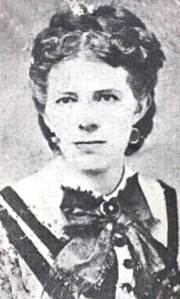
Kate Stone’s Civil War: Living so delightfully

Back in Texas from her sojourn to Oak Ridge, La., Stone finds her Tyler home as raucous as ever.

KS3

From 2012 to 2015, Stillness of Heart will share interesting excerpts from the extraordinary diary of Kate Stone, who chronicled her Louisiana family’s turbulent experiences throughout the Civil War era.

Learn more about Stone’s amazing life in 1861, 1862, 1863, 1864, 1865 and beyond. Click on each year to read more about her experiences. You can read the entire journal online here.

(Photo edited by Bob Rowen)

Back in Texas from her sojourn to Oak Ridge, La., Stone finds her Tyler home as raucous as ever.

Dec. 4, 1864

Tyler, Texas

We are just back from church, and it was a delightful walk there. Mamma, thinking the church would be too cold, deserted us at Mrs. Savage’s and Mrs. Newton joined us. An excellent sermon from the new Baptist minister. There were many gentlemen but few ladies and quite a number of new officers, but Dr. McGregor, my only acquaintance. All the officers we knew here in June have gone. Dr. McGregor and Joe Carson, who is home on furlough, are our only visitors at present. Did not see Maj. Buckner in church. Suppose he has gone back to Louisiana. We have seen him frequently lately and he is a most agreeable, entertaining visitor. I wish they would station him here. …

The house does not seem as comfortable as formerly. Living so delightfully for the last six months and being so waited on and petted have spoiled me I am afraid. Unfortunately Johnny and Uncle John are not on speaking terms. There was a general quarrel while Mamma was away, and Uncle John will not make it up. As Johnny is but a boy, it seems very unreasonable. As we are so crowded in the house, it makes it doubly disagreeable. Then Kate has added a new baby to the general confusion. Fortunately it is a good little mite, but we cannot say the same of Sally. She is a little trial but is getting to be quite pretty. Johnny makes a pet of her, since he is very fond of little children. If we only could have the house to ourselves, but there is no hope of that. Poor Uncle Johnny is so helpless. …

The Silent Enemy

The United States battled polio long before it ever faced the Soviet hegemonic threat, but only during the Cold War did the U.S. achieve significant victories in the battle against the virus.

IMG_1346[1]

The United States battled polio long before it ever faced the Soviet hegemonic threat, but only during the Cold War did the U.S. achieve significant victories in the battle against the virus.

A review by Fernando Ortiz Jr.

******

Discussed in this essay:

Polio: An American Story. By David M. Oshinsky. New York: Oxford University Press, 2005. Pp. 342. $20.45

The United States battled polio long before it ever faced the Soviet hegemonic threat, but only during the Cold War did the U.S. achieve significant victories in the battle against the virus. The struggle, as David M. Oshinsky beautifully explains in Polio: An American Story, contributed to middle-class insecurities over real and perceived communist, nuclear, and social threats throughout the era, and it made superstars out of squabbling scientists determined to find a safe vaccine. But the story he tells also serves as a prism through which to view other aspects of U.S. history: the old racial and ethnic fault lines scarring twentieth-century America, the evolution of nationwide fundraising efforts, the heartstring-tugging advertisements needed to inspire donations, and the political maneuvering vital to ensure any historic scientific victory would be seen as a victory only a Western democratic and capitalism system was capable of bestowing to a war-torn world. Oshinsky’s book intertwines each thread to create a vibrant tapestry of tragedy and triumph, groundbreaking science and fleeting fame, and flawed and brittle greatness.1

Franklin Delano Roosevelt and Jonas Salk are the two great mountains dominating the landscape Oshinsky paints for his readers. His narrative talents beautifully trace efforts predating the Cold War that marshaled the American people on a national scale to fight an illness from which no one, not even New York patricians, were safe. Roosevelt’s struggle and determination energized at-first modest efforts to help polio victims, like the Warm Springs rehabilitation center. He then inspired national efforts, like the multi-city celebration of his birthday to raise funds for the National Foundation for Infantile Paralysis, one dime at a time, and like mothers marching through neighborhoods to collect donations. The March of Dimes demonstrated how to creatively organize a public grassroots fundraising movement. Advertisers conceived the poster child to promise what a thousand words could not. The “concept of philanthropy as consumerism” offered hope to Americans “investing” in their nation’s scientific talent, its ingenuity, and its predestined victory. They were funding their own protection.2

Politicians like Roosevelt pointed to the problem. Scientists like Jonas Salk worked on the solution. Oshinsky’s antiheroes are Salk, who focused on a killed-virus vaccine, and his arch-rival Albert Sabin, who worked on a live-virus vaccine. Oshinsky first celebrates their intellectual achievements and then darkens his portraits with their less-than-admirable qualities, like pettiness, selfishness, jealousy, and hypocrisy. Salk and Sabin are both diminished but also become fuller characters, and Oshinsky’s masterful management of this character development is one of the book’s great strengths. People build their lives with mistakes, aspirations, romantic decisions, and insecurities. Oshinsky argues that history is the result of that grinding process. By humanizing Salk, Sabin, and Roosevelt, the three most recognizable figures in the polio history, he makes their scientific and political achievements all the more extraordinary.

Salk’s emergence as the public face of the scientific effort to conquer polio, beginning with his face on the cover of Time magazine and interviews with leading journalist Edward R. Murrow, embodied the Cold War trend of Americans primed to accept expert advice and direction, and certainly expertise was desperately needed during such a health crisis. But Salk, Oshinsky explains, was more than an expert. He appeared to the public as the vanguard of America’s progress. He wasn’t the faceless, all-knowing narrator of films explaining how to get a date or how to endure a nuclear shockwave. Salk was seen, interviewed, trusted, and believed. He was a husband and a father willing to demonstrate his killed-virus vaccines on his own sons before he tried it on anyone else’s. He characterized the polio vaccine as “the people’s vaccine.”3

The massive 1954 vaccination trials signaled that the war on polio was progressing and demonstrated again how polio could marshal Americans on a national scale. Oshinsky notes that the trials shared front-page coverage with the French defeat at Dien Bien Phu in Vietnam, the Army-McCarthy hearings, and the Brown v. Board of Education court decision – each a key piece of the Cold War struggle with communism at home and abroad, each echoing the vague promises of American democracy. When the Francis Report declared that the Salk vaccine worked, “April 12 resembled another V-J Day.” Sadly, the 1955 Cutter incident shattered the euphoria over and public trust in the vaccine. Critics of the National Foundation’s private efforts to develop and distribute Salk’s vaccine felt vindicated, and they warned of the emergence of socialized medicine. But the Cutter incident’s consequences also included improved polio production, highlighted the effectiveness of the forerunner of today’s Centers for Disease Control, and moved more control over and responsibility for public health into federal hands.4

Oshinsky argues that Salk and Albert Sabin both had Cold War-era political value. Their vaccines symbolized American ingenuity and optimism. The Eisenhower administration sensed Salk’s political value to Republicans angling to not only appear Rooseveltian in their support of the polio war but also to diminish Democratic association with the polio war’s victories. The Sabin vaccine, first administered to millions of Soviet children in 1959, had value to both the U.S. and the Soviets. Sabin found himself angling to ensure news of the successful vaccination program — which he feared could be seen as “typical Soviet propaganda” — was shared with the world. As Soviets asserted that their approach nearly wiped out polio, Americans worried about not just a missile gap, but also a vaccine gap. Americans wanted their Sabin vaccine too.5

Oshinsky subtly weaves ethnicity, class, and race into his polio story. Before the vaccine’s development, Americans blamed immigrants for bringing disease to America (Irish and cholera, Jews and TB) and viewed lower-class slums as cesspools of infection. And yet the poor and rich were struck equally. The wealthy blamed their immigrant servants for bringing infection into their sanitized homes. Polio defied the assumption that disease was found only in the slums. It also shattered the hope that leaving the slum life behind – ascending the class ladder — also meant leaving any risk of crippling disease behind. Scientists thought black Americans were less susceptible to polio, so they received less attention during outbreaks. During the 1954 trials, black Alabama children took their shots outside the white school, where they were banned from the restrooms. And by the mid-1950s, polio, once the scourge of suburban middle class, now ravaged the lower classes who could not afford the three-shot-plus-booster vaccination. Oshinsky also offers a detailed examination of women in this story, particularly killed-virus scientist Isabel Morgan. But there are too few of their stories, which leave the reader yearning for a better gender balance throughout the narrative. Surely, more could have been said about how mothers endured the anguish of crippled or dying children, how wives feared or embraced the sudden publicity burning onto their scientist husbands, or what motivated women to volunteer for fundraisers and vaccination efforts.6

Stylistically, Oshinsky’s decision to explore in narrative form the complex history of the polio struggle is a daring one. He manages a raucous crowd of fascinating and controversial characters with Dickensian elegance, moving them forward in compelling ways through scientific developments that would easily put most readers and historians to sleep, and punctuating his smooth writing style with moments of drama, foreboding, and the ragged endings every life experiences. His devotion to personal details sometimes goes too far, particularly with minor characters, but overall, his focus on the people guiding, experiencing, and enduring the polio struggle humanizes the entire era for readers who may never experience a similar epidemic.

His notes are a mixed bag of secondary and primary sources. Scientific histories and biographies complement letters, diaries, news reports, web links, official reports, and a few interviews, including Salk’s sons, journalist John Troan, and Salk’s embittered underling Julius Youngner. These are the doors Oshinsky leaves open for any curious readers yearning to learn more and for critics who challenge his approach to this history.

Oshinsky’s work is a lavish and intelligent introduction to America’s struggle with the polio virus. Academic readers may sniff over his narrative talents, scoff at his characterizations, and stomp over his less-than-intense analysis of the era’s social and economic themes, but to do so misses the point of his book. Oshinsky’s work is meant to invite readers unfamiliar with the story, to explain the otherwise-intimidating scientific detail, and to celebrate the men and women who achieved great things for mankind. Oshinsky’s overall message to his readers is hopeful and trusting. Americans can make the world a better place. They have done it before, he says, pointing at his book, and they will do it again and again and again.


1. David M. Oshinsky, Polio: An American Story (New York: Oxford University Press, 2005).
2. Oshinsky, Polio, 5, 40-55, 72. Warm Springs, a 2005 HBO movie, illustrated Roosevelt’s struggle with polio, his efforts to establish the Georgia facilities, and his cinematic journey from aristocratic politician to a man of the people ready to assume a role of national leadership.
3. Oshinsky, Polio, 205-211.
4. Oshinsky, Polio, 188-199, 203, 238.
5. Oshinsky, Polio, 215-216, 253, 266.
6. Oshinsky, Polio, 20-23, 65-67, 256.

Brontë and her diary

“The haughty sadness of grandeur beamed out of her intent fixed hazel eye, & though so young, I always felt as if I dared not have spoken to her for my life, how lovely were the lines of her small & rosy mouth, but how very proud her white brow, spacious & wreathed with ringlets, & her neck, which, though so slender, had the superb curve of a queen’s about the snowy throat.”

On Jan. 21, 2011, the Morgan Library & Museum in New York City opened a fascinating exhibit, “The Diary: Three Centuries of Private Lives.” Introducing the exhibit were these thoughts:

“For centuries, people have turned to private journals to document their days, sort out creative problems, help them through crises, comfort them in solitude or pain, or preserve their stories for the future. As more and more diarists turn away from the traditional notebook and seek a broader audience through web journals, blogs, and social media, this exhibition explores how and why we document our everyday lives. With over seventy items on view, the exhibition raises questions about this pervasive practice: what is a diary? Must it be a private document? Who is the audience for the unfolding stories of our lives — ourselves alone, our families, or a wider group?”

Timeless questions … certainly legitimate ones for 21st century bloggers and tweeters. The exhibit, which unfortunately I wasn’t able to visit before its conclusion on May 21, featured work from the brightest stars of the literary galaxy. As quoted in the introductory essay, Henry David Thoreau aspired for his diary “to meet the facts of life — the vital facts — face to face.” Nathaniel Hawthorne and his wife co-authored their diary to celebrate their new married life together. “I do verily believe there is no sunshine in this world, except what beams from my wife’s eyes,” he wrote. “I feel new as the earth which is just born again,” his wife later wrote in response.

St. Augustine and Anais Nin … Walter Scott and Tennessee Williams … William S. Burroughs and Charlotte Brontë … A prisoner from World War II and a police rescue worker from the 2001 World Trade Center attack — the range of work and creativity and purpose is just as astounding as the authors and the beautiful words this exhibit so elegantly celebrated.

The exhibit lives on online. In addition to the introductory essay, the website offers images of diary pages, diary excerpts, and essays on the authors.

Also included are audio readings of selected diaries by actors Paul Hecht and Barbara Feldon. Reading the diaries is, for me, a joy, but hearing them read to me is a special — and often quite romantic — experience.

This special series begins with Charlotte Brontë: “The haughty sadness of grandeur beamed out of her intent fixed hazel eye, & though so young, I always felt as if I dared not have spoken to her for my life, how lovely were the lines of her small & rosy mouth, but how very proud her white brow, spacious & wreathed with ringlets, & her neck, which, though so slender, had the superb curve of a queen’s about the snowy throat.”

Entries in this series:
Part 1: Introduction to the exhibit and Charlotte Brontë
Part 2: Frances Eliza Grenfell
Part 3: Sophia and Nathaniel Hawthorne
Part 4: Paul Horgan
Part 5: John Newton
Part 6: Mary Ann and Septimus Palairet
Part 7: Walter Scott
Part 8: Bartholomew Sharpe
Part 9: Tennessee Williams
Part 10: John Ruskin

Niche boutique’s grand opening

We’re excited to launch our men’s collection at Niche boutique’s grand opening party this Thursday at San Antonio’s Historic Pearl. It begins at 5:30 p.m.

10686629_10152587735128791_3911463796170606432_n

My wife and I are excited to launch our men’s collection alongside already amazing women’s collections at Niche boutique’s grand opening party at San Antonio’s Historic Pearl. The party is this Thursday and begins at 5:30 p.m.

I’m so proud of her.

Sophia Loren admits she was afraid Jayne Mansfield’s dress was ‘going to blow’ in infamous photo

IMG_2335

Joe Shere/mptvimages.com

Free Love Freefall

The revolutionaries were determined to make lasting changes to the various forms of sexual oppression they perceived. It remains to the current generation to ensure their still-blossoming accomplishments do not wither under cold conservative shadows.

IMG_1475

Allyn’s revolutionaries were determined to make lasting changes to the various forms of sexual oppression they perceived. It remains to the current generation to ensure their still-blossoming accomplishments do not wither under cold conservative shadows.
A review by Fernando Ortiz Jr.

*****

Discussed in the essay:

Make Love, Not War: The Sexual Revolution: An Unfettered History. By David Allyn. New York: Routledge, 2001. Pp. 381. $30.95

David Allyn’s Make Love, Not War intelligently and creatively tours a sexual renaissance that ebbed and flowed throughout the 1960s and 1970s, sparking changes of varying longevity throughout society. Latino and black Americans fought throughout this era for equal rights as citizens and for the freedom to pursue and fully embrace the American Dream. The general public’s gradual tolerance of public gay culture, the rise of swingers movements, the gaveling of obscenity trials, the publication of sex studies, and the embrace of the birth control pill all comprise for Allyn a sexual rights movement, a “revolution” that silenced some prudes, raised legal eyebrows, and brought America a few sultry steps closer to the fulfillment of “life, liberty, and the pursuit of happiness.”1

Allyn designates the early sixties to the late seventies as the era of the sexual revolution, and he links its progression to general economic health in the United States. They rise and fall together. He utilizes dozens of interviews with men and women — some identified and some under pseudonyms — thirty years after their revolution takes place. Sexual histories, sociological studies, essays, novels, and academic reports supplement his study of the birth control pill, lesbian empowerment, gay rights, fights over literary censorship, public excitement over sexually-charged theater and film works, nudist colonies, swinger parties, and the general struggle to strip shame away from anyone’s sexual life.

The revolution was a multi-pronged and disjointed effort that lurched toward sometimes unclear objectives. Critics may condemn Allyn’s book for its seemingly disorganized structure, but it actually properly reflects the messiness of a series of efforts to change social mores and personal prejudices. Allyn’s great strength as a writer is his ability to gracefully transition from one theme of the era to another.

If anyone wanted to read a new sex manual to improve their sex life, Allyn argues that the sexual revolution made that possible. If a gay man or woman wanted to add legal sexual escapades at a sex party into their urban lifestyle, the sexual revolution made that available. If upper and middle-class women wanted to control their fertility, swap their spouses with other couples, or find and buy a book filled with sexual imagery, the sexual revolution eased strictures, opened doors, and soothed public outrage. Americans could fully and freely explore their identities, fulfill their aspirations, find their limits, and live their lives. For almost everyone, Allyn explores, the sexual revolution provided the freedom from fear.2

Allyn is enamored with the term “revolution,” which is his theme as his historical tour widens its scope over American society. From the very beginning, Allyn credibly admits the duality of his terrain, of which some aspects “were not revolutionary at all but evolutionary.” The era’s development of the pill, the rise of the sexual book publishing industry, the debates over obscene literature, the stronger roles women secured for themselves in American society — all were inherited from earlier eras in American history, all far from original movements. He admits this duality and does nothing to compensate for its contradictory influence on his narrative structure except pair stories of triumph with stories of eventual defeat or threat.

The era’s legacy is a mixed success of progression and regression, like all revolutions in American history. American society generally accepts the use of birth control and the popularity of premarital sex, though religious leaders and worried parents still frown on the still-expensive pill. Uncensored pornography — from hard-core videos to the soft sensuality of Anais Nin — is ubiquitous in the online world and easily found in the most popular bookstores, though erotica still faces many “family-oriented” enemies. Celebrities, news organizations, the military, scientific organizations, national leaders, and students across the United States embrace homosexuality as a normal sexual orientation, gay rights for citizens and servicemen, gay adoptions, and gay unions. But legal recognition of gay marriages retains its legal and political polarizing effect.3

Not everything can change all at once. Not everyone is won over when new ideas, new bathing suits, new aspirations, and new freedoms dawn over the raucous American society. When it comes to sex, each citizen had to make his or her own personal journey. People change as they grow older. Love and desire bring their own contradictory and revolutionary effects on one’s understanding and acceptance of the world around them. Jealousy, lust, insecurity, and fear can easily disrupt carefully constructed arrangements among sexual partners.

His interviews with the revolution’s participants best capture these intimate journeys. However biased or self-conscious they may be three decades later, Allyn’s interviewees echo the bittersweet afterglow the revolution’s sunset left in their lives. One father remembered his son loudly declaring in an airport terminal that his mother took a shower with a male sexual friend. One humiliated teenager remembers when her sexually supportive father left condoms on every bed in case she wanted to have sex with her male guest. Allyn deserves credit for including the long, dark slopes of the era’s gleaming aspirations for sexual liberation. He mostly maintained his balance between giddy celebration of short-term sexual bliss and grim acknowledgement of the long-term emotional consequences.4

His book’s duality also demands answers to eternal historical questions: Do changes deserve to be considered revolutionary if they are not all long-lasting? Was the sexual blossoming in the sixties an aberration in social values, enough to be considered revolutionary, or was the real revolution comprised of religious attitudes and social frigidity that put in place decency laws, targeted erotic literature, oppressed gay communities, marginalized women, and put shame into the hearts and minds of millions of sexual beings? Perhaps Allyn’s era was simply a counter-revolution, an attempt to take further the romantic aspirations of early twentieth century struggles for gender equality, sexual freedom, a more-just democracy, and fulfilled personal desires. Perhaps Allyn’s era consisted of a series of moments when Americans again grappled with and consummated fundamental American ideals that the original revolutionary generation left their descendants in a different and better America to achieve.

The book’s focus is mostly on urban upper and middle-class Anglo citizens. Blacks, Latinos, and lower-class citizens are not part of this study, which leaves readers hungering for a greater variety of voices and experiences. However, his study is linked to the economic health of the U.S. When the economy worsened in the seventies, the sexual revolution sputtered, which suggests the sexual revolution belonged only to those who could afford its luxurious promise. Impoverished minorities had larger and more immediate problems to worry about — how to feed their children and themselves, where to find work, how to avoid or at least endure an oppressive and heartless society — that they could not be concerned about swinger parties, literary censorship, or lesbian rights.

Overall, Allyn’s conflicted book is a valuable contribution to the study of postwar America. He brings together a detailed examination of various aspects of a sexual renaissance that benefited and benefited from other struggles for other freedoms. The arguments from this era came down — and still do — to eternal American issues: How much equality is necessary to fulfill our founding principles? How much are Americans entitled to? Where does private control — over our bodies, our gender, our children’s education, our moral principles — end and a democratic society’s standards begin? Allyn’s revolutionaries were determined to make lasting changes to the various forms of sexual oppression they perceived. It remains to the current generation to ensure their still-blossoming accomplishments do not wither under cold conservative shadows.


1. David Allyn, Make Love, Not War: The Sexual Revolution: An Unfettered History (New York: Routledge, 2001), 3-4. Allyn asserts that the every aspect of the sexual revolution “had an impact on how we as a nation have come to think of life, liberty, and the pursuit of happiness.”
2. Allyn, 4-5.
3. Allyn, 8, 295-296.
4. Allyn, 217, 297-299.

Kate Stone’s Civil War: I suffered intensely

As Stone works her way back to Texas, a toothache adds to her discomfort and fear throughout a journey through wild and war-torn swampland.

KS2

From 2012 to 2015, Stillness of Heart will share interesting excerpts from the extraordinary diary of Kate Stone, who chronicled her Louisiana family’s turbulent experiences throughout the Civil War era.

Learn more about Stone’s amazing life in 1861, 1862, 1863, 1864, 1865 and beyond. Click on each year to read more about her experiences. You can read the entire journal online here.

(Photo edited by Bob Rowen)

As Stone works her way back to Texas, a toothache adds to her discomfort and fear throughout a journey through wild and war-torn swampland.

November 1864

On the road to Texas

We got off from Col. Templeton’s Monday morning, all sorry to part after a delightful summer and fall with not a disagreeable incident to mar our intercourse. They have been the soul of kindness to me, one and all. The direct road through the swamp is impassable, and so Capt. Wylie piloted us a new route. Capt. Wylie, Johnny, and I were on horseback, and about 2 o’clock we reached the hill road without getting bogged down as Johnny had in coming through the old road. We dismounted, entered the carriage, and bade Capt. Wylie a warm farewell, thanking him for his many courtesies. …

It was a rainy day and we did not reach Monroe until about sunset. Capt. Brigham met us, and we waved him adieu as we crossed the Ouachita on a flat. We passed the night at Mrs. Scale’s at Trenton, much to Johnny’s disgust as he does not like them. Some gentlemen called, and we had cards. After they left, Lucy and I tried our fortunes in divers ways as it was “All Hallow’e’en.” We tried all magic arts and had a merry frolic, but no future lord and master came to turn our wet garments hanging before the fire. There were no ghostly footprints in the meal sprinkled behind the door. No bearded face looked over our shoulders as we ate the apples before the glass. No knightly forms of soldiers brave disturbed our dreams after eating the white of an egg half-filled with salt. …

The third morning we left in a cold drizzling rain with a splendid lunch and a jar of pickles, and with kisses and good wishes of the family. I had a raging toothache, because of sitting all day in wet shoes after passing the swamp. Capt. Wylie’s solicitude on the subject of my thin, wet shoes was not uncalled for at last.

Our trip to Vienna was disagreeable. We stopped at twelve, built a fire, enjoyed our dinner, and then smoked leaf cigarettes. They relieved my tooth for a time, but the pain returned. For several days I suffered intensely, nearly ruining all my teeth I fear by using creosote, caustic, and any strong thing people recommended. Our supper at the hotel at Vienna consisted of cold stewed pumpkins, cold greens, and cold white cornbread. Nothing else but cold well water. The breakfast was nearly as unpalatable, but it was warm. We had nothing to eat all day except the pickles, which Johnny first ate and then drank the vinegar. …

Kate Stone’s Civil War: Fairy castles in the air

Stone offers a slice of life in Oak Ridge, La., as her caretakers search for a window of safety to escort her back to Texas.

1863

From 2012 to 2015, Stillness of Heart will share interesting excerpts from the extraordinary diary of Kate Stone, who chronicled her Louisiana family’s turbulent experiences throughout the Civil War era.

Learn more about Stone’s amazing life in 1861, 1862, 1863, 1864, 1865 and beyond. Click on each year to read more about her experiences. You can read the entire journal online here.

(Photo edited by Bob Rowen)

Stone offers a slice of life in Oak Ridge, La., as her caretakers search for a window of safety to escort her back to Texas.

Oct. 15, 1864

Near Oak Ridge, La.

We have kept on the even tenor of our ways with no hairbreadth escapes by land or sea to ruffle the calm. There are still occasional reports of advancing Yankee raids, but all blow over and no Yankees yet, though this country is still defenseless. …

We have little company and pay few visits, but we enjoy the days, and the weeks fly by like magic — no startling events to mark them off. Capt. Wylie and Dr. Wylie are here. They amuse themselves during the day, but in the evening we all assemble, play chess or cards, and carry on long and animated discussions on all topics under the sun. All the older members of the family are very fond of argument and discussion and are thoughtful talkers and well educated, though one must know them some time before finding that last out.

We made a rule fining everyone for each lapse in grammar, which worked famously for awhile, until we found we would soon all be bankrupt in both purse and temper, and by tacit consent it was dropped and grammar is no more alluded to. Mrs. Templeton said she knew she would never be fined. She knew every rule in the book, but she was the first and most grievous offender and hated worst to be reported. … We lounge in rocking chairs building fairy castles in the air, mapping out lives of goodness and noble endeavor, until Mrs. Templeton rouses from her half-doze on the bed and sends us all to rest. …

Our pleasant days are drawing to a close as Mamma writes she will send Johnny at once for me, and we are looking for him every day. Capt. Brigham rode in from Monroe to tell us that the long expected tableau would come off the next evening and that he had come in to escort us out. Early the next morning we three girls and Sally McGraw with Jimmy, Capt. Wylie, and Capt. Brigham as outriders and the maid Henrietta bringing up the rear, made our way to Monroe under many difficulties. We had a most trying time after reaching there, owing to Capt. Brigham’s blundering. We did not enjoy the tableau as we were too worried and were thankful to be all safe at Mrs. Templeton’s next evening.

Oct. 30

The last time I shall write here. Johnny arrived with the carriage two days ago, and we start home tomorrow. This will end a most pleasant visit, or rather visitation, for I have been here more than three months. All the family have been unfailingly kind and have done all in their power to make me enjoy the time. I certainly have had a most charming visit and grieve to leave them. Then I shall have to break off two most promising flirtations. My only comfort is in thinking of the lovely trip Johnny and I are going to have a comfortable carriage well stocked with lunches, a good driver, strong mules, no hurry, and a lodging every night with friends, good roads, and fair October weather.

Recommended reading / viewing / listening

This week: Enduring sexism / LBJ and the Secret Service / Exercise and depression / The Roman Empire / The political Eva Longoria

IMG_1475

This week: Enduring sexism / LBJ and the Secret Service / Exercise and depression / The Roman Empire / The political Eva Longoria

Most of these great items come from my social media networks. Follow me on Twitter, Tumblr, LinkedIn, MySpace, and Facebook for more fascinating videos, photos, articles, essays, and criticism.

1. Jessica’s Feminized Atmosphere
By Jessica Williams | The Daily Show | Oct. 2
“Also, that’s redundant.”

2. L.B.J.’s Bravado and a Secret Service Under Scrutiny
By Michael Beschloss | The Upshot :: The New York Times | Oct. 2
“Not long after President Kennedy’s assassination, President Johnson chafed under his Secret Service protection.”

3. What made Japan’s deadly volcanic eruption so unpredictable?
By Judy Woodruff and Miles O’Brien | PBS NewsHour | Sept. 30
“More than 250 people were out hiking and enjoying a nice fall day, when a surprise eruption littered the mountain with falling boulders, thick smoke and piles of ash. At least 36 people were killed.”

4. This Is How Eva Longoria Is Trying to Win the Midterms
By Asawin Suebsaeng | The Daily Beast | Oct. 1
“From working behind the scenes in the midterms to making a new farm labor documentary, the former Desperate Housewife has emerged as a force to be reckoned with in liberal politics.”

5. How Exercise May Protect Against Depression
By Gretchen Reynolds | Well :: The New York Times | Oct. 1
“Exercise may help to safeguard the mind against depression through previously unknown effects on working muscles.”

6. The Elements of Style
By Sasha Weiss | The Sunday Book Review :: The New York Times | Oct. 3
“Watching other women, seeing how they’re dressed and how they pull it off, is the way most of us learn to become ourselves.”

7. Former Haiti president Duvalier dies
By Mike Wooldridge | BBC News | Oct. 4
“Duvalier was just 19 when in 1971 he inherited the title of “president-for-life” from his father, the notorious Francois ‘Papa Doc’ Duvalier. He was accused of corruption, human rights abuses and repression in his rule, which ended in a 1986 uprising.”

8. Catastrophic Coltrane
By Geoff Dyer | NYR Gallery :: New York Review of Books | Oct. 4
“The interest of recordings from this final phase — in which Coltrane’s playing became increasingly frenzied and the accompaniment more abstracted — lies partly in what they preserve and partly in any hints they contain as to where Trane might have headed next.”

9. The Aral Sea’s Disappearing Act
By Anna Nemtsova | The Daily Beast | Oct. 4
“Satellite photos show how the depredations of dictators have turned the world’s fourth largest inland sea into a poisonous desert.”

10. 40 maps that explain the Roman Empire
By Timothy B. Lee | Vox | Aug. 19
“Two thousand years ago, on August 19, 14 AD, Caesar Augustus died. … Under Augustus and his successors, the empire experienced 200 years of relative peace and prosperity. Here are 40 maps that explain the Roman Empire — its rise and fall, its culture and economy, and how it laid the foundations of the modern world.”

The Disco Pall

The mirage inspired the working class and their tenuous allies toward distant horizons of hope, unaware that only predators awaited them in the night.

IMG_1467

The mirage inspired the working class and their tenuous allies toward distant horizons of hope, unaware that only predators awaited them in the night.
A review essay by Fernando Ortiz Jr.

Discussed in this essay:

Stayin’ Alive: The 1970s and the Last Days of the Working Class. By Jefferson Cowie. New York: The New Press, 2010. Pp. 464. $19.58

*****

Jefferson Cowie illustrates in Stayin’ Alive a sad era of American labor’s political and economic strife. The book recounts 40 years of corporations, political figures, and labor’s own leaders undermining, defusing, or ravaging the postwar economic opportunities of working-class Americans, who gradually lost every ally gained during the New Deal era. The working-class identity at the beginning of his story captures their pride and belief in a better future. Their identity at the end is strangled, stabbed, and ground down into a pitiable symbol of social irrelevance, political isolation, and self-absorbed psychic catatonia.1

Cowie divides his story into two sections: “Hope in the Confusion, 1968-1974” and “Despair in the Order, 1974-1982.” He begins with vivid accounts of labor’s role as “junior partners” in a New Deal coalition to re-engineer American capitalism and of a younger generation’s struggles against calcified labor leaders in the 1960s to improve their economic standing. He then moves into the chaos of the 1968 presidential campaigns. Public uproar over the Vietnam War left President Lyndon B. Johnson exhausted. He refused to run for another term, leaving the desiccated corpse of the presidency for Democratic contenders to rip apart like starved hyenas. Vice President Hubert Humphrey emerged from the violent Democratic nominating convention as the last man standing, with only the labor machinery at his side, Cowie writes, making labor the “big boss in the Democratic Party.”2

Labor’s support of the Vietnam War, Cowie explains, meant no alliance with anti-war Democrats. Patriarchal labor leaders rejected civil rights and social movements, which poisoned any relationship with social liberals, women, and minorities. Humphrey’s nomination triumph and labor alliance amounted to little more than a Pyrrhic victory when Richard Nixon, leading a Republican resurgence against divided Democrats, won the election. The cracks in the Democratic lines would also lead to complete political failure in 1972 when Democrat George McGovern challenged then-President Nixon and was obliterated.3

The tragic and foreboding theme of division overshadows every working-class ambition, and Cowie highlights its importance at every turn. The compromised aspirations of the 1935 National Labor Relations Act and Title VII of the 1964 Civil Rights Act are two of his best examples. Both aimed for “occupational justice.” The former enabled union formation and opened economic opportunities to immigrants. The latter ensured non-white, non-male, and non-Christian workers would not face workplace discrimination. The former was rooted in the hopes for economic equality. The latter was rooted in the hopes for cultural and gender equality. Some victories required the exclusion of black rights.

Others required the exclusion of women’s rights. Inherent tensions between the governmental and political forces that achieved both victories doomed the unity needed to face foes in the 1970s and 1980s, who exploited “an unbridgeable chasm” between allies fighting over race or over class. Cowie is at his best when he explores these key flaws in the coalition the unions depended upon throughout the postwar decades.4

Nixon cynically targeted that central cultural-vs.-material dichotomy in the workers’ outlook. He lured them into his New Majority, his own coalition of Republicans, conservative Democrats, and white workers disgusted by the civil rights or other social movements. He emphasized his empathy with their frustrations, and he shared their disgust for “effete” Northern elitists and antiwar protesters. He anesthetized their doubts or shame over their support for a Republican with dazzling themes of shared patriotism. Once working-class Democrats were numbed to their own political transformation and suffocated by the rhetorical American flags in which he wrapped them, Nixon added their votes to his victorious totals, laughed at their seeming blindness to his manipulations, and then subsequently did little to justify their support.5

Cowie ends the book’s first half with the convincing contention that in 1973, after years of high earnings and low unemployment, labor’s prospect for further prosperity began to fade. That year was a turning point, he writes, when “a troika of disasters” began to unfold: an oil embargo, the spread of suffocating stagflation, and the Watergate scandal that led to Nixon’s resignation in 1974. Nixon, Cowie argues, “was the last [postwar president] to court labor seriously.” Instead of playing on the old New Deal chessboard, Nixon simply invented a new game with new rules. After 1974, labor faced threats it was no longer armed against, on battlefield on which it had no effective allies, and fought for a place in an economy that no longer valued its contribution or importance.6

If the book’s first half sees the working class feel the unstable shoreline crumble under their feet, the second half sees them slide helplessly into the shark-infested water. Nixon’s successor, Gerald Ford, defeated Ronald Reagan for the 1976 presidential nomination. Democrat Jimmy Carter then defeated Ford in the general election. Nixon’s and Ford’s defeats emboldened Democratic liberals, and their triumph blinded them to Carter’s limitations as a labor ally. At first, liberals and labor saw new hope in the new president, who could potentially fuse old George Wallace supporters, Southern Democrats, Northern workers, and minorities into a new coalition. Cowie points to hopes for new legislation that would generate more jobs, improve labor laws, and begin a national health insurance. But Carter had little regard for liberal dreams, and his career was not beholden to labor’s support. His narrow and principled vision focused only on particular priorities, and his stiff rudder rarely moved to accommodate labor’s needs.7

Labor needed help more than ever before. Companies laid off workers and moved production overseas. Plants closed. Industries gravitated to regions that rejected union activism, instituted right-to-work laws, and promised tax incentives and low regulation. The general economic malaise acted like a drought, drying up what little hope remained for labor to find economic or political rejuvenation in the Democratic Party’s empty and neglected fountains. By 1980, Cowie explains, “a unionized manufacturing job … had become a rare and coveted source of security” -– a stale scrap from the corporate table crowded with conservative allies.8

Cowie’s pursuit of working-class identity throughout the postwar decades is a powerful intellectual feature of the book. He also argues that working-class identity found itself reflected in TV shows like All in the Family, in ballads from Bruce Springsteen and Devo, and in films like Saturday Night Fever. But the musing quickly turns into bloviating and regrettable tedium. Much of what he wanted to say could have been condensed from two chapters into one, or incorporated into the photos section with enriched captions. The attempt to casually expound on entertainment diminishes the power of Cowie’s serious and informative history.9

Republican Ronald Reagan won the presidency in 1980. By then, Cowie laments, the “redefinition of the working class beyond its New Deal form” had failed. Postwar attempts to maintain workers in the middle class failed. Conservative enemies torpedoed their legislative and policy accomplishments. Carter and a new generation of liberal Democrats had no shared history with labor and little inspiration to court their rusted and scarred loyalties.10 The working classes had nowhere to go but inward in their search for a credible identity. Ironically, that desperation left them open to another round of Nixonian seduction. Reagan’s New Right vision promised a return to a revitalized America built on the rubble Carter and his Eastern elites had left behind, one nation under God, ruled by white Christian men just as they ruled in their own communities.

The potent, sickening sweetness of Reagan’s nostalgic platitudes — Cowie calls it “symbolic sanctuary” — mesmerized workers who hungered for a time when they mattered to American society. Reagan swung the final major blow to the remnants of the labor movement when he shattered the Professional Air Traffic Controllers (PATCO) union strike in 1981. Cowie calls Reagan’s decision “one of the boldest acts of his administration.” Cowie could have added details of the administration’s decision-making process, internal debates, or recollections from Reagan advisors. Instead, the incident, which signaled to the corporate world how weak and vulnerable the union community truly was, is barely explored in a rush to finish the second half of the book, which ends in 1982. By the 1990s, a globalized economy of union-free service workers emerges, ruled by a conservative coalition descended not solely from conservative victories, Cowie argues, but also from liberalism’s failures and shortsighted divisions.11

Cowie’s sad and fascinating story points to the “internal weaknesses” of the working class when explaining why labor movements failed to sustain cohesion and strength long enough after the New Deal to pose a significant challenge to “[m]arket orthodoxy.”12 Perhaps, he argues, their noble alliance was little more than a “conceptual unity” that never truly existed. The mirage inspired the working class – enthused by their New Deal identities — and their tenuous allies toward distant horizons of hope, unaware that only predators awaited them in the night.


1. Jefferson Cowie, Stayin’ Alive: The 1970s and the Last Days of the Working Class (New York: The New Press, 2010), 9-11.
2. Cowie, 9, 29, 83.
3. Cowie, 41, 84.
4. Cowie, 236-237.
5. Cowie, 122-124, 132-133.
6. Cowie, 12, 164.
7. Cowie, 14, 266.
8. Cowie, 15.
9. Cowie, 209-210, 357-369.
10. Cowie, 366.
11. Cowie, 362-364.
12. Cowie, 18.
Behind The Wall

Tabletop Games

Rebecca Aguilar

#CallingAllJournalists Initiative | Reporter | Media Watchdog | Mentor | Latinas in Journalism

Anna Fonte's Paper Planes

Words, images & collages tossed from a window.

Postcards from Barton Springs

Gayle Brennan Spencer - sending random thoughts to and from South Austin

The Flask Half Full

Irreverent travelogues, good drinks, and the cultural stories they tell.

Government Book Talk

Talking about some of the best publications from the Federal Government, past and present.

Cadillac Society

Cadillac News, Forums, Rumors, Reviews

Ob360media

Real News That Matters

Mealtime Joy

bringing joy to family meals

Øl, Mad og Folk

Bloggen Øl, Mad og Folk

a joyous kitchen

fun, delicious food for everyone

A Perfect Feast

Modern Comfort Food

donnablackwrites

Art is a gift we give ourselves

Fridgelore

low waste living drawn from food lore through the ages

BeckiesKitchen.com

MUSINGS : CRITICISM : HISTORY : NEWS

North River Notes

Observations on the Hudson River as it passes through New York City. The section of the Hudson which passes through New York is historically known as the North River, called this by the Dutch to distinguish it from the Delaware River, which they knew as the South River. This stretch of the Hudson is still often referred to as the North River by local mariners today. All photos copyright Daniel Katzive unless otherwise attributed. For more frequent updates, please follow northriverblog on Facebook or Instagram.