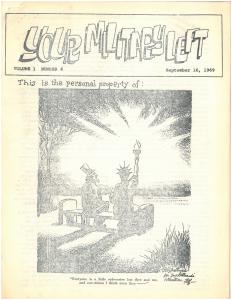
Between 1967 and 1971, American GIs stationed on military bases across the world, wrote, produced, published and distributed over 130 newspapers.[1] These newspapers, edited and written anonymously and often distributed clandestinely, offer a unique window on the activities and thoughts of many servicemen who opposed the US intervention in Southeast Asia and found the situation in Vietnam intolerable.
Often using generic military commands as titles (Your Military Left, About Face!, All Ready on the Left, Fall in at Ease, As You Were), the papers not only deliberately subverted traditional military ethos, but also alerted potential readers to the contents and sentiments expressed within the pages. The reader’s interests dictated the papers’ contents and, not surprisingly, GI publications often solicited written and financial contributions from their readers and subscribers.[2]
Stone is reunited with her brothers, who were sent ahead to evaluate the condition of the Brokenburn plantation. They bring back disastrous news.
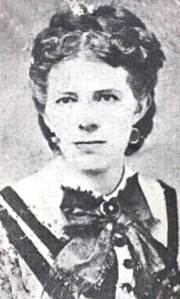
From 2012 to 2015, Stillness of Heart will share interesting excerpts from the extraordinary diary of Kate Stone, who chronicled her Louisiana family’s turbulent experiences throughout the Civil War era.
Learn more about Stone’s amazing life in 1861, 1862, 1863, 1864, 1865 and beyond. Click on each year to read more about her experiences. You can read the entire journal online here.
(Photo edited by Bob Rowen)
Stone is reunited with her brothers, who were sent ahead to evaluate the condition of the Brokenburn plantation. They bring back disastrous news.
Oct. 10, 1865
Lamar County, Texas
Jimmy and My Brother joined us about ten days ago, and we have never passed ten more unhappy days. Our future is appalling: no money, no credit, heavily in debt, and an overflowed place. No wonder Mamma is so discouraged. Since My Brother’s return, we have all had the blues and look forward with dread to our return to Louisiana. But there is nothing else to do. Nothing for us here. Mamma, Sister, and I, with Johnny or Jimmy, will get off early next week, going straight on, while My Brother will bring the Negroes back. The contrabands are all crazy to return to Louisiana, as soon as they realized that My Brother did not wish to take them, and are on their best behavior. What a treacherous race they are! I doubt whether one will remain with us a week after we return.
The name “Vexation” we have given this place is most appropriate. It has been a most trying job settling up the business, and My Brother and Mr. Smith say everyone they have had dealings with has not only tried but succeeded in cheating them. We are in all the stir and disagreeable confusion of moving, yet preparations to get off advance but slowly, though all four of the menfolks are doing their best to expedite our departure. We have to send such a distance for everything we need.
It seems an ill-advised move to take the Negroes back unless they could be bound by some contract to remain on the place, and that is impossible. It is so expensive and troublesome to move about eighty or ninety Negroes such a distance. …
Jimmy goes to Tyler this week and will join us somewhere on the road. We will camp out just as we did when we came to Texas but will have a more comfortable vehicle and a more careful driver. …
Mamma and Mrs. Smith are away today visiting the dentist at Ladonia, the boys are off on business, and so Sister and I have the house to ourselves. It is delightful to be alone sometimes, a pleasure we have rarely enjoyed since we left Brokenburn. We have lived in crowded quarters all the time. I shall be glad to get to the solitude of my own room at Brokenburn, even if it will be but sparsely furnished. My Brother says all our furniture has been divided out among the Negroes and Yankees.
How exceedingly quiet he is. Rarely talks at all. He was never very fluent and being in the army has intensified his silence and reserve, and he seems to take little interest in hearing others. We hope home life will brighten him up and make him more cheerful. He feels the bitterness of defeat more than anyone we have met. He cannot reconcile himself to give up everything but honor. …
Our trip will probably take a month. The weather is lovely, and we hope to get home over good roads and to arrive before the fall rains set in. A sad journey to the old scenes.
For just one night, on Friday, Oct. 16, 2015, at 8 p.m., an artist will project light onto the building, virtually “restoring” the Mission to its former glory.
I’m a history teacher at Northwest Vista College in San Antonio. I teach both parts of the introduction to U.S. history. HIST 1301 begins the tour in Native America and ends with post-Civil War Reconstruction. HIST 1302 begins with Reconstruction and brings it to the modern era.
Every teacher ends the second half in different places: the Reagan Revolution, 9/11, the election of Barack Obama. Because I’m emphasizing the relevance of history to current events (if they leave my class with nothing else, at least they will be more sensitive to and appreciative of the historical roots of news events all around them), I intend to end the second half with the rise of ISIS.
I’ve slowly come to appreciate the historical richness and importance of San Antonio, if only because of my lifelong failure to fully appreciate Mexican and Tejano culture. But San Antonio has captured my heart and, more importantly, my respect as a historian. I’ve tried to share my new enthusiasm with my students by making them aware of the truly unique place of San Antonio in Spanish, Mexican, Texas, Confederate, and U.S. history.
One of their extra-credit opportunities is to visit one of the San Antonio Missions (a visit to the Alamo doesn’t count). They have to take a picture of themselves next to a sign indicating which Mission they visited, show it to me, and then they get an extra ten points towards their final grade for the semester.
As I just told them on our class blog, Ortiz History, I recently learned of one more reason to visit the beautiful Mission Concepcion. For just one night, on Friday, Oct. 16, 2015, at 8 p.m., an artist will project light onto the building, virtually “restoring” the Mission to its former glory. That will be the highlight of a three-hour festival of food trucks, picnics, historical tours, music, and family-friendly activities spread throughout the mission grounds. Festivities begin at 6 p.m.
October 10th is designated Electronic Records Day by the Council of State Archivists. In recognition, we thought it would be a good time to share some basic tips for managing your own personal digital records.
Computer terminal in the UTSA library, 1980. Office of University Communications Photographs, UA 16.01.01, UTSA Special Collections.
Your cell phone has a software meltdown one night and needs to be restored to factory settings. Your computer will no longer recognize your external hard drive. You accidentally deleted your entire email inbox.
Do any of these situations sound familiar? By now, you’ve probably experienced the reality of losing some of your personal digital archives. As more and more of our daily activities integrate digital technology, more and more of our stuff rests in a precarious position. While not all failures can be prevented, there are steps you can take to help ensure that the next…
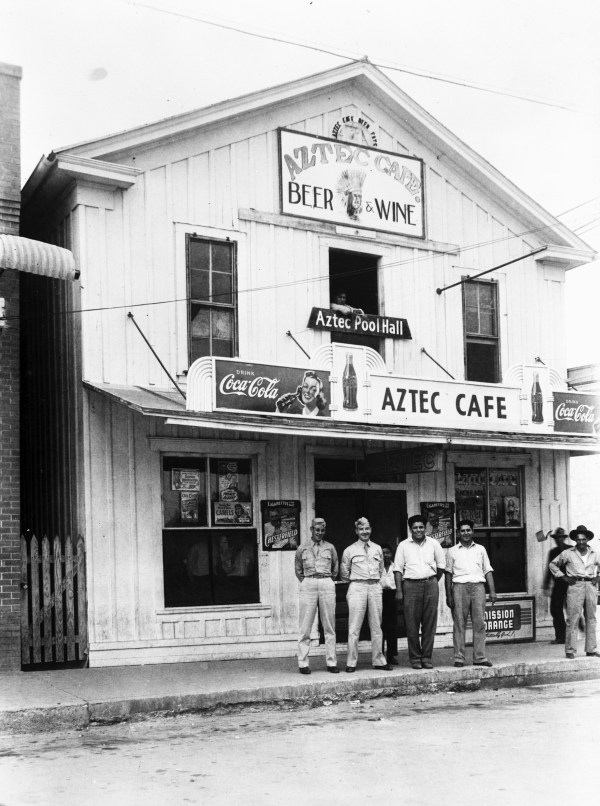
Not long after photographic equipment became more portable, commercial photographers began taking pictures of their client’s businesses. Along with the usual studio portraits, these photographs were saved as part of the family records. Multiple copies would sometimes be made for regular patrons of the business, both for gift or purchase. In the 20th century, business owners saw that such photographs would be useful for other purposes, such as illustrations for company catalogs, reports and advertisements.
These photographs are representative of our images of Texas businesses, from various times and regions.
Rudy Domingez (center) and Joe Domingez pose with customers outside their café and pool hall, 18th Street, Hondo, early 1940s. (General Photograph Collection, MS 362: 096-0815, courtesy of Eva Arcos )
Mrs. M. E. Reed’s City Hotel on North Street, across the street from the Houston and Central Texas Railroad, Elgin, 1880s. (General Photograph Collection, MS 362: 096-1268, courtesy of Elgin Historical Association…
Stone has little sympathy or respect for former slaves, who she sees as “insolent” and insubordinate.
From 2012 to 2015, Stillness of Heart will share interesting excerpts from the extraordinary diary of Kate Stone, who chronicled her Louisiana family’s turbulent experiences throughout the Civil War era.
Learn more about Stone’s amazing life in 1861, 1862, 1863, 1864, 1865 and beyond. Click on each year to read more about her experiences. You can read the entire journal online here.
(Photo edited by Bob Rowen)
Stone has little sympathy or respect for former slaves, who she sees as “insolent” and insubordinate.
Sept. 21, 1865
Lamar County, Texas
We reached this haven a week ago. Shall we ever forget that forty-mile jolt in a four-mule wagon, the mules at full trot? We made it in a clay over a broken, sorry prairie with nothing to eat but dried peaches, uncooked, soggy biscuits, and warm, salty-tasting well water. We were bruised black and blue and were too tired to sleep or eat the first night. We did not find out until nearly night that the wagon floor was much easier than the chairs we were perched in, and we all crouched down in the straw, too worn out to hold up our heads.
The people who had sheltered us utterly refused all pay and were hurt at the idea — and they with absolutely nothing. Truly it is not the rich who are the most generous! Mamma will send them lots of things when she sends for the carriage.
We found nearly all the Negroes in a state of insubordination, insolent and refusing to work. Mamma had a good deal of trouble with them for a few days. Now they have quieted down and most of those who left have returned, and they are doing as well as “freedmen” ever will, I suppose. We were really afraid to stay on the place for the first two days. We are looking for the boys up from Tyler and for Jimmy and My Brother next week. Then, Ho, for Louisiana!
We have all the butter, milk, and curd that Mamma promised us with wild plums, maypops, and apples in abundance, and Mrs. Smith is a good housekeeper. But it is undeniably a dull spot. …
Johnny has taken Mr. Smith’s place as overseer. The Negroes mind him better.
A reluctant Stone leaves Tyler to return to Louisiana, but one minor disaster after another make it a bitter journey.
From 2012 to 2015, Stillness of Heart will share interesting excerpts from the extraordinary diary of Kate Stone, who chronicled her Louisiana family’s turbulent experiences throughout the Civil War era.
Learn more about Stone’s amazing life in 1861, 1862, 1863, 1864, 1865 and beyond. Click on each year to read more about her experiences. You can read the entire journal online here.
(Photo edited by Bob Rowen)
A reluctant Stone leaves Tyler to return to Louisiana, but one minor disaster after another make it a bitter journey.
Sept. 11, 1865
Hopkins County, Texas
Here we are … wearing away the time as best we may for two days and nights in a real prairie hut awaiting relief from our place, thirty miles away. The carriage stands in the yard with a crushed wheel, and we are mired up in all sorts of dirt and discomfort in the middle of the wildest prairie with not a tree or a house in sight. We broke down two miles from here journeying on our way to Lamar County with nothing in sight but the broad sweep of the prairie and one lonely tree. We made our way to that. No gentleman with us, no money, no possible way of getting on, and in a great hurry. We were in despair. Richard mounted a mule and scoured the country to find a carriage, wagon, or wheel to take us on, while we with parasols, books, and cushions, betook ourselves to the grateful shade of the tree to await his return. I was fast asleep in the tall grass, and Mamma and Sister were dozing when Richard got back. He could not find any conveyance, but a lady two miles away would give us shelter. So there we were in for a two-mile walk under the burning sun and over the shadowiest prairie with a wind blowing hot as a sirocco of the desert. The prospect was appalling, and I foolishly burst into tears. Mamma scolded. I remonstrated. But soon we cooled down in temper., if not in person, and commenced our weary jaunt to shelter.
It is the roughest two-room affair with six or eight people living in it, and with nothing to eat this last day but bread and milk and butter. They killed their last chicken for us yesterday, an old, old hen, but the people are as kind as they can be, and as hospitable. They give us of their best and are really sorry for us. There are two women and a girl and not a scrap of ribbon or lace or any kind of adornment in the house. I never saw a woman before without a ribbon. They have not even a comb. They are the very poorest people I ever saw.
We — that is Mamma, Sister, Johnny, and I — broke up our establishment and started on short notice from Tyler on last Friday, and our entire trip has been a chapter of accidents since. A wheel crushed four miles from town, and after spending most of the day in the woods we returned very reluctantly to Tyler, We had gone the rounds the evening before making farewell calls and hated to return after so many solemn leavetakings, but go back we must.
The room is filling with the family so must close my book.
The bugs are awful, and so we three slept last night on the carriage cushions and a bolt of domestic out on the front gallery, much against the wishes of our hosts who seemed to think it inhospitable to allow it. But it is impossible to sleep in the rooms with four or five untidy folks, being bled from every pore by the voracious bugs. The natives do not even toss in their sleep from them. They do not know the bugs are there.
A glorious full moon, light enough to read by, and a pleasant breeze. We quite enjoyed our outdoor bunk, especially as we had not slept for two nights. Oh, the happy summer days of our life in Tyler. … And all this discomfort would have been spared us if My Brother had only come out when Joe did and made this trip to the farm in Mamma’s place. Poor Mamma, what a weight of responsibility and trouble she has had on her hands. …
Mollie Moore gave me a pretty copy of The Lady of the Lake as a souvenir of our happy friendship. Shall I ever see her cheerful face again? …
Stone faces the moment she has waited so long for: the return to Brokenburn. And yet, she realizes her time in Texas may be among the best years of her life.
From 2012 to 2015, Stillness of Heart will share interesting excerpts from the extraordinary diary of Kate Stone, who chronicled her Louisiana family’s turbulent experiences throughout the Civil War era.
Learn more about Stone’s amazing life in 1861, 1862, 1863, 1864, 1865 and beyond. Click on each year to read more about her experiences. You can read the entire journal online here.
(Photo edited by Bob Rowen)
Stone faces the moment she has waited so long for: the return to Brokenburn. And yet, she realizes her time in Texas may be among the best years of her life.
Sept. 3, 1865
Tyler, Texas
Just rested after our long, warm walk to church. Mollie and I appeared in all the glories of new caps and bodices, and pretty they are. We think the caps would please the most exacting milliner and Olympia would be charmed with my velvet waist. Mamma and I have worked untiringly to finish them in time, and our labors were only completed at nine last night. We never worked harder in our lives, but the combination of white silk, velvet, and embroidery meets with unqualified approval. Mamma fashioned our caps after we made the braids, and I embroidered both waists, mine in bunches of blue flowers and Mollie’s in pale pink roses. They are beauties.
September is here but My Brother still tarries. Mamma is so impatient to be off that she will not wait many more days on him. She wishes to start everything to the prairie next Thursday, and so our pleasant Tyler life will be broken up forever and a day. I fear we will look back to this last year of our life in Texas with regret. The happiest year of my life. …
Stone demonstrates how she can love the region but still look down on its residents.
From 2012 to 2015, Stillness of Heart will share interesting excerpts from the extraordinary diary of Kate Stone, who chronicled her Louisiana family’s turbulent experiences throughout the Civil War era.
Learn more about Stone’s amazing life in 1861, 1862, 1863, 1864, 1865 and beyond. Click on each year to read more about her experiences. You can read the entire journal online here.
(Photo edited by Bob Rowen)
Stone demonstrates how she can love the region but still look down on its residents.
Aug. 26, 1865
Tyler, Texas
None of us can muster the energy to go to hear Mr. Seaton’s dry-as-dust discourse this burning August day, and so we will wear the day away at home. We are looking for My Brother daily. Johnny is out at the Bachelor Ranch. … But tomorrow Johnny and the boys return, bringing all noise and nonsense in their train.
Mr. Pierson returned bringing quite a number of new books to us and Mollie Moore, but to our disgust most of them are by Yankee authors and are unreadable trash. … He brought a long letter to Mamma from Lt. Dupre, who says he is the happiest of happy men to be again with his family. …
Mollie Moore, Sally Grissman, and I are busy making ourselves palmetto caps and black bodices. The caps will soon be done and the bodices next week, and we expect to astonish the natives with our brave attire next Sunday. Mrs. Tooke is to give a small party on September 5, and we are all as much excited over it as though it were the grand hall of a season. Mrs. Tooke has spent several days with us lately and notes come every two or three days. We all like her very much. We are particular of the party and invite whom we please. …
Hahaha … well, it has potential.
“Sadly, this currently only works in the San Francisco Bay Area, Fresno (which Google helpfully tells us is in central California) and Boston (a major city on the East Coast, as far as we are aware).”



 …
…













You must be logged in to post a comment.