Loreta’s Civil War: Swaggered about in fine style

Velazquez participates in the Civil War’s first major battle, the Battle of Bull Run. In retrospect, she admits that the Confederate victory was an empty one.

KS20

Throughout 2016 and 2017, Stillness of Heart will share edited excerpts from the extraordinary memoir of Loreta Janeta Velazquez, who chronicled her adventures throughout the Civil War — either as herself, as a Confederate spy, or in disguise as Confederate Lt. Harry T. Buford. She fought and led men in terrible battles, fell in love, bore and lost children, and traveled throughout the U.S. and Europe, ultimately fulfilling her childhood dream of a rich and adventurous life.

You can read the entire 1876 memoir online here. Learn more about Velazquez (and the incredible documentary film Maria Agui Carter made about her) here.

Part 11: Velazquez participates in the Civil War’s first major battle, the Battle of Bull Run. In retrospect, she admits that the Confederate victory was an empty one.

******

As the hot July sun mounted upwards through the almost-cloudless sky, and the mists of the morning disappeared before His ardent beams, the approach of the enemy could be distinctly traced by the clouds of dust raised by the tramping of thousands of feet, and, once in a great while, the gleam of the bayonets was discerned among the heavy clumps of timber that covered the undulating plain which the commanders of the armies of the South and the North had selected for their first trial of strategy and of strength. The desultory firing with which the battle opened soon was followed by rapid volleys, and ere the morning was far advanced, the sharp rattling of the musketry, the roar of the artillery, and the yelling of the soldiers, developed into an incessant tumult; while along the entire line, for miles, arose clouds of yellow dust and blue smoke, as the desperateness of the conflict increased, and the men on either side became excited with the work they had in hand.

It soon became apparent that the position in which fortune had placed me was to be the chief point of the Federal attack, and that my immediate comrades would be compelled to bear the brunt of the battle. … The Federal artillery, which sent its shell showering over us, and bursting in our ranks, creating terrible slaughter, was commanded by an acquaintance of mine, Ricketts. I did the best I could to give him as good as he sent, for the sake of old times when we were friends, and when neither of us imagined that we would some day be opposed to each other on the battlefield. The Confederates, although greatly outnumbered, succeeded for a long time in maintaining their ground, in spite of the odds against them, and again and again pierced through the enemy’s lines. Our men suffered terribly … Bee was compelled to give the order for us to fall back, the enemy having been heavily reinforced by the commands of Sherman and Keyes.

The Federals, doubtless, thought that the victory was theirs when they saw us in retreat. It was a terrible moment, and my heart failed me when I heard Bee’s order. I was wrought up to such a pitch of excitement while the fight was going on that I had no comprehension whatever of the value of the movements being made by the different commanders. I only saw the enemy before me and was inspired by an eager desire to conquer him. I forgot that I was but a single figure in a great military scheme; and as, while we stood face to face with the foe, every man on the other side became for the moment my personal enemy, whom I was furious to overcome, so, when by the general’s command, we were compelled to fail back, I was overcome with rage and indignation, and felt all the shame and mortification of a personal defeat.

I soon, however, saw the object Bee had in view in his momentary retreat, when he rallied his men in the rear of a house, and gave them a breathing spell. … This movement on the part of Bee afforded me an opportunity to cool off a little, and to observe the ebb and flow of the tide of battle more critically. I ere long was able to understand the general plan upon which the action was being conducted, and to view the combatants as masses to be wielded in a certain way for the accomplishment of definite objects, and not as a mere howling mob, bent only on a momentary success. From this point, therefore, the battle became more interesting than ever, and while nonetheless exciting, simply as a personal adventure — for my spirit rose and sank as victory or defeat seemed likely to rest upon our banners — I was more under the dominion of my reason, and less of my passions, than I had been when the fight commenced.

Bee rallied his men, with a voice of thunder, saying, “My boys, at them again! Victory or death! See how Jackson stands there like a stone wall!” This last expression seemed to please the men mightily, for they took it up immediately; and with a cheer for “Stonewall” Jackson, they made another dash at the enemy.

At noon the battle was at its fiercest, and the scene was grand beyond description. The simile that came into my mind was the great Desert of Sahara, with a broiling sun overhead, and immense whirlwinds of sand rolling along over the plain between heaven and earth. The red dust from the parched and sun-dried roads arose in clouds in every direction, while the smoke from the artillery and musketry slowly floated aloft in huge, fantastic columns, marking the places where the battle was being fought with most bitterness. The dry and motionless air was choking, to the nostrils, from the dust and smoke which filled it, while the pitiless July sun poured its hottest rays upon the parched and weary combatants. It was a sight never to be forgotten — one of those magnificent spectacles that cannot be imagined, and that no description, no matter how eloquent, can do justice to. I would not have missed it for the wealth of the world and was more than repaid for all that I had undergone, and all the risks to my person and my womanly reputation that I incurred, in being not only a spectator, but an actor, in such a sublime, living drama.

At the moment when Bee rallied his men for another grapple with the enemy, I would have given anything could I but have had the strength to make a clean sweep of our opponents, and, by a single blow, end the great struggle. Looking towards the hill which, in the morning, had been occupied by three of our bravest and best generals — Beauregard, Johnston, and Bonham — and their staffs, I saw it covered with men fighting with desperation; all along the valley were dense clouds of dust and smoke, while the yells of the excited soldiery, and the roar of the guns, were almost deafening. … The fiercer the conflict grew the more my courage rose. The example of my commanders, the desire to avenge my slaughtered comrades, the salvation of the cause which I had espoused, all inspired me to do my utmost; and no man on the field that day fought with more energy or determination than the woman who figured as Lt. Harry T. Buford. …

The expression constantly heard, that one Southerner could whip five Yankees, was not mere bounce, but it really represented what nearly everybody thought; and very few had any doubt as to the speedy end of the conflict that had been begun, or that it would end in the recognition of Southern independence. It took time to convince our people that they had no holiday task to perform; but the difficulty of effectively forcing the Federal lines, in spite of victories won by Confederate arms in the field, combined with the privations caused by the constantly increasing efficiency of the blockade, at length compelled all classes of people at the South to realize the fact that they had a tough job on their hands, and that if they expected to obtain their independence it would be necessary for them to work, and to work hard for it.

In many respects, the [Confederate] victory at Bull Run was anything but a benefit to the South. The panic which overtook the Federal soldiers, so far from communicating itself to the people of the North, only inspired them with a determination to wipe out the disgrace, and they hurried men to the front with such rapidity and in such numbers, that they soon had a force in the field which compelled the Confederates to act upon the defensive, and to think about the means of resisting invasion instead of attempting to assume the aggressive. On the other hand, not only the men who fought at Bull Run, but the whole South, were greatly elated at having won the first great battle; and, overestimating the importance of their victory, they were more than ever impressed with the idea that whipping the Yankees was a remarkable easy thing to do.

The victory at Bull Run, while it elated the whole Southern people, and very greatly excited their hopes and expectations, was most demoralizing to Richmond, to which city the capital of the Confederacy had been removed a short time before the battle came off. Crowds of soldiers, officers, and privates thronged the streets, when they ought to have been on duty in the field; while innumerable adventurers, male and female, were attracted to the seat of government in the hope of making something out of the war, careless of what happened so long as they were able to fill their pockets. Money was plenty, entirely too plenty, and the drinking-saloons, gambling-houses, and worse resorts, reaped a rich harvest. For a time all went merrily; but after a while, as month after month wore away, and no substantial fruits of our brilliant victory were reaped, and the prospect of a severe contest became every day more decided, those who, like myself, had their hearts in the cause, began to be impatient and disgusted at the inactivity that prevailed, and were disposed to do a good deal of growling. I confess that I enjoyed the excitement of life in Richmond at this period hugely for a time, but I soon had enough of it, and was glad to get away.

After the battle of Bull Run I did as much tall talking as anybody, and swaggered about in fine style, sporting my uniform for the admiration of the ladies, and making myself agreeable to them in a manner that excited the envy of the men, and raised me immensely in my own esteem; for I began to pride myself as much upon being a successful lady’s man as upon being a valiant soldier. …

Not being successful in getting the kind of appointment I desired at Richmond, I concluded to try my luck elsewhere. I went to Danville, and remained a couple of days, and on my return to Richmond obtained a pass and transportation for the West. When I got as far as Lynchburg, however, I changed my mind, owing to meeting some of the boys from Leesburg, who persuaded me to go there with them, as there was every prospect of another fight coming off soon. This suited me exactly, and to Leesburg I accordingly went, with a full determination to take a hand in a battle if one did come off. The fight did occur, although not so soon as I expected or wished, and I played my part in it as successfully as I had done at Bull Run, In the mean time, however, I splurged around Leesburg in fine style, and enjoyed myself immensely, being quite as successful as I had been in other places in winning the regards of the members of my own sex, not one of whom appeared to have the slightest suspicion that I was other than I pretended to be.

One young lady in particular, Miss E., showed a marked regard for me; and as she was a very charming girl, our acquaintance would probably have developed into a decided attachment, had I not been sailing under false colors. I was sorry that I could not reciprocate, in a proper manner, the very evident partiality she displayed towards me; and I more than half regretted that I permitted matters to go as far as I did, when I found what an impression I was making on her susceptible heart. It was necessary for me to sustain the character I had assumed, of a dashing young officer; and, situated as I was, it was important that I should make myself as agreeable as possible to the members of my own sex. Apart from this, however, much of the male society into which I was thrown was so very disagreeable to me, that I was glad to escape from it by seeking that of lady friends. It afforded me some amusement, too, to carry on a bit of a flirtation with a nice girl; and was very much tempted to entertain myself in this manner, without reflecting very deeply as to the consequences. I am very willing to admit that I ought not to have acted as I did in this, and some other similar cases; and if anything should occur to induce me to assume male attire again, I should carefully avoid making love to young ladies, unless I had occasion to do so for the immediate furtherance of my plans. My error in allowing myself to indulge in flirtations with my own sex, arose from thoughtlessness, and from a desire to play my part to the best advantage; and I am sure my readers will forgive me, as I hope the young ladies, whom I induced to indulge false expectations, will, when the publication of this narrative makes known to the world the whole truth about the identity of Lt. Harry T. Buford, C.S.A.

I met Miss E., by accident, in a store, and she was introduced to me by a young dry goods clerk, with whom I had struck up an acquaintance. After a little conversation on indifferent subjects, she gave me a very pressing invitation to call on her. I said that I would do myself the honor, and accordingly put in an appearance, dressed in my best, at her residence. She received me with many smiles and with great cordiality, and introduced me to her father and mother. As I noticed that the old people were rather inclined to be a little cool, and evidently did not regard me with overmuch favor, I cut short my visit, and, politely bowing myself out, determined, in my own mind, never to enter the house again. Had I been a man, the conduct of the parents would probably have spurred me to court the favor of the daughter with more pertinacity than ever. I have noticed that parental opposition to a young man generally has this sort of stimulating effect upon him; but, being a woman, I did not look at the thing exactly from a masculine point of view, and, as the French say, Lejeuri’en valait jxis la chandelle. I was sufficiently piqued, however, to accept any advances the young lady might make with some degree of favor, and to revenge myself upon the old people, by making myself intensely agreeable to the daughter, in spite of them. When Miss E., therefore, showed a very marked disposition to continue our acquaintance. …She then informed me that, if I wished, I could see her at her cousin’s, and as she seemed to be exceedingly anxious to have me call upon her again, I consented to do so. As we walked up the street together she pointed out her cousin’s house, and I made an appointment to meet her there the next day, at five o’clock. …

I was punctual in keeping my appointment with Miss E. … she was even more cordial in her manner towards me than on the previous occasions when we had met. She asked me innumerable questions about myself, where I was from, who were my parents, and seemed to be particularly anxious to find out all about me. I made up a story that I thought was suited to the occasion and the auditor; and, among other things, told her that I was the son of a millionaire, that I had joined the army for the fun of the thing, and that I was paying my own expenses. This seemed to make a great impression, on her; and, with a very significant smile, she said she wished that the war would soon end, and that I would settle permanently in Leesburg.

This was a rather broad hint, and I could scarcely refrain from laughing at it; but restraining myself, and keeping my countenance straight, I asked, “Why do you take such a fancy to me, Miss E., when there are so many elegant, accomplished, and wealthy young men in Leesburg, with whom you have been acquainted for along time? You know nothing whatever of me.”

“It won’t be hard for us to become better acquainted,” she replied.

‘”Well,” said I, “I don’t want to deceive you; but the fact is, I am as good as married already,” and producing a young lady’s photograph, which I had in my pocket, added, “I expect to be married to this lady as soon as the war is over.”

She turned pale at this, and the tears sprang to her eyes, while I could not but feel regret at having permitted the matter to go thus far. For a time neither of us spoke; and at length, to put an end to a scene that was becoming embarrassing to both of us, I arose, and, extending my hand, said that I must bid her good evening. She looked at me in a pitiable sort of way, and said, “Will I never see you again?” I answered that she might, if I was not killed, but a battle was expected shortly, and it was my intention to take part in it. I then said adieu, and precipitately left her, not feeling altogether comfortable about the affair; but judging, as a woman, that the young lady would, before a great while, find herself heart-whole, and be none the worse for having permitted herself to become unduly interested in Lt. Harry T. Buford.

So ended my Leesburg flirtation; and a desire to avoid meeting Miss E. again, at least until she had had time to recover her equanimity, as well as my eager wish to see some more fighting, induced me to leave the town as soon as possible.

UTSA Libraries Special Collections exhibits celebrate LGBTQ Pride month

An amazing collection

Melissa Gohlke's avatarThe Top Shelf

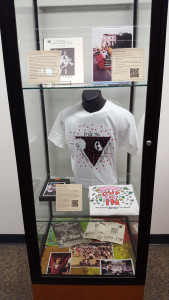
To commemorate LGBTQ Pride month during June 2016, UTSA Special Collections staff have created two exhibits that give patrons a glimpse into some of the amazing LGBTQ collections held by the repository and offer a portal to San Antonio Pride celebrations of the past.

DTL exhibit June Pride 2016 LGBTQ Pride Special Collections exhibit at the UTSA Downtown Library

Located in the UTSA Downtown library and the John Peace Library Faculty Center, the exhibits highlight t-shirts with Pride motifs, local queer publications, and images from San Antonio Pride events of the 1990s.

T-shirts as Historical Objects

Ever think that well-worn t-shirt stuffed in the bottom of a drawer should be thrown out one day? Think again! Some t-shirts and textiles shine light on cultural trends and local history! The t-shirts on exhibit for Pride 2016 were donated along with more traditional archival materials such as photographs and organization records. Fortunately, donors had the foresight to…

View original post 191 more words

Loreta’s Civil War: The plucky little devil

Velazquez experiences combat for the first time, and she realizes that it is nothing compared to what is to come.

KS19

Throughout 2016 and 2017, Stillness of Heart will share edited excerpts from the extraordinary memoir of Loreta Janeta Velazquez, who chronicled her adventures throughout the Civil War — either as herself, as a Confederate spy, or in disguise as Confederate Lt. Harry T. Buford. She fought and led men in terrible battles, fell in love, bore and lost children, and traveled throughout the U.S. and Europe, ultimately fulfilling her childhood dream of a rich and adventurous life.

You can read the entire 1876 memoir online here. Learn more about Velazquez (and the incredible documentary film Maria Agui Carter made about her) here.

Part 10: Velazquez experiences combat for the first time, and she realizes that it is nothing compared to what is to come.

******

On going to my room, I found a note from my lady friend, requesting me to visit her in her chamber. This considerably astonished me, and assuredly did not increase my good opinion of her. I was almost tempted, however, to comply, just for the sake of hearing what she had to say to me, but wisely concluded that, situated as I was, it would be more prudent to avoid any further acquaintance with such a forward specimen of my sex.

I slept late the next morning, having forgotten to give directions for being called, and found, much to my satisfaction, on inquiring of the clerk, that my lady had left before I was out of bed. After breakfast, I ordered Bob to have everything ready for our departure by the six o’clock train. While strolling about the street, I was accosted by an officer, who asked me to show my papers. I told him that I had none, but that I was an independent, and had recruited, and put in the field, at my own expense, a battalion of two hundred and thirty-six men. This seemed to highly delight him, for he shook me warmly by the hand, asked me to step over to his office, where he could furnish me with transportation, and otherwise showed a desire to be of service to me. I thanked him, but declined the offer, on the plea that I proposed to pay my own way.

During the day I bought two horses and shipped them, and provided myself with a number of articles necessary for the campaign upon which I was about entering. Returning to the hotel, I paid my bill, had a lunch put up, and my baggage got ready, while Bob blacked my boots and brushed my coat. As ill luck would have it, however, I missed the six o’clock train, and was consequently compelled to remain another night in Richmond. … I was now about to enter upon the realization of all my dreams, to see some real warfare, to engage in real battles, to do some real fighting, and, as I fondly hoped, to have some opportunities of distinguishing myself in a signal manner. I was never in better health and spirit than on that bright summer morning, when I left Richmond for the purpose of joining the forces of the Confederacy in the face of the enemy ; and the nearer we approached our destination, the more elated did I become at the prospect before me of being able to prove myself as good a fighter as any of the gallant men who had taken up arms in behalf of the cause of Southern independence. I had only one fear, and that was, that I should be stopped on account of not having the proper papers; but my motto was, “Nothing venture, nothing have,” and I was bent on facing the thing through, and trusting to luck to bring me out all right. Fortunately I had no trouble of any kind, and arrived safely at Clifton — a supply-station about a dozen miles from the headquarters of the army in the field.

At Clifton I bought a couple of fine horses, and on the 15th of July set out for headquarters, with a view of being assigned to a command where I should have a chance to see some fighting. I sought an interview with a prominent general, but he was in rather a crusty humor; and as he did not seem inclined to talk with me, I concluded not to bother him, but to take my chances as matters might shape themselves for the accomplishment of my designs. His adjutant was more polite and desired to employ me as a courier; but this did not suit my notions, and I consequently declined. I told him that I was an independent, paying my own expenses, and that the only thing I wanted was an opportunity to take a hand in the coming fight. I suppose he thought that I was entirely too independent for him, for he said no more, but turned away, and went about other affairs.

Gen. [P.G.T.] Beauregard was in command of the entire army; but I felt a hesitation in approaching him, especially after the rebuff I had just received. Thinking that the shortest way to get what I wanted was to obtain a regular commission, I offered an officer, with whom I became acquainted, five hundred dollars for his. He would not sell, however; and I then went over to Brig. Gen. Bonham, who was holding Mitchell’s Ford, and introduced myself to him. Gen. Bonham looked at me sharply and asked what company I belonged to.

“To none,” I replied. “I belong wherever there is work to do.”

“Well,” said Bonham, “you are the right sort to have around when a fight is going on. If you stay here a little while, I reckon you will be able to find plenty of work.”

I took this as a hint that I might make myself at home, and, bowing myself out of the general’s presence, went to look after my boy Bob. The darkey was just beginning to have some appreciation of what fighting was really like and was badly scared. I told him that if he ran off and left me, I would kill him if I ever caught him again; which threat had its desired effect, for he stuck to me through thick and thin.

At half past twelve o’clock, on the 18th, the enemy made a sharp attack, but did not do any great damage. … As they broke and ran, I fired a last shot at them with a dead man’s musket, which I picked up. During the greater part of this fight, the men belonging to the two armies who engaged in it were often not more than a few feet from each other, and it seemed more like a series of duels than anything such as I had imagined a battle would be. …

This skirmish was but the prelude to the great battles of Manassas or Bull’s Run, which was fought on the 21st of July, 1861. It served, however, to initiate me, and to make me impatient to see an engagement of real importance, in which I should have an opportunity to make a first-rate display of my fighting qualities. I was the more anxious for a big fight soon, as I had been placed temporarily in command of a company, the senior officer of which had been killed, and I was afraid that if a fight was long delayed I should be superseded, and should be compelled to lose my best chance of distinguishing myself. I had no occasion, however, to be afraid of a fight not coming off, for we had ample information of all the movements of the enemy, and knew that he was about to advance upon us in full force, so that the conflict was likely to begin at almost any moment. I was able, therefore, to take part m the first great battle of the war, under the best possible auspices, and to thus accomplish what had been one of the great objects of my ambition from my earliest childhood. There may have been men who did harder fighting at Bull Run than myself, but no one went through the fight with a stouter heart, or with a greater determination to behave valiantly, and, if possible, to give the enemy a sound thrashing, if only for the sake of affording him an idea of the magnitude of the job he had undertaken in attempting to coerce the Southern people.

On the 18th I assisted, with the rest, to bury the dead, my boy, Bob, rendering us efficient service in the performance of this duty. When night came I was tired out, and, lying down on the bare ground, slept soundly until four o’clock the next morning. When I awoke, I was weary and sore in all my limbs through the unusual exertions I had been compelled to make, and the exposure to the hot sun in the day time, and the damp air and cold ground at night. I was not sick, however; and as I had no doubt that I should soon get used to this kind of rough life, I never thought of giving up, especially as a great battle was impending, upon taking part in which my heart was bent.

At daybreak, on the 19th, I was in my boots, and ready to march. Passing through Ashby’s Gap, we reached the little town of Piedmont, on the Manassas Gap Railroad, where we halted. On the 20th, Gen. [Joseph E.] Johnston arrived at Manassas about noon, and was followed by two Georgia regiments and [Thomas] Jackson’s brigade of gallant Virginians. Then came Bernard E. Bee, with the 4th Alabama Regiment and the 2n Regiment, and three companies of the 11th Regiment of Mississippians. On account of some delay, or detention on the railroad, it was now found necessary to hold a council of war, and to make some changes in the plans already arranged. …

On the morning of the day of the battle I was awake at dawn, and ready to play my part in the great drama which was about to begin; and although some of the men around me had been disposed to laugh at the efforts of the little dandified independent to get a chance to display his valor, not one of them was more eager for the fight than myself, or was more bent upon doing deeds of heroism. If I had allowed myself to be irritated by snubs from officers, who behaved as if they thought the results of the war depended upon them alone, I should have gone back to Richmond in disgust several days before the battle came off, and should have resumed the garb of my sex, with a determination never to figure as a man again. I was not to be bluffed by anybody, however; and having come thus far to see and to take a hand in a great battle, I had no thought of turning back for any cause, or under any circumstances, no matter what might be said or thought of me.

I labored under some disadvantages in not having a regular commission, and not being attached to a regular command. This exposed me to slights that would otherwise not have been put upon me, and prevented officers, who would, under some circumstances, have gladly taken advantage of my readiness to attend faithfully to any task assigned me, to avail themselves of my services. On the other hand, my being an independent, enabled me, to a great extent, to choose my own position in the battle, and I probably, therefore, had a better opportunity of distinguishing myself than I should have had otherwise. I was especially bent upon showing some of them, who were disposed to smile at me on account of my petite figure and jaunty air, that I was as good a man as any one of them, and was able to face the enemy as valiantly. This I did show them before the day was over, and I was highly elated at the commendations which some of the best soldiers bestowed upon the “plucky little devil,” as they called me.

By the time it was fairly daylight, the preparations for meeting the enemy were well advanced, and the sun rose in all his majesty upon a host of men drawn up in battle array — the brave among them anxious for the fray to begin, the cowards — and there were plenty of them in both armies — trembling in their boots, and eager for a pretext to sneak away, and hide themselves from the coming danger. The morning was a beautiful one, although it gave promise of a sweltering day; and the scene presented to my eyes, as I surveyed the field, was one of marvelous beauty and grandeur. I cannot pretend to express in words what I felt, as I found myself one among thousands of combatants who were about to engage in a deadly and desperate struggle. … Fear was a word I did not know the meaning of; and as I noted the ashy faces, and the trembling limbs of some of the men about me, I almost wished that I could feel a little fear, if only for the sake of sympathizing with the poor devils. I do not say this for brag, for I despise braggarts as much as I do cowards; but, in a narrative like this, the reader has a right to know what my feelings, as well as my impressions, were, upon so important an occasion as my appearance as a combatant upon the battlefield, where the Confederate troops first gave the enemy a taste of their genuine quality, and achieved their first great victory.

Loreta’s Civil War: Winning the fame I coveted

Velazquez surprises her husband with her presence, her disguise, and her soldiers. The joy created by their reunion, however, does not last long.

KS18

Throughout 2016 and 2017, Stillness of Heart will share edited excerpts from the extraordinary memoir of Loreta Janeta Velazquez, who chronicled her adventures throughout the Civil War — either as herself, as a Confederate spy, or in disguise as Confederate Lt. Harry T. Buford. She fought and led men in terrible battles, fell in love, bore and lost children, and traveled throughout the U.S. and Europe, ultimately fulfilling her childhood dream of a rich and adventurous life.

You can read the entire 1876 memoir online here. Learn more about Velazquez (and the incredible documentary film Maria Agui Carter made about her) here.

Part 9: Velazquez surprises her husband with her presence, her disguise, and her soldiers. The joy created by their reunion, however, does not last long.

******

I determined to march my men to the river, in order to break them in; but before we got to the landing, a good many of them were decidedly of the opinion that soldiering was much harder work than they had calculated upon. None of them showed any disposition to back out, however, and the majority, despite the fatigue of the march, were quite elated at the prospect before them of being able to see something of the world. I do not think any of them appreciated the real importance of what they were doing, and looked upon the whole affair much in the light of an excursion, which would be rather jolly than otherwise. Indeed, to tell the truth, I rather regarded the thing in that light myself, notwithstanding that I had seen enough of military life for me to understand something of its serious character.

At the landing I met my Memphis friend with my baggage and equipment and a tent, and with blankets and camp utensils for the use of the men. He also handed me a letter from my husband. This I eagerly read, and much to my disappointment, learned from it that he had gone to Pensacola. I determined, however, to push on and meet him there, for I was bent on carrying out my original idea of surprising him, and of offering him the command of my battalion. I accordingly embarked my men — two hundred and thirty-six in all — upon the steamer Ohio Belle, and issued to them blankets and other articles necessary for their comfort.

My plan now was to go down to New Orleans, where I should be able to procure such stores and equipment as were immediately needed and where I could perfect my disguise; for, not only did my padded coat not fit me as it ought, but it was almost unbearably warm, and I was anxious to substitute something more comfortable for the padding at the earliest possible moment. … On arriving at New Orleans, I landed my men a short distance above the city, and then, with as little delay as possible, purchased my quartermaster and commissary stores, and perfected my private outfit. … No finer body of men ever went out of New Orleans than the Arkansas Grays, as my battalion was called. As we passed through Mobile we were heartily cheered, the men waving their hats, and the women their handkerchiefs, and everybody commenting in the most laudatory terms upon our martial appearance, I cannot pretend to tell how proud I was, when I noted how much attention we were attracting; and if the shadow of a doubt as to the propriety of the course I was pursuing remained in any mind, it assuredly vanished as the cheers of the citizens of Mobile greeted my ears. I felt that, in spite of my being a woman, I was intended for a military leader, and I resolved, more firmly than ever, to let nothing stand in the way of my winning the fame I coveted.

At Pensacola we were received by my husband, who came to meet us in response to a telegraphic dispatch I had sent him, signed by my nom de guerre. He had not the slightest idea who I was, and would not have recognized me had I not revealed myself. So soon as I was able, however, after landing my men from the train, I took him aside where I could speak to him privately and disclosed my identity. He was intensely astonished and greatly grieved to see me come marching into Pensacola at the head of a body of men in such a guise, and said, that although I had done nobly, he would not for the world have had me attempt such a thing. I told him, however, that there was no use of discussing the matter, for was determined to be a soldier, and then placed in his hands the muster-rolls of my company to show him how well I could do what I undertook. He was proud of the ability I had displayed in carrying out my plans, and seeing the uselessness of further argument, took command of the men, and commenced putting them in training … while I was ordered back to New Orleans to purchase more stores and equipment.

I had scarcely arrived at my destination when I received a dispatch announcing the death of my husband and requesting my immediate return. Terribly shocked, and nearly wild with grief, I started for Pensacola again, and found, upon my arrival there, that, while drilling his men, my husband undertook to explain the use of the carbine to one of the sergeants, and the weapon exploded in his hands, killing him almost instantly.

I was now alone in the world, and more than ever disposed to take an active part in the war, if only for the purpose of revenging my husband’s death. Smothering my grief as much as possible, I turned over the command of my battalion to Lt. Thomas de Caulp, for the double reason that the men were only enlisted for three months and were to be stationed in Pensacola … and that I had resolved to go to the front in the character of an independent, with a view of leading a life of more stirring adventures than I probably should be able to do if permanently attached to a particular command.

During the brief time I had been in Pensacola I had formed the acquaintance of a number of officers who were going to the front, and, as they intended to leave for Richmond shortly, I concluded that it would be better to go in their company, especially as several of them were first-rate fellows, and one or two particular friends of my late husband. I also became acquainted with a good many ladies, one of whom, a dashing young widow, paid my masculine charms the compliment of falling desperately in love with them. This lady did not require any encouragement from me; but finding that, while polite to her, I was rather shy and reserved, and apparently insensible to her attractions, she made a dead set at me, and took pains to let me know, in terms that could not be misunderstood, the sentiments she felt for me.

I was really in no mood for nonsense of this kind, and, to tell the truth, I was not particularly pleased with the decidedly unfeminine advances that were made towards me. The necessity of playing the character I had assumed, however, in a successful manner, pressed upon me, and I felt that diversion of some kind was requisite to divert my mind from the sad and gloomy thoughts caused by my bereavement. I accordingly determined to meet my fair one half way, and paid her numerous attentions, such as taking her to the theater, and to drive upon the beach. I, however, resolutely refused to accept any of the numerous very broad hints she threw out, to the effect that a little more lovemaking would be more than agreeable, at which she seemed considerably surprised. Finding, at length, that I either could not or would not understand what she was driving at, she bluntly reproached me for not being more tender in my demonstrations towards her.

I put on the innocent air of a green schoolboy, perfectly non-plussed with the advances of a pretty woman, and assured her that I had never courted a lady in my life, and really did not know how to begin. The eagerness with which the widow undertook to instruct me was decidedly comical, and I learned more about some of the fine points of feminine human nature from her in a week than I had picked up for myself in twenty years. The courting was pretty much all on her side, and I really had not imagined before that it was possible for a lady to take such an important matter so entirely out of the gentleman’s hands. For the fun of the thing I pretended to soften to her, and by the time I was ready to start for Virginia, we were the best possible friends, and although I was careful to make no definite promises, the widow parted from me with the understanding that when the war was over we were to be something more than friends to each other. If I were a man, it would be absurd for me to tell all this, but being a woman, this and other of my love adventures have a comical interest for me, as I doubt not they will have for the reader. If they do not show some of the members of my own sex in the best possible light, it is their fault and not mine.

On the 16th of June I started for Virginia, in company with quite a jovial party of fellows. … They had a good deal of whiskey with them, and I was constantly importuned to drink, my declining to do so not having the best possible effect on some of them. The conversation became more and more profane and ribald, as the whiskey produced its natural effect; and being almost the only sober person in the party, I was not only intensely disgusted, but the warnings I had received from my husband came into my mind, and had a most depressing influence upon me. Much of the talk was mere meaningless blackguardism, and my ears were saluted for the first time with nastiness in the shape of language, such as it would have been impossible for me to have imagined the tongues of human beings to utter. It was an intense relief to me when, about four o’clock, the train arrived at Montgomery, [Alabama].

At the Exchange Hotel I met Mr. Leroy P. Walker, the secretary of war, with whom I had a very pleasant conversation about the prospects of the contest with the North, the political situation, and other matters of interest. The next day I bought a smart and mannerly negro boy, named Bob, of about eighteen years of age. I procured him a proper suit of clothes and a military cap, and then gave him charge of my baggage, with instructions to keep a sharp eye on my effects, to behave himself properly, and to come to me when he wanted spending money. Bob proved an excellent servant, taking care of my clothing in good style, and when we were in camp, attending to my two horses in a very satisfactory manner.

From Montgomery I went to Columbia, South Carolina, where I remained over for several days. During my stay in this place I formed the acquaintance of a very pleasant family, one of the young ladies of which. Miss Lou, seemed to be quite taken with me. I was invited to the house, and passed a number of agreeable hours there, and on parting, Miss Lou gave me her address, requesting me to write to her, and pinned a small C.S. flag on my coat.

On the train bound north, there was another quite jovial party, but, very much to my gratification, not so much addicted to whiskey-drinking, blasphemy, and obscenity, as that with which I had started out. A good deal of the conversation was about wives and sweethearts, and pictures of the loved ones at home were freely handed about. I was rallied rather severely because I could not show a photograph of my sweetheart, and some of the men intimated that I must be a poor kind of a man not to be able to find a girl to exchange photographs with me. I took the sharp things they thought fit to say of me in good part, and replied that I did not doubt of my ability to get a sweetheart soon enough when I wanted one.

Before the journey was ended, I had an opportunity to prove myself as good a lady’s man as the best of them, for at Lynchburg, where we were compelled to remain over all night, on taking the train for Richmond, an elderly gentleman stepped up, and after inquiring my destination, asked if 1 could take charge of some ladies. I replied that I would do so with pleasure; but was rather taken aback when I found myself placed in the position of escort to five women and two children. I could not imagine what induced the old gentleman to pick out a little fellow like me, when so many much larger, older, and more experienced officers were present, some of whom were greatly my superiors in rank. I was dreadfully embarrassed, but resolved to play the gallant to the best of my ability, although my heart was in my throat, and I could scarcely find voice to announce myself as Lieutenant Buford, when he inquired my name for the purpose of introducing me.

I was about to inquire whether the ladies had their tickets and checks, when the old gentleman presented them, very much to my satisfaction. Excusing myself for a few moments, I went to attend to checking my own baggage. …

We were soon under way, and had a pleasant enough ride, or at least it would have been pleasant enough had I not been tormented with the fear that they would penetrate my disguise, and discover that I was not what I pretended to be. No suspicions were excited, however, and we finally arrived at Richmond without anything having happened to mar the enjoyment of the journey. On alighting from the cars, I procured carriages to convey the several members of the party to their destination ; two of the ladies, however, accompanied me to the Ballard House, where I obtained rooms for them. The youngest of my newly-found female friends — a very pretty girl, who seemed to have taken quite a fancy to me — had the room adjoining mine, and I had scarcely established myself in my new quarters, when a waiter knocked at the door and handed me a card from her, asking me to escort her to supper. I laughed to myself at this, and fancying that I had succeeded in making another conquest, determined to get myself up in the best style I could, and to do credit to the uniform I wore by showing her that her appreciation was not misapplied. I dressed myself in my best apparel, and, after a visit to the barber’s, I was ready to play the gallant in the best possible manner.

It was all well enough while I was pacing the corridors of the hotel with mademoiselle on my arm, but I confess that my heart failed me when we entered the dining-room, and I fancied that everybody was looking at us. When the big steward, advancing towards us with his politest bow, said, “Lieutenant, step this way with your lady,” and then turning to one of the waiters, told him to attend to this gentleman and lady, it seemed to me as if every eye in the room was fixed on me. I was a rather conspicuous object, it is true, for my uniform, made of the best cloth, and trimmed with buttons and gold lace, was well calculated to attract attention, while the lady on my arm being rather taller than myself, made me even more an object for the curious to gaze at than if I had been alone. …

The young lady was nothing daunted by my silence and chattered away at a great rate on all imaginable subjects and finally succeeded in putting me somewhat at my ease. … My lady at length finished her supper, much to my relief, and I hurried her out of the room as fast as I could, and repaired to the drawing room, where I excused myself on the plea that I had urgent business to attend to, as I intended leaving the city on the first train. She seemed extremely reluctant to part company with me and would not let me go until I promised to see her again before I left the city. In bidding her good night, she extended her hand; and when I took it, she gave mine a squeeze, that indicated as plain as words that a trifle more forwardness on my part would not be disagreeable. I was a little bit disgusted with her very evident desire to capture me, and was very glad to get her off my hands, my determination on parting being not to see her again if I could avoid doing so.

Loreta’s Civil War: A mild flirtation with this fair flower

Velazquez completes her disguise, doesn’t hesitate from flirting with farm girls, and rounds up men to form her Confederate battalion.

KS17

Throughout 2016 and 2017, Stillness of Heart will share edited excerpts from the extraordinary memoir of Loreta Janeta Velazquez, who chronicled her adventures throughout the Civil War — either as herself, as a Confederate spy, or in disguise as Confederate Lt. Harry T. Buford. She fought and led men in terrible battles, fell in love, bore and lost children, and traveled throughout the U.S. and Europe, ultimately fulfilling her childhood dream of a rich and adventurous life.

You can read the entire 1876 memoir online here. Learn more about Velazquez (and the incredible documentary film Maria Agui Carter made about her) here.

Part 8: Velazquez completes her disguise, doesn’t hesitate from flirting with farm girls, and rounds up men to form her Confederate battalion.

******

I immediately proceeded to change my garments, and ere a great many minutes had elapsed, I was transformed into a man, so far as it was possible for clothing to transform me. When I was ready, I called my friend and asked his opinion of the figure I cut. He admitted that I was not a bad-looking specimen of a man, considering I had only been about five minutes, and thought that in time I should be able to do credit to the name I bore and the clothes I wore.

The only regret I had in making up my disguise was the necessity for parting with my long and luxuriant hair. This gave me a real pang but there was no help for it, and I submitted with as good a grace as I could muster, while my friend played the part of tonsorial artist with a pair of shears. He trimmed my hair tolerably close and said that it would answer until I could visit a barber’s shop with him and be initiated into some of the mysteries of such a peculiarly masculine place of resort. … [H]e made me promenade the room, practicing a masculine gait until I had acquired it tolerably well, and gave me a great number of very minute instructions about the proper manner of conducting myself so that my sex would not be suspected. He particularly enjoined me to watch his actions closely at the barber’s, in the drinking saloons, the billiard rooms, and the other places he intended conducting me to, for the purpose of informing me with regard to some masculine habits and ways of acting, talking, and thinking. …

Strolling down the street, we soon came to the hotel and entered the barroom, where my companion met a number of friends, to whom he introduced me as a young officer on his way to the seat of war. I was received with much cordiality, and the whole party speedily engaged in an animated conversation about the coming conflict. … The men all took whiskey straight but I did not venture on anything stronger than cider. Soon my companion managed to give me a quiet hint, and I treated the party to drinks and cigars. We then adjourned to the billiard-room, and my friend, taking off his coat, went at a game in good earnest with another member of the party. I had never seen the game of billiards played before, and I soon became intensely interested … pretending to smoke my cigar, the balls rolling over the table. As the weather was warm, I very soon, after entering the billiard-room, availed myself of what seemed to be the custom of the place, to take off my heavily padded coat, which began to be unbearable, and found myself much more at my ease sitting in my shirt sleeves. …

The next day I completed my outfit by purchasing a pair of field glasses, a pair of blankets, a rubber overcoat, and a rubber blanket. On returning to my room I made out a form of attorney in my friend’s name and authorized him to attend to all my business matters for me. I also prepared a lot of recruiting papers on the model of some genuine ones I succeeded in getting hold of, and some muster rolls, and procured a manual of tactics, and before the day was over was pretty nearly ready to commence active operations.

My friend, thinking that my disguise could be somewhat improved and a more manly air given to my countenance, obtained a false mustache and a solution with which to stain my face in order to make it look tanned. I rubbed on the solution until my skin was about the right tint, and then my friend carefully fastened the mustache on my upper lip with glue. This was a very great improvement, and I scarcely knew myself when I looked in the glass, and laughed at the thought of what my husband would say when he saw me in this disguise. …

Everything was now in proper trim for me to commence operations in earnest; so, packing my trunk, rolling up my blankets in army style, as I had often seen soldiers do, preparing my papers, and getting ready a change of underwear, and other matters for immediate use in a small satchel, I was ready to start on my campaign with as stout a heart as ever beat in the breast of a soldier.

The plan of action I had fixed upon, after mature reflection, was to raise and equip a battalion at my own expense, taking care to select good material for it, and then to appear at the head of my little army before my husband, and to offer him the command. I pictured to myself again and again the look of astonishment he would put on when he recognized his wife as the leader of a gallant band who were pledged to fight to the death for the cause of Southern independence, and flattered myself with the idea that, so far from being inclined to censure me for my obstinate persistence in carrying out my idea of becoming a soldier, he would be disposed to praise without reservation, and so far from being ashamed of my action, would be proud of it. Whatever view of the matter he might take, however, he would be compelled to yield to my wishes, whether he desired to do so or not, and I would consequently be free to follow the bent of my inclinations without fear of further opposition on his part. My desire was to serve with him, if possible; but if this could not be done, I intended to play my part in the war in my own way, without his assistance. I, however, did not contemplate any further difficulty in obtaining his consent, and even his assistance, in the execution of my plans, and so started out on the war path with a light heart and with brilliant anticipations for the future.

I crossed over to Hopefield, on the Arkansas side of the river, and took the five o’clock train, not knowing exactly where I proposed to bring up. For a time I busied myself with the study of my Manual of Tactics, with the intention of becoming sufficiently posted on certain points to get my recruits into something like military training immediately. Having been the wife of an army officer for a number of years, and having seen some hard service on the frontier, I was, in a measure, pretty well qualified for the work I had now undertaken, especially as I had paid a good deal of attention to the details of military organizations, and had seen soldiers drilled hundreds of times. I had not been in the train very long, before, finding the conductor at leisure, I entered into conversation with him with a view of obtaining information that might be useful in the furtherance of my designs.

Explaining to this individual, who appeared to take the liveliest interest in my affairs, that I was on a recruiting expedition, I asked him if he could not suggest a good neighborhood for me to commence operations in. He said that Hurlburt Station was as likely a place as I could find to pick up a company of strong, hearty fellows who would do some good fighting, and advised me to try my luck there. Hurlburt, he told me, was not much of a place — a saw-mill, a country store, in which the post office was located, a schoolhouse, which was also used as a church, being pretty much all there was of it. …

The train sped through the swamps, and it was not a great while before we reached Hurlburt Station, where, in accordance with the conductor’s suggestion, I alighted. With my satchel in my hand, I made for the nearest house, and inquired of a negro, who was chopping wood, whether his master was at home. The darkey stared at me a bit, evidently attracted by something in my appearance, and then, grinning until he showed all his ivories, said that the old boss was away, but that the young boss was about somewhere. I accordingly told him to call the young boss; and soon up came a well-built, good-looking young fellow, whom I fixed upon immediately as a suitable recruit. …

I told him that I had the army regulations with me and would take pleasure in explaining them to him in the morning. I then asked him to give me some water so that I could clean myself up a bit before supper, as I was pretty well covered with dust and cinders after my ride. He accordingly got me a basin of water and then left me to go off and hunt the old man, full of eagerness to tell him of the arrival of the recruiting officer, and of his own desire to go soldiering.

The sudden intrusion of a gallant young officer, in a gay uniform, plentifully decorated with buttons and lace … made an even greater impression on the female than upon the male part of the family. My arrival had clearly created an intense excitement, and I understood very well that I was the subject of the whispered conversation that I heard going on outside. From the manner in which the old woman and her son had addressed me, I knew that they had no suspicions of my being other than what I seemed, but I judged that it would be necessary to be pretty careful how I carried myself before the former, for she was clearly a sharp one and would be quick to take note of any peculiarly feminine traits of manner I might display. I therefore determined to play the man right manfully, whether I thought myself observed or not; and this I found to be a very good rule to go by throughout the entire period during which I wore my disguise. …

The eldest of the two daughters was about sixteen and was attired in a bright, flaring yellow calico; the youngest was about twelve years of age and was somewhat less unbecomingly dressed in pink. Both of the girls had put on the best they had to do honor to the occasion, and the eldest, especially, so soon as her first bashfulness wore off, seemed very much disposed to attract the particular attention of the visitor by various little feminine artifices, which I understood very well, and which amused me immensely.

On entering the room, the old woman said, awkwardly waving her hands towards her daughters, “These is my gals, sir.”

I bowed in the politest manner, and said, with what I intended to be a particularly fascinating smile, “Good evening, ladies,” laying a particular emphasis on the word “ladies,” which had the desired effect, for both of the girls blushed deeper than ever, and the eldest simpered as if she heartily enjoyed it. … I started a talk with the old woman by remarking that it had been an exceedingly pleasant day. … After a few commonplaces of this kind about the weather and other matters of no particular moment, I thought I might as well proceed to business at once, for I expected that I would have some opposition from the old woman in my effort to enlist [her son]. So I said, “Madam, I am trying to enlist your son for a soldier in my company; don’t you think you can spare him?” She burst out crying, and exclaimed, “Oh, sir, I can’t let my boy go for a soldier and get killed.” The youngest girl, seeing her mother in tears, began to blubber a little also; but the eldest not only did not cry, but she looked at me in such a peculiar way that I was convinced she wished I would take her instead of [her brother].

The idea of having a mild little flirtation with this fair flower of the Arkansas forest rather grew upon me as I noticed the impression I was making upon her susceptible imagination. I had some curiosity to know how lovemaking went from the masculine standpoint and thought that the present would be a good opportunity to gain some valuable experience in that line; for it occurred to me that if I was to figure successful in the role of a dashing young Confederate officer, it would be necessary for me to learn how to make myself immensely agreeable to the ladies. I knew how to make myself agreeable to the men, or thought I did, and I could, if I chose, be agreeable to women in a feminine sort of fashion; but I had never studied the masculine carriage towards my sex critically with a view of imitating it, and it was important, therefore, that I should begin at once to do so, in order that when compelled to associate with women, as I assuredly would be to a greater or less extent, I might not belie my outward appearances by my conduct. I flatter myself that during the time I passed for a man I was tolerably successful with the women, and I had not a few curious and most amusing adventures, which gave me an insight into some of the peculiarities of feminine human nature which had not impressed themselves on my mind before, perhaps because I was a woman.

My flirtation with Miss Sadie Giles was not a very savage one, and I hope that it did not inflict more damage on her heart than it did on mine. It was immensely amusing to me while it lasted, and I presume, if not exactly amusing, it might at least be deemed entertaining to her. At any rate, I succeeded not only in having a little sly fun at her expense, but I picked up an idea or two that I subsequently found useful. Noticing that Miss Sadie was developing a marked partiality for me, but was much too bashful to give me any encouragement, except some shy glances out of the corners of her eyes, I commenced to ogle her, and, whenever I had an opportunity, to pay her some delicate attentions, for the purpose of making her think I was just a bit fascinated with her. It soon became very evident that the heart which beat under that yellow calico dress was in a great state of excitement, and Miss Sadie, while not encouraging me by any direct advances, made it very plainly understood that my little attentions were appreciated.

Supper was now announced, and we all sat down to a tolerably plentiful repast, the principal features of which were bacon, cabbage, and fried chickens — the latter having been prepared in my honor. Miss Sadie managed to place herself by my side, by a dexterous little maneuver which escaped the attention of the family but which I understood perfectly. I, for my part, strove to play the gallant by helping her bountifully to the bacon, cabbage, and chicken, and by endeavoring to induce her to join in the conversation. She undoubtedly appreciated my attentions at their full value, but was not sufficiently self-possessed to do much talking; indeed, during the supper I could scarcely get anything out of her except a timid “yes” or “no.”

[Her father], on the contrary, was very talkative, and plied me with all kinds of questions about myself, my errand, the war, and the prospect of a speedy accomplishment of Southern independence. I told him that my name was Buford, that I was a lieutenant in the army, and that I had been sent down to Arkansas for the purpose of recruiting a company for service in Virginia. He said that I would have no difficulty in getting all the recruits I wanted, as the young fellows in those parts were every one eager to have a dash at the Yankees, and promised to aid me in every way possible. …

Before the supper was over I had a terrible fright. … While drinking a glass of buttermilk, which I greatly enjoyed, for it was the best thing on the table, and was most refreshing, my mustache got full of the fluid, and when I attempted to wipe this ornament, which my Memphis friend had so carefully glued upon my upper lip, and which added so much to the manliness of my countenance, I fancied that it was loose and was about to fall off. Here was a terrible situation, and I cannot undertake to describe what I felt. To say that I was frightened scarcely gives an idea of the cold chills that ran down my back. The ridicule of my entertainers, and especially of Miss Sadie, was the least thing that I feared, and I would rather brave any number of perils at the cannon’s mouth than to repeat the emotions of that dreadful moment. Such a situation as this is ludicrous enough, but it was not a bit funny for me at that time, and I was on pins and needles until I could get away and take means to secure the mustache firmly on again. I managed, however, to keep a straight countenance and to join in the conversation with a tolerable degree of equanimity, keeping my hand up to my mouth all the time though, and doing my best to hold the mustache on. My fright, after all, was causeless, for on examination I found that the hair was too firmly glued to my lip to be easily removed; indeed, I subsequently discovered that it was practically impossible to move it without the aid of alcohol.

After supper, the old man and Frank went off to finish up their work before going to bed, and the women folks busied themselves in clearing the dishes. … I glanced over my shoulder, and seeing that Miss Sadie had finished her work and was apparently anxious to be better acquainted with me, I politely arose and offered her my raw-hide chair. This she blushingly declined but took a wooden stool, upon which she seated herself quite close to me. I could think of nothing so likely to loosen her tongue and make her properly sociable as a reference to religious matters; so I asked her if there were any churches in the neighborhood. She said that there was no regular church, but that on Sundays a preacher held forth in the schoolhouse. … The old man, I presume, was rather tired, and so, taking advantage of this change of subject in our conversation, he went to bed, and soon was snoring lustily. Finally, Miss Sadie got back to what was the subject uppermost in her thoughts and began questioning me about my own affairs, by asking if I had any brothers.

“Yes,” I replied, “One, older than myself, who is more fortunate, for he is married,” giving a look at her out of the corner of my eye, which I intended her to understand as an intimation that, although not married, I had no objections to being so if I could find a girl to suit me.

“You ought to be married, too,” said Miss Sadie, with a simper, and apparently appreciating this kind of conversation much better than the war talk the old man and I had been indulging in.

“How can I get married when none of the girls will have me?” I retorted. … The old woman thinking, I suppose, to flatter me, said, “A handsome young fellow like you, with, I dare say, a pretty fair education, needn’t be afraid of the gals not having you.”

At this point of the conversation the old man awoke, and sang out, “Don’t you women talk that man to death. Why don’t you git out and let him go to bed?” and then, pointing to a bed in the corner, he told me to turn in there when I felt like it. …

Here I was at the end of my first day’s experience in playing the part of a soldier, with every reason to believe that I had thus far played it most successfully, and that I had really made quite a brilliant start. … the susceptible heart of Miss Sadie was apparently touched in a way that it could never have been had the faintest suspicion of my not being a man crossed her mind. The old woman, too, who, in a matter of this kind, would be quite certain to be a more critical observer than the rest of the family, had no hesitation in believing me to be a gallant young soldier; so that, taking all things into consideration, I had reason to congratulate myself upon a brilliant opening to my campaign. …

[The next day, when] breakfast was over … I crossed over to the schoolhouse, where I found half a dozen rather rough fellows waiting to see me, all of whom expressed themselves as extremely anxious to enlist. One very hard-looking specimen, who could not even write his name, wanted very badly to be captain; indeed, they all were quite ambitious to be officers, and I had some difficulty in explaining to them, that in the army, in time of war, where actual fighting was being done, it was a very different thing holding the position of an officer, from what it was in the militia. I, however, encouraged them to believe that they all might be lieutenants, captains, and even generals, some day, if they fought bravely, and succeeded in creating such an enthusiasm among them over the prospect of a brush with the Yankees, to be followed by rapid promotion, that the whole party were soon ready to enlist on any terms I chose to suggest.

After talking the matter over with these men for some time, and explaining the situation in the best style I was able, I wrote out some bills calling for volunteers, one of which I posted on the school-house door. … During the day I read the army regulations at least a dozen times, and tried to make the men understand what they meant. This was not a very easy matter, but I succeeded in enrolling thirty-six, whom I ordered to report for roll call the next morning. This they did not much fancy; but on my stating that they were under oath and bound to obey, they yielded without making any trouble about it, but apparently with no great admiration for military discipline.

My quota was easily filled in four days, and I then proceeded to get my battalion organization complete and to make preparations for departure. Two of the most intelligent of the men I appointed subordinate officers, one sergeant and the other corporal, and gave them instructions about drilling the battalion and maintaining discipline in my absence. Everything now being in proper trim, I sent a messenger ahead to the friend in Memphis who had so efficiently aided my plans with instructions for him to engage transportation, and then getting my troops into marching order, off we started. …

Videos I Love: The ‘Ali’ movie trailer

Love it or hate it, no one can deny Will Smith’s evident determination to at least evoke ‘The Greatest’ in all his cultural and egomaniacal glory, standing up to the Vietnam-era war machine, ravishing beautiful women and inspiring millions of fans.

I’m occasionally sharing some light thoughts on a few videos that make me smile, make me think, or preferably do both. Read more from this special series here.

Michael Mann’s thrilling 2001 docudrama on world heavyweight champion Muhammad Ali was celebrated by many for the accuracy of its fight scenes and criticized by many more for its vivid portrayal of its complicated hero. I tend to forgive some its historical flaws out of admiration and respect for the film’s overall accomplishment: powerfully illustrating Ali and his era for younger Americans to ponder.

“Ali” carries extra favor with me because it introduced me to incredible music from Sam Cooke, Mighty Joe Young, and Johnny Farmer.

Love it or hate it, no one can deny Will Smith’s evident determination to at least evoke “The Greatest” in all his cultural and egomaniacal glory, standing up to the Vietnam-era war machine, ravishing beautiful women and inspiring millions of fans.

Smith can also be commended, if nothing else, for refusing to be eclipsed by the dazzling constellation of movie stars from one end of the film to the other — without a doubt the best cast Michael Mann ever assembled, an assertion this trailer beautifully confirms.

Full disclosure: I’m easily entranced by anything that includes Michael Michele.

Flora and Fauna

It is such a beautiful campus.

Kristin Law's avatarThe Top Shelf

Mountain laurel in bloom, March 1992. Mountain laurel in bloom, March 1992. Photo source: Office of University Communications Photographs, UA 16.01.01, UTSA Libraries Special Collections.

Every May, as classes end and students graduate or head off on summer adventures, I’m shocked to realize how quiet the university becomes—especially after the persistently frenzied feeling that signals the end of the spring semester. The vibe on campus settles into its summer rhythm, allowing a greater opportunity to notice the beauty of the outdoor spaces we inhabit in our daily working lives.

Tomato plants in the garden of the Back 40 at the UTSA Institute of Texan Cultures. Tomato plants in the garden of the Back 40 at the UTSA Institute of Texan Cultures. Photo source: Kristin Law.

Tall corn in the garden of the Back 40 at the UTSA Institute of Texan Cultures. Tall corn in the garden of the Back 40 at the UTSA Institute of Texan Cultures. Photo source: Kristin Law.

Spending time on UTSA’s campuses offers many chances to experience the flora and fauna of our region, whether that includes stopping to smell the plants in the…

View original post 238 more words

Loreta’s Civil War: Victims of masculine viciousness

Velazquez manages to slip into a Confederate encampment, and the soldiers’ language and behavior offend and outrage her. She is particularly disgusted with how supposed gentlemen speak about women.

KS15

Throughout 2016 and 2017, Stillness of Heart will share edited excerpts from the extraordinary memoir of Loreta Janeta Velazquez, who chronicled her adventures throughout the Civil War — either as herself, as a Confederate spy, or in disguise as Confederate Lt. Harry T. Buford. She fought and led men in terrible battles, fell in love, bore and lost children, and traveled throughout the U.S. and Europe, ultimately fulfilling her childhood dream of a rich and adventurous life.

You can read the entire 1876 memoir online here. Learn more about Velazquez (and the incredible documentary film Maria Agui Carter made about her) here.

Part 7: Velazquez manages to slip into a Confederate encampment, and the soldiers’ language and behavior offend and outrage her. She is particularly disgusted with how supposed gentlemen speak about women.

******

The style of conversation that was common in camp, and the kind of stories told around our fires at night, I will leave to the reader’s imagination, hoping, however, that he or she has not imagination enough to compass anything so utterly vile. My favorite amusement was a game of cards, and I preferred this way of entertaining myself, and of beguiling the weary hours, to listening to anecdotes which could only debase my mind. Anything relating to military affairs, to social science, to the deeds of great men or women, or whatever else I could improve myself by listening to, I took great delight in. From my earliest recollection, however, I have had a thorough distaste for vulgarity of language and profanity. … The manner in which too many men are in the habit of referring to the other sex in conversation among themselves is, in my opinion, thoroughly despicable; and I really think that it would be morally and intellectually beneficial to many of my sex, especially those who are the victims of masculine viciousness, if they could only listen to some such conversations as I have been compelled to listen to, and learn how little respect or real regard of any kind men have for them.

I would that God would put it into my power to utter such a warning as would be heeded, to the weak and erring of my sex, and which would enable them to fortify themselves against the temptations constantly assailing them. But I suppose no warning would prevent those who are disposed to sin from doing so, although I well know that women, and men too, can resist temptation, and can avoid vileness in living and in language if they will only choose to do so. I do not pretend to say that I am possessed of firmer nerves, or am less under the influence of the natural emotions of my sex, than many others; but my strong constitution, and the perfect health I enjoyed, enabled me to endure more fatigue and hardship than most women, while my firm-mindedness, and resolute determination to carry my point, enabled me to avoid anything like laxity of conduct. I was compelled to sink my sex entirely, for the least inadvertence would have thwarted my plans, and prevented the realization of all I aimed at.

Many and many a time has the subject of women serving in the army as soldiers been discussed at the mess-tables and around the campfires; and officers, who have been in my company for days, and weeks, and months, have boasted, with very masculine positiveness, that no woman could deceive them, little suspecting that one was even then listening to them. I have sometimes been asked my opinion on the subject; but have generally answered evasively, without expressing, in very decided terms, my ideas one way or the other. Some of the men with whom I have been associated have spoken in respectful and even commendatory terms concerning women serving as soldiers; but too many have had nothing but vileness to utter on the subject. I can never forget, although I may forgive, the disgraceful language which some of these individuals have used with regard to this matter; and my experiences in the army will not have been in vain, even if they have taught me nothing more than the utter contemptibleness of some individuals, whom it would be a stretch of courtesy to call gentlemen.

Within three days I managed to provide myself with a very complete military outfit, quite sufficient to enable me to commence operations without delay, which was the main thing I was after, for I was exceedingly anxious to carry out a magnificent idea I had in my mind, and to present myself before my husband, under such auspices that he could no longer find an excuse for refusing his consent to my joining the Southern army as a soldier. My uniform suit having been arranged for, it was an easy matter for me to procure the rest of my outfit without unduly attracting attention, and I soon had in my room a trunk well packed with the wearing apparel of an army officer, and neatly marked upon the outside with the name I had concluded to adopt. …

Cool Things I Learned About The Civil War This Week…

Civil War Fangirl's avatarCivil War Fangirl

Whew! Yeah, it’s kind of a long title, I know. I don’t need to tell any of you that Abraham Lincoln and the Civil War are huge passions of mine. While I’m not a scholar in either area, I still do a great amount of reading and research about it. I do that for personal interest but also for blog posts on here.

I always come across things every day that I find really interesting. It’s usually just some random, little fact.  I decided that every week (or perhaps more) I’m going to try and do a post about some cool things I learn about Abraham Lincoln and/or the Civil War. Or perhaps it’ll just be some random facts I’ve known for awhile and just feel like writing about them. Some of the things I find might even turn into longer blog posts.

So, what are some things I found out…

View original post 597 more words